micro1 AI jobs sit inside a larger category of remote AI training work: projects where skilled humans help improve how artificial intelligence systems reason, write, code, calculate, explain, and follow instructions. Instead of answering customer support calls or doing generic data entry, applicants are usually evaluated on judgment. Can you compare two answers? Can you explain why one response is more accurate than another? Can you catch a factual error? Can you apply professional knowledge in a structured way?
That is why micro1 is especially interesting to people searching for expert AI training opportunities. The best candidates are not always software engineers. They may be marketers, salespeople, social media managers, finance and business professionals, customer service leads, writers and editors, teachers, consultants, data analysts, lawyers, medical writers, or strong generalists who can write clearly and think carefully.
This guide explains how micro1-style AI training work usually functions, what kinds of tasks applicants should expect, how to prepare for the application process, and how to evaluate a platform before investing serious time.
What micro1 is in the remote AI work market
micro1 is part of the expert human data and AI training market. In plain English, platforms in this space help AI labs and companies collect better human feedback so large language models can produce stronger answers. That feedback can include ratings, rewritten answers, factual corrections, expert annotations, rubric-based comparisons, safety reviews, and domain-specific explanations.
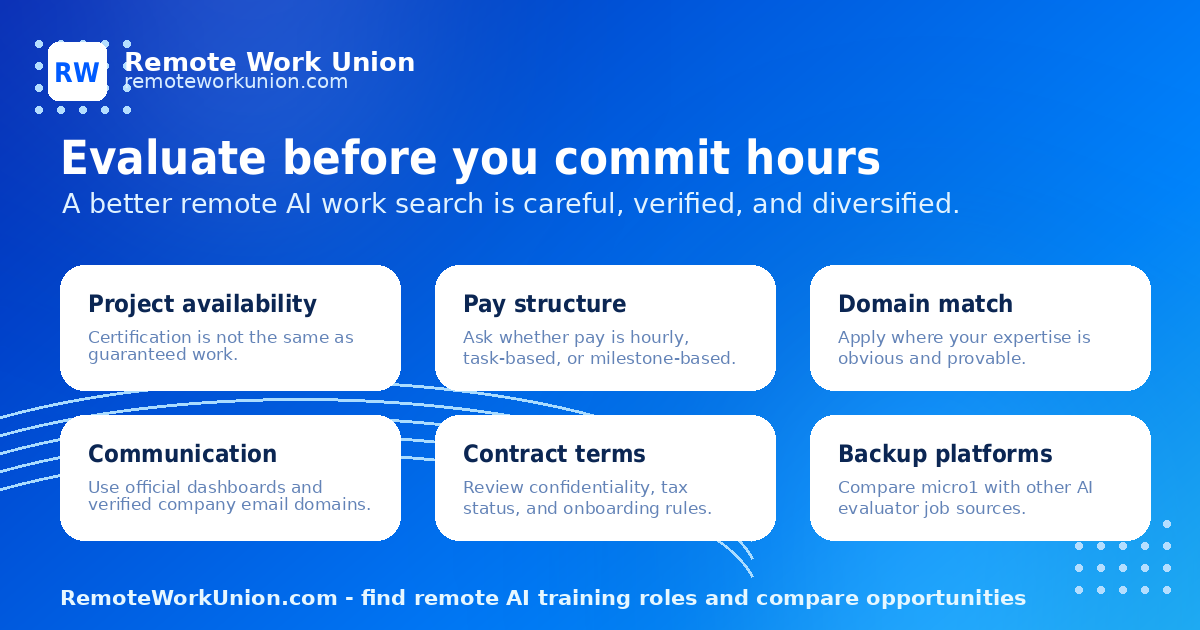
The important distinction is that micro1 should not be viewed like a traditional job board where every listing leads to a predictable full-time role. It is closer to a project-matching platform. A candidate may apply, complete an interview or certification step, and become eligible for future work that matches their skills. That eligibility can be valuable, but it is not the same as a guaranteed stream of hours.
For job seekers, this means micro1 can be worth exploring, but it should be part of a broader remote AI job search that also includes other platforms, direct company postings, LinkedIn searches, and niche AI evaluator opportunities.
Why people search for micro1 AI jobs
Searches for micro1 AI jobs usually come from people who want a better version of online work. They are not just looking for any remote job. They are looking for remote work that pays for expertise, writing ability, research judgment, or technical knowledge.
The appeal is simple: AI companies need human reviewers who can teach models what high-quality answers look like. Models like ChatGPT, Claude, Gemini, Grok, and other AI systems are improving quickly, but they still need human feedback around factual accuracy, reasoning quality, tone, safety, and usefulness. That creates demand for people who can judge outputs in areas such as law, healthcare, finance, software engineering, education, linguistics, writing, business, and science.
For many applicants, micro1 is attractive because some opportunities may be remote, flexible, and project-based. That flexibility can be useful for people who already have a job, freelance income, graduate school, caregiving responsibilities, or multiple contract platforms. The tradeoff is that flexible AI training work can also be inconsistent. A strong applicant should prepare for both sides of that reality.
How expert AI training opportunities usually work
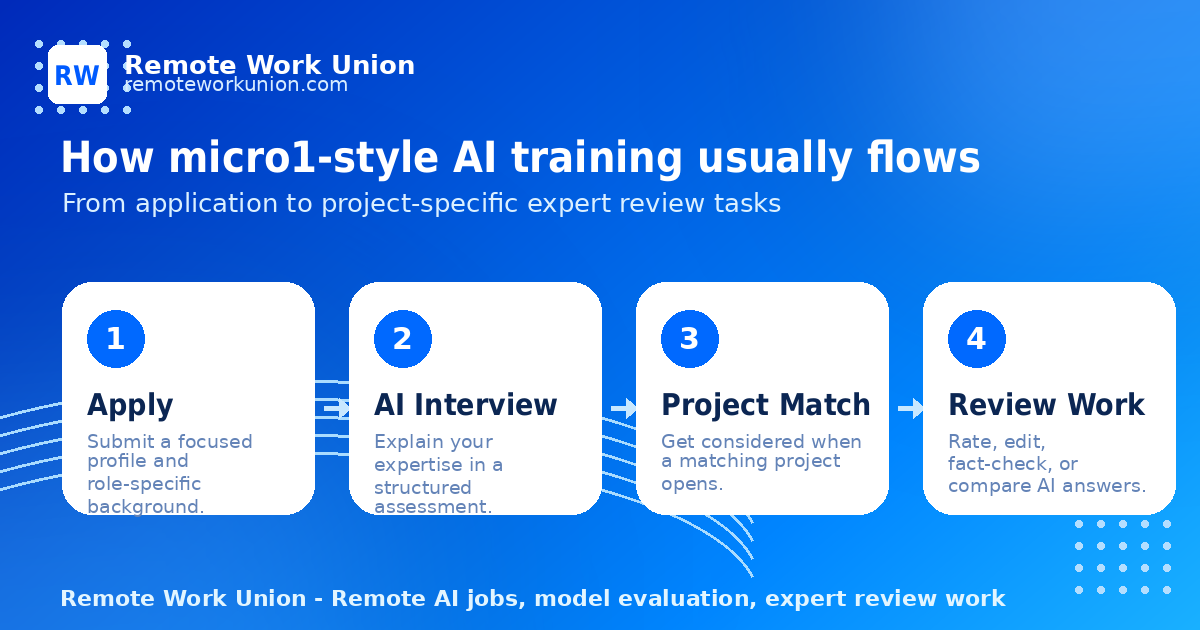
Most expert AI training platforms follow a similar pattern. First, you apply to a role or create a talent profile. Then you complete some form of assessment. That assessment may test your domain knowledge, writing clarity, reasoning, English fluency, coding ability, or ability to explain decisions. After that, the platform may match you with available projects.
On micro1, the public-facing process emphasizes applying for opportunities, taking an AI interview, getting onboarded, and starting work when selected for a matching project. Applicants should understand each stage as a filter. Passing one stage can make you eligible, but project access still depends on client demand, your specific skills, available tasks, location requirements, and timing.
Important: A common mistake is treating certification or a strong interview as proof that work will start immediately. Treat it as one asset in your pipeline — apply, complete the process carefully, keep your profile updated, and continue building opportunities elsewhere.
What the work may look like
The exact work depends on the project, but most AI training and AI evaluation tasks fall into a few recognizable buckets.
You may compare two AI answers and decide which one is better. You may rate a model response for helpfulness, accuracy, safety, depth, or instruction-following. You may rewrite a weak answer into a stronger one. You may fact-check a response against reliable sources. You may write prompts that test whether a model can handle complex professional tasks. You may review code, math, legal reasoning, medical explanations, financial analysis, or business strategy.
For expert roles, the value is not only whether you know the answer. The value is whether you can explain your judgment. AI labs need structured feedback that can be converted into training signal. A comment like "this is bad" is not useful. A comment like "Response B is better because it identifies the correct exception, avoids making an unsupported claim, and gives the user a safer next step" is much more useful.
Who is a strong fit for micro1-style AI training work
A strong candidate usually has three things: subject matter knowledge, clear communication, and reliability.
Subject matter knowledge helps you catch errors that a general reviewer would miss. A finance professional can spot a weak valuation explanation. A lawyer can identify missing caveats. A nurse or medical writer can recognize unsafe phrasing. A software engineer can test whether code actually runs. A teacher can judge whether an explanation is appropriate for a beginner.
Clear communication matters because many AI training tasks require written justification. The platform may not only ask which answer is better; it may ask why. Strong reviewers write concise, specific, evidence-based feedback.
Reliability matters because remote AI projects often move quickly. The best contractors follow instructions, meet deadlines, read rubrics carefully, and avoid overclaiming. If a task asks for a narrow comparison, they do not write a long essay. If a task requires evidence, they do not guess.
Best domains for expert AI training opportunities
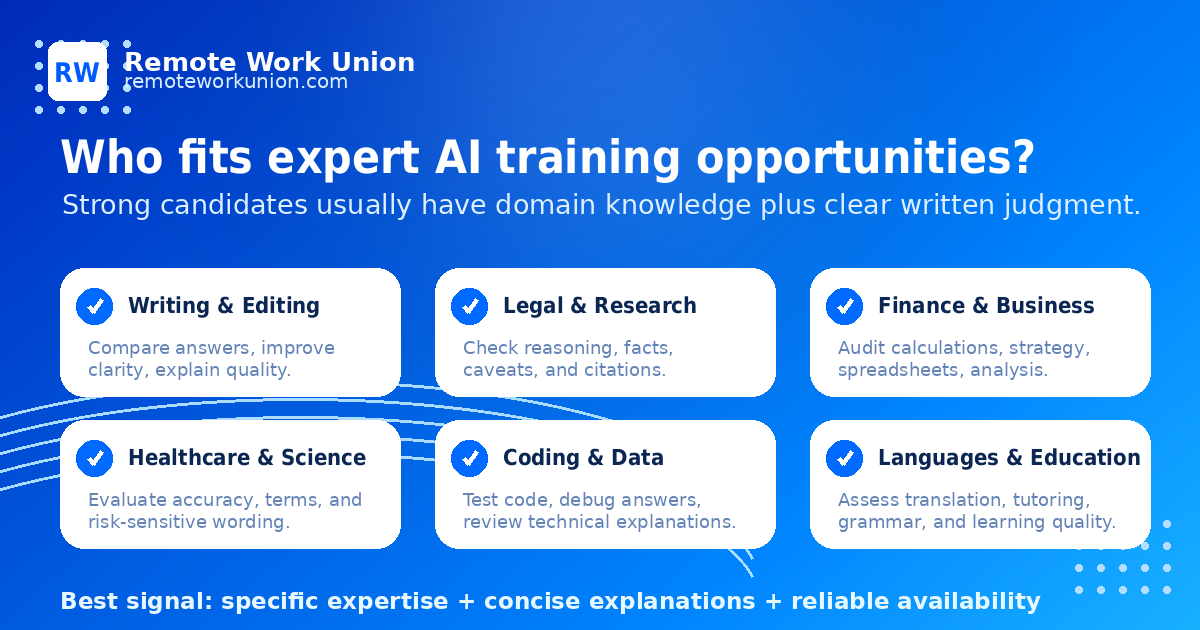
Expert AI training work can appear across many domains. Legal reviewers may evaluate contract explanations, case summaries, legal research outputs, or policy reasoning. Healthcare reviewers may assess medical writing, clinical terminology, patient-facing explanations, or biomedical research summaries. Finance and accounting experts may review spreadsheets, financial models, tax concepts, valuations, investing explanations, or business analysis.
Software engineers may test code, compare debugging strategies, evaluate technical documentation, or write prompts that require programming knowledge. Writers, editors, and journalists may evaluate tone, structure, factual support, originality, and clarity. Consultants, MBAs, product managers, and startup operators may review strategy, market sizing, product reasoning, and operational plans.
There is also demand for language experts, tutors, educators, data analysts, Excel users, researchers, and people who can apply advanced degrees to practical AI evaluation tasks. The common thread is not the job title. The common thread is whether your knowledge helps an AI system produce better answers.
Remote Work Union connects professionals to legitimate expert AI training roles across micro1, Mercor, Outlier, and other platforms. Apply for free.
Find Roles Hiring Now →How to prepare your resume and profile
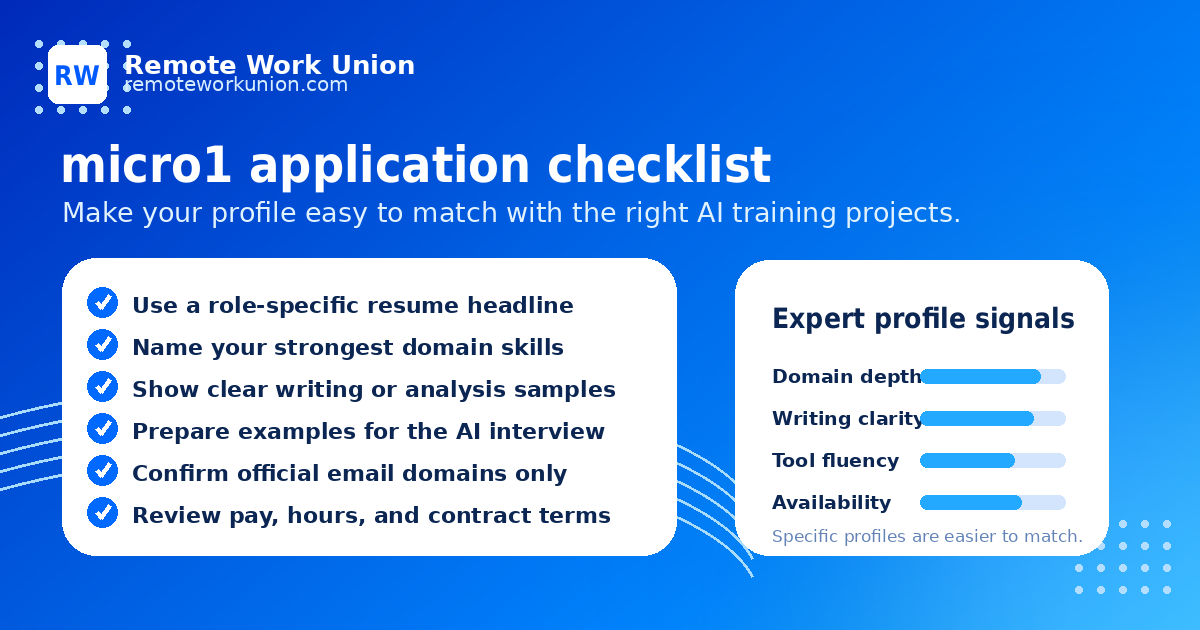
Your resume for micro1 or any AI training platform should not read like a generic job application. It should make your expertise obvious fast. The first screen should show your domain, your strongest skills, and your ability to communicate clearly.
Use a headline that tells the platform what to match you with. Examples include "Legal Researcher and AI Evaluation Candidate," "Finance Analyst With Excel and Valuation Experience," "Healthcare Writer Focused on Patient-Friendly Explanations," or "Software Engineer for Code Review and LLM Evaluation."
Add concrete proof. Mention tools, industries, credentials, writing samples, research experience, publications, degrees, certifications, technical skills, and measurable work outcomes. If you have used ChatGPT, Claude, Gemini, Copilot, Grok, Perplexity, or other AI tools professionally, include that experience without exaggerating.
The goal is to reduce uncertainty. A platform should be able to look at your profile and immediately understand what kinds of AI training tasks you are qualified to review. See the remote work resume guide for a deeper walkthrough on positioning.
How to handle the AI interview
Many applicants underperform in AI interviews because they treat them too casually. A remote AI interview may feel less formal than a human interview, but the output still becomes part of your evaluation.
Prepare short examples before starting. Be ready to explain your background, your strongest domain, the types of tasks you can review, and how you make quality judgments. Speak or write in a structured way. For example: "I would evaluate this answer on accuracy, completeness, risk, and clarity. First, I would check whether the core claim is correct. Second, I would look for missing caveats. Third, I would decide whether the answer fits the user's level."
Do not ramble. Do not pretend to know domains you do not know. Do not give vague claims like "I am good with AI." Better signals include specific tools, specific task types, and specific examples of professional judgment.
Tip: micro1 uses Zara, an AI interviewer, to screen candidates. Treat it like a real expert interview — structure your answers, use domain-specific examples, and explain your reasoning rather than making broad claims.
What to ask before accepting a project
Before accepting any AI training project, clarify the basics. Is the work hourly, task-based, or milestone-based? Are there minimum or maximum weekly hours? Are tasks always available, or do they appear in batches? How are rejected tasks handled? When are payments sent? What tax form or contractor classification applies? Are there confidentiality rules? Can you work on other AI platforms at the same time?
You should also verify communication channels. Use official dashboards and official company email domains. micro1 official communication should come from @micro1.ai, @micro1.io, or @micro1.co domains. Be cautious with messages that pressure you to sign immediately, ask for unusual payments, request sensitive information too early, or come from domains that do not match the company.
Legitimate remote AI jobs should never require you to pay a fee to get work. This is not about being paranoid — it is about being professional. Remote AI work is a real category, but scams and low-quality listings often copy the language of real opportunities.
micro1 vs other AI training platforms
micro1 is not the only platform people compare in this space. Applicants often search for Mercor, Outlier AI, Handshake AI, Surge AI, Stellar AI, data annotation jobs, AI evaluator jobs, search quality rater roles, and RLHF jobs at the same time. That is the right instinct.
No single platform should be your entire plan. AI training work can slow down without warning. Projects can fill quickly. Clients can change requirements. Some weeks may be busy; other weeks may have no tasks. The strongest strategy is to build a portfolio of applications across several legitimate sources while keeping your best profile current.
If micro1 fits your expertise, apply carefully. But also keep searching for roles that mention AI model evaluation, AI data annotation, AI response ranking, prompt evaluation, LLM feedback, AI safety review, coding evaluator, writing evaluator, medical AI reviewer, finance AI expert, legal AI reviewer, and domain expert AI training.
Frequently Asked Questions
What is micro1 and how does it work for remote AI jobs?
micro1 is part of the expert human data and AI training market. It connects applicants with projects where skilled humans help improve how AI systems reason, write, and respond. Candidates apply, complete an AI interview or assessment, and become eligible for projects that match their expertise. Eligibility does not guarantee immediate work — project access depends on client demand, skills, and timing.
What is the Zara AI interview on micro1?
Zara is micro1's AI-powered interview system used to evaluate applicants. It tests domain knowledge, communication clarity, and the ability to explain professional judgment. Applicants should prepare concrete examples of their expertise and practice structuring their answers clearly rather than giving vague or generic responses.
Who is a strong fit for micro1 AI training work?
Strong candidates have subject matter knowledge, clear communication, and reliability. This includes marketers, salespeople, finance and business professionals, customer service leads, writers and editors, teachers, consultants, data analysts, software engineers, lawyers, and medical writers. The key is being able to apply real professional expertise to evaluating AI-generated answers and explaining your judgment clearly.
How does micro1 compare to Mercor, Outlier, and Handshake AI?
micro1, Mercor, Outlier, and Handshake AI all sit in the remote AI training market but can feel different to applicants. No single platform should be your entire plan — project demand can slow without warning. The strongest strategy is to build applications across several legitimate platforms while keeping your profile current and specific to your expertise.
How do I prepare my resume and profile for micro1?
Your resume should make your expertise obvious fast. Use a headline that signals your domain, add concrete proof (tools, credentials, writing samples, degrees), and include relevant keywords naturally: AI model evaluation, prompt evaluation, RLHF, domain expert, fact-checking, and your specific field. The goal is to reduce uncertainty so the platform can immediately understand what kinds of AI training tasks you are qualified to review.