Remote work can look closed off from the outside. Job posts ask for experience. Platforms ask for a profile. Companies want proof. If you are new, it can feel like every work-from-home job is already built for someone who has done it before.
The truth is more practical. You do not need a perfect remote work background to start. You need to understand which beginner-friendly roles are realistic, how to present the experience you already have, and how to apply in a way that signals reliability. Many remote work opportunities are not looking for a fancy title. They are looking for people who can follow instructions, communicate clearly, notice mistakes, research carefully, and finish tasks without being chased.
This guide is for beginners who want real remote work, not survey apps, fake passive-income promises, or jobs that charge you to get started. It explains how to choose your first lane, build a simple profile, apply to legitimate work-from-home jobs, and use entry-level remote work as a bridge into better-paying projects.
What "No Experience" Actually Means
No experience does not mean you have no useful skills. It usually means you have not held a job title that says remote assistant, AI evaluator, data annotator, content reviewer, or online researcher. That is different from having nothing to offer.
Most beginners already have transferable experience. School assignments, customer service, office work, sales, social media management, spreadsheets, writing, research, scheduling, proofreading, tutoring, volunteer work, and personal projects can all become remote-work signals when they are described correctly. A hiring manager or platform reviewer does not need your entire life story. They need to see that you can do the specific task in front of you.
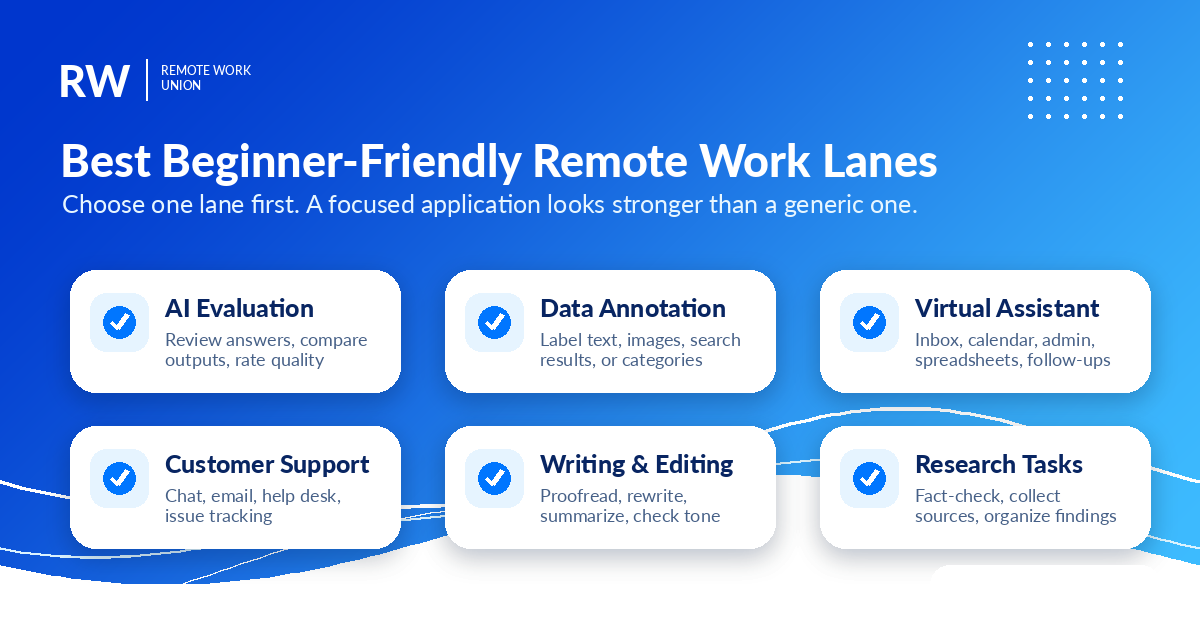
For beginner remote work, the most important signals are simple: clear writing, good judgment, ability to follow instructions, comfort with basic online tools, attention to detail, and consistency. These are also the same skills that appear in many remote AI jobs, including AI training, AI model evaluation, AI data annotation, prompt review, response rating, and research-based tasks.
The Best Remote Work Lanes for Beginners
The fastest way to waste time is to apply to every remote job with the same generic resume. Beginners should pick one or two lanes first. A lane is a category of work where your profile, resume, keywords, and examples all point in the same direction.
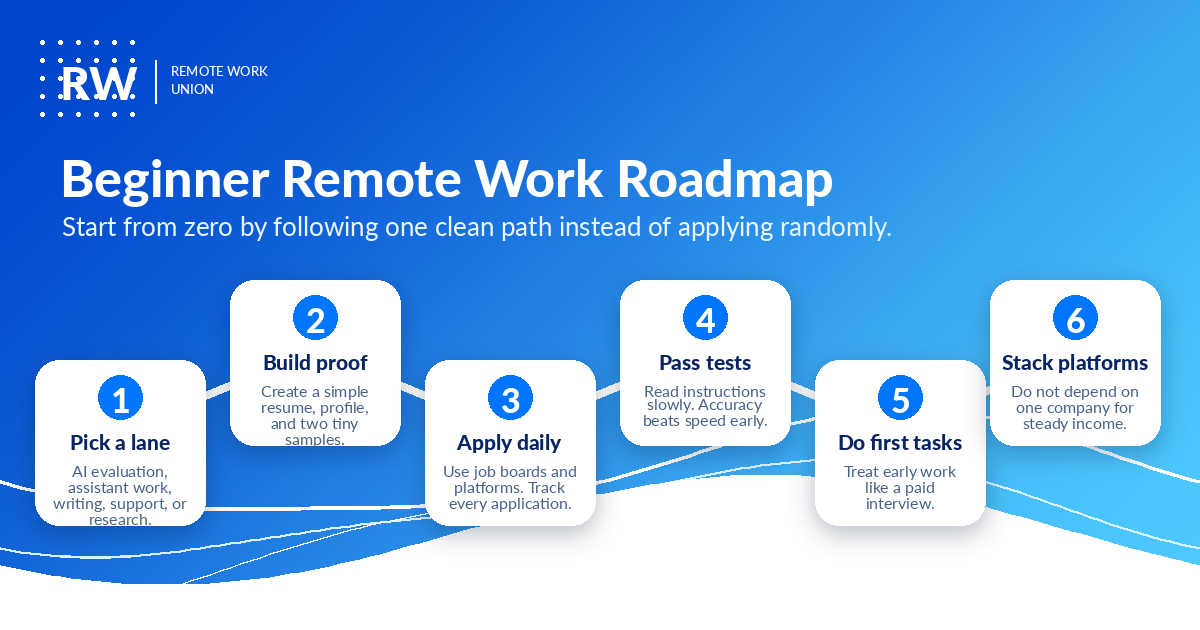
AI training and model evaluation are strong beginner lanes for people who write clearly and think carefully. These roles may involve comparing AI responses, rating answers, checking factual accuracy, improving prompts, labeling data, or explaining why one response is better than another. You usually do not need to be a programmer to start. The broader AI ecosystem includes companies and labs such as OpenAI, Anthropic, Google, Meta, and Grok-related projects, along with platforms that connect contractors to AI evaluation and data work.
Data annotation is another beginner-friendly category. Annotation work can involve labeling text, organizing search results, tagging images, classifying content, or checking whether information fits a set of guidelines. The work can be repetitive, but it builds experience with instructions, quality standards, and online task systems.
Virtual assistant work is a good lane for organized people. Tasks can include inbox management, calendar scheduling, spreadsheet cleanup, basic research, travel coordination, customer follow-up, and document formatting. You can start with general admin tasks and later specialize in sales support, operations, recruiting coordination, real estate admin, creator support, or executive assistance.
Customer support is one of the most common work-from-home categories. Many remote support jobs are based on email, chat, help desk tickets, order issues, refund requests, and internal documentation. If you want remote work with no phone calls, look for phrases like chat support, email support, customer operations, customer success assistant, help desk support, and support specialist.
Writing, editing, proofreading, and content review can also be beginner lanes if you can show clean samples. You can begin with product descriptions, blog updates, basic editing, social captions, content moderation, transcription cleanup, research summaries, or AI response editing.
Research work is useful for people who enjoy finding accurate information. Remote research tasks can include building lists, checking sources, comparing companies, gathering contact information, summarizing articles, verifying facts, or organizing findings in a spreadsheet. This lane pairs well with AI evaluation because both reward careful judgment.
Build a Simple Remote Work Profile Before You Apply
A beginner profile should not try to sound impressive. It should make the reviewer understand what you can do. Start with one sentence that names your lane and your strongest practical skills. For example: "Beginner remote worker focused on AI evaluation, research, writing, and detail-heavy online tasks."
Then add a short skill list. Use plain keywords that match real work-from-home job descriptions: AI model evaluation, data annotation, online research, proofreading, content review, customer support, virtual assistant tasks, Google Docs, Google Sheets, Microsoft Office, Slack, email support, quality checking, fact-checking, and prompt writing. Do not stuff keywords randomly — use the ones you can honestly support.
Add proof even if you have not been hired remotely before. Proof can be a one-page research summary, a cleaned-up spreadsheet, a before-and-after writing sample, a mock customer support response, a short AI response comparison, or a simple admin workflow. Beginners often skip this step because they think proof has to be from a paid job. It does not. It only has to show that you understand the kind of work you are applying for.
Remote Work Union connects beginners to legitimate remote AI training roles, data annotation, virtual assistant work, and more. Apply for free.
Find Roles Hiring Now →How to Write a Beginner Remote Work Resume
Your resume should make remote work feel logical, even if your past jobs were not remote. The mistake beginners make is listing old duties without connecting them to online work. A restaurant job, retail job, office job, campus job, real estate job, sales job, or customer service job can all show useful remote-work skills if you describe them correctly.
Use a short summary at the top. Mention your target lane, your core strengths, and the types of tasks you can handle. Then include a skills section with remote-work keywords. After that, list your work, education, or projects with bullet points focused on communication, organization, accuracy, research, tools, customers, writing, and problem solving.
For example, instead of writing "handled customer questions," write "answered customer questions clearly, documented recurring issues, and followed company procedures to resolve requests." Instead of "helped with social media," write "drafted captions, organized content ideas, tracked engagement, and edited posts for clarity." Instead of "did data entry," write "entered and checked records for accuracy using spreadsheets and internal tools."
If you have no formal work history, build a small projects section. Include mock projects that match your target lane: AI response evaluation sample, research summary, spreadsheet organization sample, email support response sample, proofreading sample, or virtual assistant task checklist. Label them honestly as projects or samples. The point is not to pretend they were paid work — the point is to show ability.
Where Beginners Should Apply
Beginners should apply in more than one place because remote work volume changes. One platform may have tasks this week and nothing next week. One job board may be full of applicants. One company may need your country, language, or background while another does not. Stacking applications gives you better odds.
For remote AI work, look at platforms and project marketplaces that offer AI training, model evaluation, data annotation, research, and writing tasks. Names people often search include micro1, Mercor, Handshake AI, Outlier AI, DataAnnotation, TELUS Digital, Appen, Alignerr, and similar platforms. Availability can vary by country, skill area, language, and project demand, so treat each platform as one option, not a guaranteed job.
For traditional remote work, search job boards for entry-level remote roles, but use narrower terms than "remote job." Try remote virtual assistant, remote research assistant, remote content reviewer, remote customer support chat, remote email support, remote data entry, remote operations assistant, remote recruiting coordinator, remote sales support, remote administrative assistant, and remote proofreading assistant.
A Practical 7-Day Starting Plan
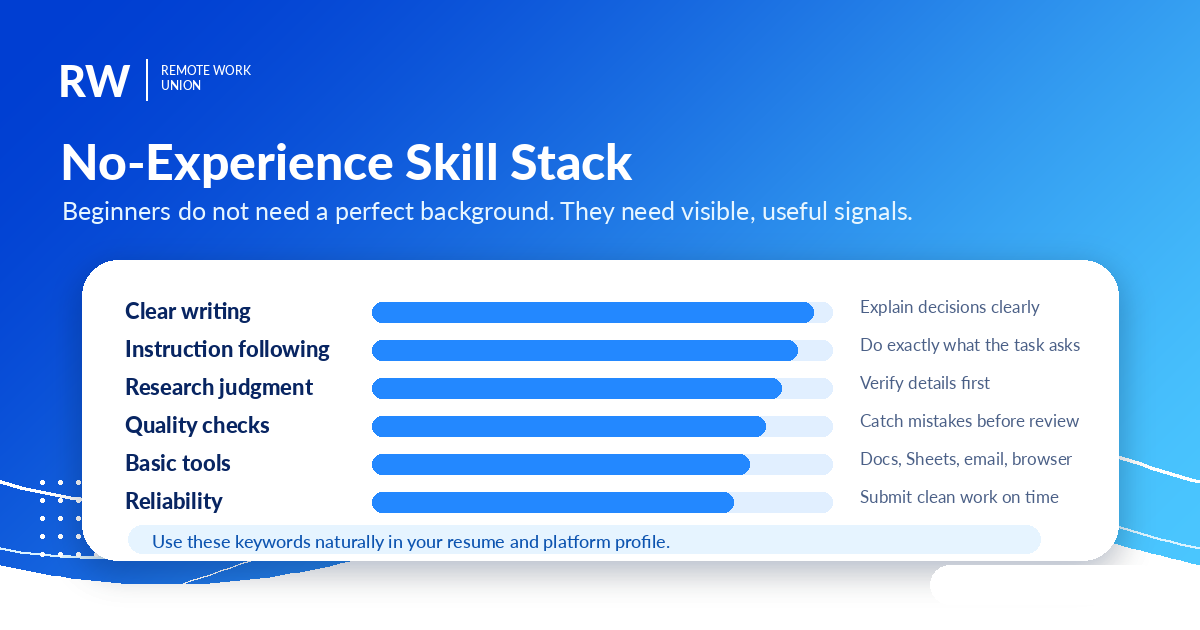
Day one: Choose one primary lane and one backup lane. For example, AI evaluation plus online research. Or virtual assistant work plus email support. Do not choose six lanes at once.
Day two: Build a simple resume or profile using the keywords from your chosen lane. Remove unrelated filler. Make every bullet point show communication, accuracy, organization, research, tool use, or customer judgment.
Day three: Create two small samples. For AI evaluation, compare two short answers and explain which is better. For virtual assistant work, create an inbox triage workflow or calendar checklist. For research work, summarize five sources into a clean one-page brief. For customer support, write three sample email replies.
Day four: Apply to five to ten platforms or jobs. Use a spreadsheet to track the company, role, date, login email, status, assessment, and follow-up date. Beginners lose opportunities because they forget where they applied.
Day five: Improve your profile based on what applications ask for. If every role mentions Google Sheets, add spreadsheet proof. If AI platforms ask about writing, add your writing sample. If support jobs ask for customer tools, mention ticketing, documentation, email, and issue resolution.
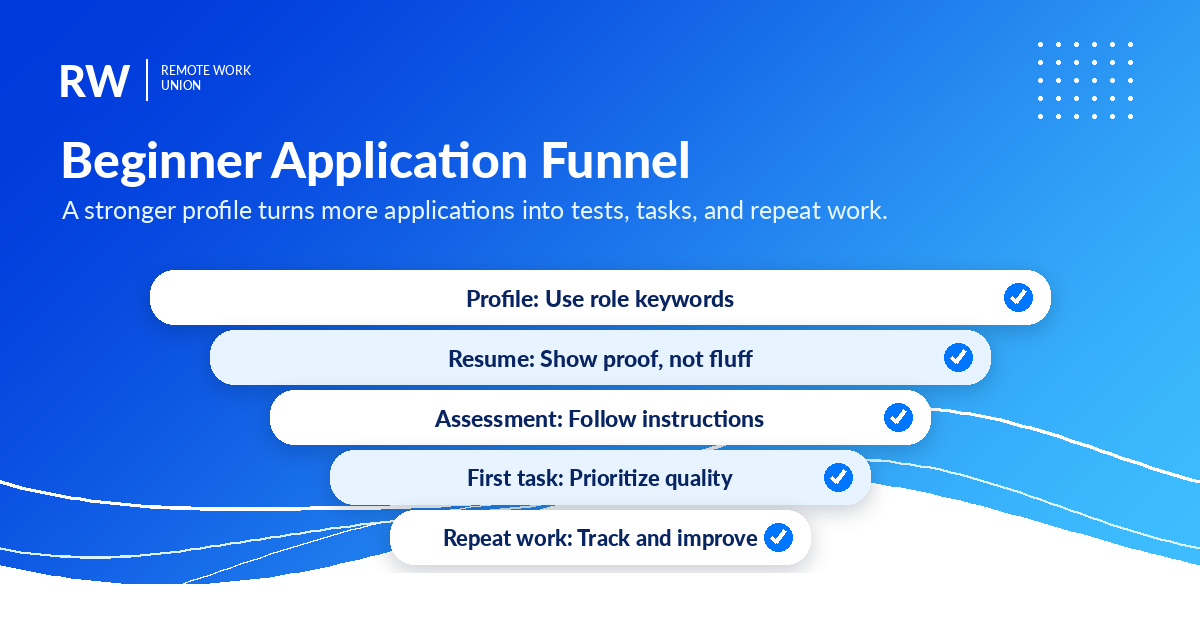
Day six: Take assessments slowly. Many beginner applicants fail because they rush. Read the instructions twice. Submit clean work. Explain your reasoning when asked. In remote AI jobs, quality is often more important than speed at the start.
Day seven: Apply again, but better. Use the information you learned from the first round. Tighten your resume. Replace weak bullets. Add stronger keywords. Follow up where appropriate. Remote work is usually a process, not one magic application.
How to Avoid Beginner Remote Work Scams
Real remote work platforms do not need you to pay a starter fee before you can work. Be careful with any job that asks you to buy equipment from a specific vendor, deposit a check, move money, receive packages, reship products, open crypto accounts, or pay for training before being considered. Those are common scam patterns.
Also be careful with vague jobs that promise very high pay for almost no work. Real remote work can pay well, especially specialized AI training, expert review, technical evaluation, consulting, sales, and skilled writing. But legitimate work still has screening, instructions, quality expectations, and accountability.
A beginner should also avoid applying with personal documents too early. You may need tax forms or identity verification after acceptance on a legitimate platform, but a random recruiter should not need sensitive information before a real process has started. When in doubt, verify the company website, email domain, platform login, and public reputation before sending anything sensitive.
Tip: If a job offers unusually high pay for no skill, no screening, and no accountability, it is almost certainly not a legitimate remote work opportunity. Real platforms explain the work, set standards, and have a real application process.
How Beginners Move From Low-Pay Tasks to Better Remote Work
Your first goal is not to find the perfect remote job. Your first goal is to create evidence. Evidence makes the second opportunity easier. A completed project, positive feedback, a passed assessment, a strong sample, or a clean task history can help you apply for better work.
After your first tasks, keep notes on what you did. Track the type of work, tools used, quality standard, topic area, and results. Over time, this becomes resume material. Beginner remote workers often understate their work because it feels small. But remote companies care about proof that you can operate independently.
To increase your pay, specialize gradually. AI evaluation can lead into writing evaluation, expert review, prompt testing, factuality review, coding evaluation, legal review, medical review, finance review, or multilingual evaluation depending on your background. Virtual assistant work can lead into operations, project coordination, executive support, recruiting coordination, sales operations, or customer success. Research work can lead into market research, lead generation, competitive analysis, recruiting research, or content research.
Do not depend on one platform or one client. Remote work is more stable when you have multiple sources. A beginner might start with AI training tasks, apply to virtual assistant roles, keep a profile on several platforms, and continue building samples. The goal is to move from waiting for work to building a pipeline.
Common Beginner Mistakes
- Applying too broadly with no positioning. If your profile says you can do anything, it usually sounds like you are good at nothing specific. Pick a lane and make your application match it.
- Treating remote work like passive income. Real remote work still requires effort, accuracy, communication, and patience. Even flexible work has standards.
- Ignoring assessments. Platforms use tests to decide who gets matched to work. Read every instruction. Avoid unsupported claims. Do not use AI to fake expertise. If a task asks for your own reasoning, provide your own reasoning.
- Quitting too early. Many beginners apply to three jobs, hear nothing, and assume remote work is impossible. It is better to apply consistently, track results, and improve your materials every week.
- Only chasing the highest hourly rate. High-paying remote work often requires rare expertise, strong writing, technical skill, professional experience, or excellent judgment. Beginners can still get paid, but the path is usually first proof, then better projects.
Conclusion
Start with one lane. Build proof. Apply to multiple platforms. Take assessments seriously. Track everything. Improve weekly.
The first remote opportunity may be small, but it can become evidence for the next one. Once you have proof, you are no longer applying as a complete beginner. You are applying as someone who has already done the work, understands the standards, and knows how to operate from home.
Frequently Asked Questions
Can I get remote work with no experience?
Yes, but you need to create proof. A resume with no proof is weak. A beginner profile with clear skills, relevant keywords, and small samples is much stronger. School work, volunteer projects, personal projects, and job experience from any industry can all be repositioned to show remote-work ability.
Are AI training jobs good for beginners?
They can be, especially for people who write clearly, follow instructions, research carefully, and explain decisions. Some projects are beginner-friendly, while others require expert knowledge or technical skill. Platforms like micro1, Mercor, Handshake AI, and Outlier all have different requirements, so applying to multiple is the safest approach.
What is the easiest remote job to get with no experience?
The easiest category depends on your background. People with strong writing may start with editing, AI evaluation, or content review. Organized people may start with virtual assistant work. Customer-facing people may start with email or chat support. Detail-oriented people may start with data annotation or quality review.
How long does it take to get remote work as a beginner?
There is no fixed timeline. Some people get a response quickly. Others need weeks of applications, profile improvements, and assessments. The controllable part is applying consistently and improving the quality of your materials every week. Applying to five to ten opportunities and improving your profile based on what they ask for gives you the best odds.
Should I apply to micro1, Mercor, Handshake AI, and Outlier at the same time?
For most beginners, yes. Work volume can change by platform, location, and skill area, so it is safer to apply to multiple legitimate platforms rather than waiting on one response. Track each application separately so you can follow up and improve your profile based on what each platform asks for.