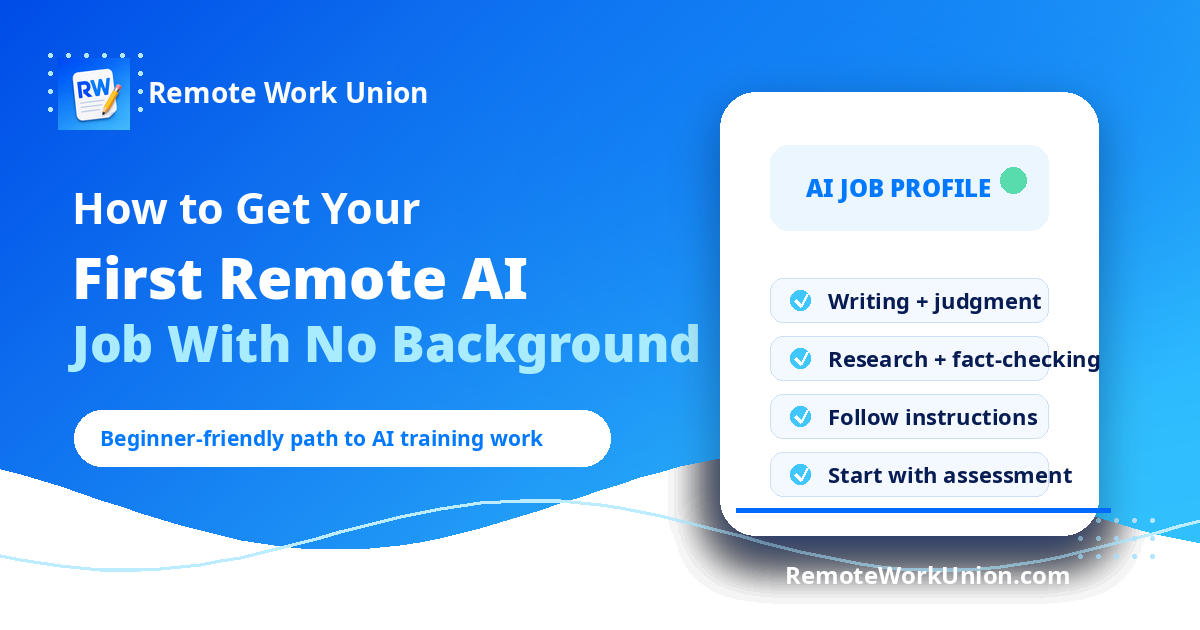
A remote AI job can sound like something reserved for coders, machine learning engineers, or people with computer science degrees. That is not the whole market. A large part of remote AI work is built around human judgment: reading, writing, comparing, labeling, researching, fact-checking, editing, following instructions, and explaining why one answer is better than another.
That is why someone with no AI background can still qualify for beginner-friendly AI training jobs, AI evaluation jobs, data annotation work, prompt writing tasks, search quality projects, content review assignments, and model response rating work. You may not be building the model. You are helping improve it.
The key is to stop applying like a generic beginner and start presenting yourself like someone who can help an AI company produce better data.
What "No Background" Really Means
When people say they have no background, they usually mean one of three things:
- They have no coding background.
- They have never worked in artificial intelligence.
- They do not have a specialized degree or job title.
Those are not always deal breakers. Many remote AI jobs do not ask you to write code. They ask you to evaluate output, compare answers, edit content, annotate text, identify mistakes, write better examples, or judge whether a response is useful, safe, accurate, and clear.
That said, no AI background does not mean no standards. Remote AI platforms still need workers who can follow detailed instructions, communicate clearly, and stay consistent across repetitive tasks. The beginner who gets hired is usually not the person who says "I will do anything." It is the person who says "I can evaluate writing, check facts, follow a rubric, and explain my reasoning."
The Easiest Remote AI Jobs to Start With
Beginner-friendly remote AI jobs often use different titles, but the work usually falls into a few categories.
AI Response Evaluator
An AI response evaluator reviews answers from a chatbot or language model and rates them based on quality. You may compare two answers and choose the better one, or explain which answer is more accurate, helpful, complete, safe, or natural. This is one of the best entry points because it rewards reading comprehension and judgment. You do not need to know how the model was built — you need to understand whether the final answer works for a real user.
Data Annotator
Data annotation jobs involve labeling information so AI systems can learn from structured examples. You might classify text, tag images, identify intent, label sentiment, flag policy issues, or categorize search results. For beginners, the goal is to apply to tasks that match what you already understand: writing, customer service, research, basic business, education, sales, marketing, or general knowledge.
Prompt Writer or Prompt Tester
Prompt writing work involves creating prompts that test how an AI model responds. A prompt tester may try to make the model solve problems, follow instructions, refuse unsafe requests, or produce a specific style of answer. This work is often a good fit for writers, teachers, editors, researchers, marketers, and people who are good at asking precise questions.
AI Content Editor
AI content editing jobs involve improving AI-generated text — rewriting awkward sentences, removing hallucinated claims, improving structure, checking tone, or making an answer more useful. This is one of the best paths for people with writing, proofreading, communications, marketing, blogging, tutoring, academic, or customer support experience.
Search Quality Rater
Search quality work involves reviewing search results, web pages, snippets, or answers and judging whether they satisfy a user's intent. This can overlap with AI evaluation because modern search products often use AI-generated summaries. If you are good at noticing whether a page actually answers a question, this path can be beginner-friendly.
Voice, Audio, and Conversation Evaluation
Some AI projects evaluate voice assistants, audio responses, conversation flow, or spoken answers. These jobs can fit people with strong listening skills, language skills, acting, teaching, customer service, or communication experience.
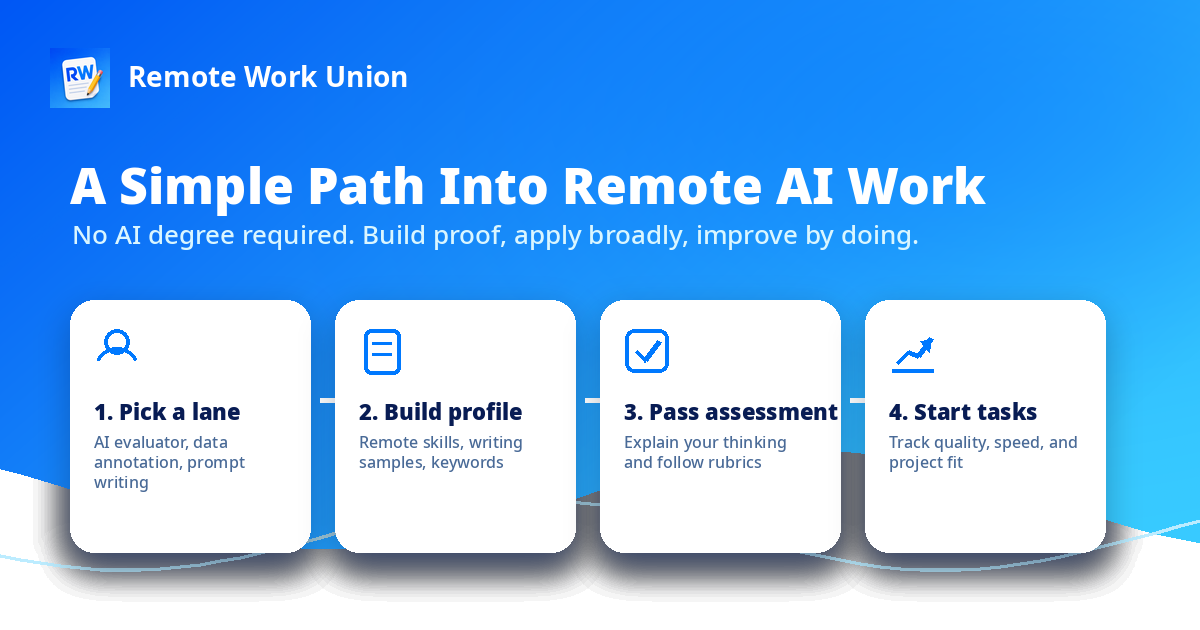
Why AI Companies Hire Non-Coders
AI companies do not only need engineering. They need feedback from humans who can recognize quality. Even the strongest AI systems still need examples, corrections, ratings, and evaluation data.
A model can produce an answer that looks confident but is wrong. It can follow part of an instruction and ignore another part. It can sound fluent while missing the user's real intent. It can over-explain a simple question or under-explain a serious one. It can be technically correct but unhelpful.
That is where human reviewers matter. The job is not just clicking buttons — it is applying human standards to AI output.
This is why major AI companies are important in this space. OpenAI, Anthropic, Google, Meta, xAI, and other AI companies all compete around model quality, safety, reasoning, usefulness, and real-world reliability. Even when the work comes through platforms instead of directly from a lab, the underlying demand is the same: AI systems need better human feedback.
What Beginner Applicants Should Have Ready
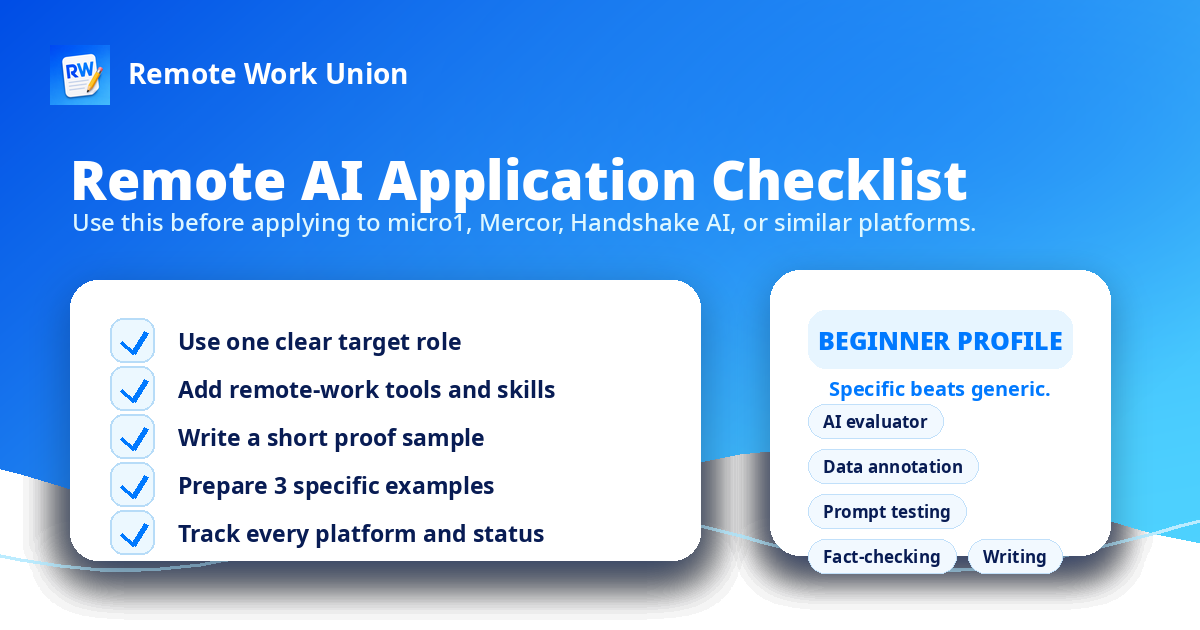
You do not need a perfect resume to apply for your first remote AI job. You do need a clear profile. Before you apply, prepare these five pieces.
1. A Short Positioning Statement
Write one sentence that explains what kind of remote AI work you are best suited for.
Weak version: "I am looking for any remote job."
Stronger version: "I am applying for beginner-friendly AI evaluation, data annotation, and content review roles where I can use writing, research, and attention to detail."
Even if you are new, the stronger version gives the platform something to match.
2. A Skills List That Fits AI Evaluation Work
Use skills relevant to remote AI jobs. Examples: AI response evaluation, data annotation, prompt writing, prompt testing, fact-checking, research, writing and editing, content review, search quality evaluation, rubric-based scoring, attention to detail, written communication, reading comprehension, ChatGPT, Claude, Gemini, Grok, and other AI tools. Do not stuff every keyword in without context — use the terms that honestly fit what you can do.
3. Two or Three Proof Examples
A proof example is a small sample that shows how you think. For an AI evaluator role, create a simple example like:
- Prompt: "Explain compound interest to a beginner."
- AI answer A: concise but incomplete.
- AI answer B: accurate, step-by-step, and easier to understand.
- Your rating: Answer B is better.
- Your reasoning: It defines the term, gives a simple example, avoids jargon, and answers the user's likely intent.
This shows a platform that you can compare outputs and explain judgment — which is more useful than "hard worker" or "fast learner."
4. A Clean Remote-Work Setup
Many remote AI roles require only a laptop, reliable internet, a quiet work environment, and the ability to use browser-based tools. At minimum, be ready with: a laptop or desktop, stable internet, a professional email address, an updated resume or profile, a payment method accepted by the platform, time blocks for assessments, and a basic spreadsheet to track applications.
5. A Realistic Expectation
Your first remote AI job may not be your highest-paying one. Beginner work can be inconsistent. Projects may pause. Applications may sit with no response. Platforms may accept you but not immediately match you to tasks. That does not always mean you failed — it often means timing, location, skills, and project demand have not aligned yet. Apply to multiple legitimate platforms, build proof, and keep your profile active.
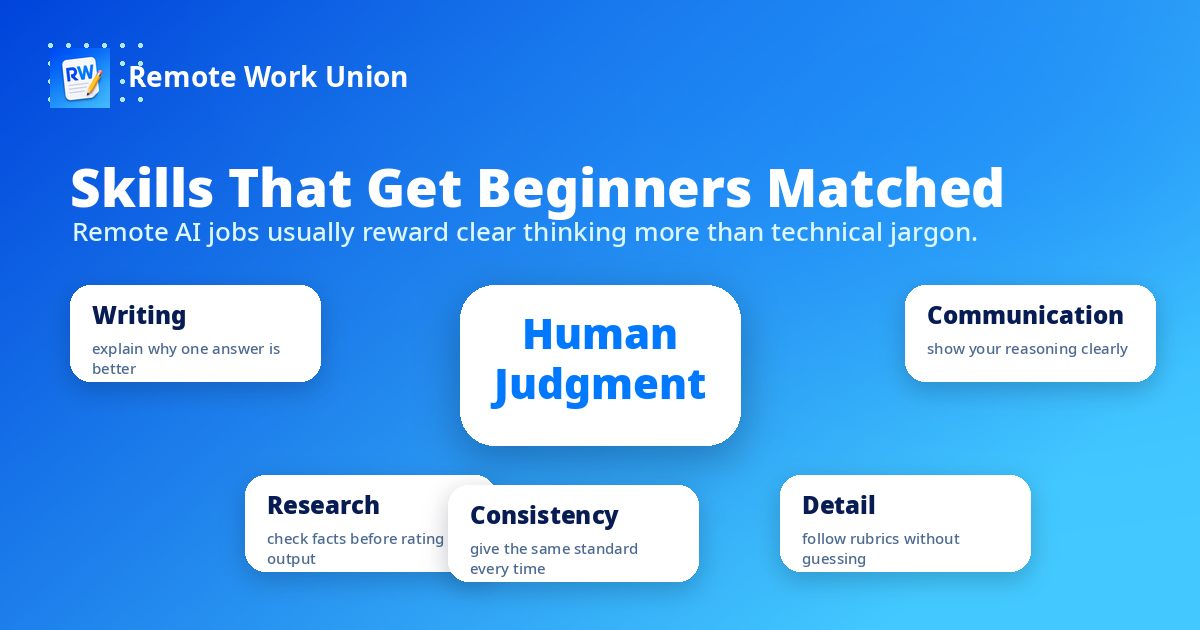
How to Apply When You Have No AI Experience
Step 1: Choose One Beginner-Friendly Lane
Do not start by applying to everything. Pick one primary lane: writing and editing, research and fact-checking, general AI evaluation, data annotation, prompt writing, customer support or conversation review, or subject matter expert. Your first lane should match your strongest existing skill.
Step 2: Rewrite Your Resume for Remote AI Keywords
Your resume should show evidence of the skills AI platforms need. Instead of "Handled customer emails," write "Reviewed customer messages, identified the user's intent, wrote clear responses, and followed company guidelines for accuracy and tone." Instead of "Wrote blog posts," write "Researched topics, structured clear written content, edited drafts, and checked facts before publishing." Translate your experience into AI-evaluation language.
Step 3: Build a Short AI Work Sample
Create one page with two sample tasks. Sample task one: compare two AI answers and explain which is better. Sample task two: write a prompt that tests whether an AI can follow a multi-step instruction. Keep it simple. The purpose is to show that you understand the work.
Step 4: Apply to Multiple Platforms
Do not rely on one platform. Remote AI work can be project-based, and each platform has its own matching process. Some roles are location-specific. Some need experts. Some need generalists. Some need writers. Beginner applicants should create a simple tracker with columns for: platform, role applied for, date applied, assessment status, profile status, payment setup, last follow-up, and notes.
Step 5: Take Assessments Slowly
A common beginner mistake is rushing the assessment. AI training platforms often test exactly what the work requires: attention to instructions, consistency, writing quality, reasoning, accuracy, and judgment. Before submitting, check: Did you answer the actual question? Did you follow every instruction? Did you explain your reasoning clearly? Did you avoid unsupported claims? Did you write in a clean, professional tone?
Step 6: Start With the Work You Can Get
Your first project is mostly about getting started. It gives you experience with guidelines, dashboards, task queues, feedback, quality scores, and payment systems. Once you complete beginner tasks, you can improve your profile with specific experience: "Rated AI-generated answers for helpfulness and accuracy," "Compared model responses using a project rubric," "Annotated text data for classification tasks."
Remote Work Union connects beginners to legitimate remote AI training and evaluation roles. Find jobs hiring now.
Find Roles Hiring Now →How to Make a No-Background Profile Look Credible
A credible beginner profile is specific. It does not exaggerate. It does not claim expert status. It connects real skills to AI work.
Here is a simple profile structure that works:
Headline: Beginner AI Evaluator | Writing, Research, Data Annotation, Prompt Testing
Summary: I am applying for remote AI evaluation and data annotation work where I can use clear writing, research, and attention to detail. I am comfortable comparing AI-generated responses, checking whether answers follow instructions, and explaining why one output is more accurate, helpful, or complete than another.
Skills: AI response evaluation, prompt testing, data annotation, fact-checking, content review, search quality, written feedback, rubric-based scoring, remote work tools, spreadsheets.
Proof: Include a short example of comparing two AI answers or rewriting an AI-generated response.
This kind of profile is not flashy, but it tells the platform what you can do. That is what matters at the matching stage.
Transferable Backgrounds That Work Well
Many people are closer to remote AI work than they think. These backgrounds can transfer well:
- Writers and editors: content review, prompt writing, model response editing
- Teachers and tutors: educational answer evaluation, explanation quality, grading rubrics
- Customer service reps: conversation quality, intent recognition, tone evaluation
- Sales reps: persuasion analysis, customer intent, CRM-style documentation
- Marketing workers: ad copy review, SEO content, audience intent, creative testing
- Researchers: fact-checking, source evaluation, structured analysis
- Administrative workers: data organization, guidelines, process consistency
- Recruiters and HR professionals: resume review, interview evaluation, communication quality
- Accountants and bookkeepers: finance-related annotation and accuracy review
- Bilingual professionals: translation evaluation, multilingual annotation, localization review
- Subject matter experts: higher-paying expert review in a specialized field
The more specific your background, the easier it is to target better projects. But generalists can still start with broad evaluation and annotation work.
What Not to Do as a Beginner
Do not say you will do anything. Platforms match based on skills. "Anything" gives them nothing to match.
Do not fake expertise. If a project needs a legal expert, medical expert, software engineer, or financial analyst, do not pretend. Expert projects often have harder assessments. False claims can get you removed.
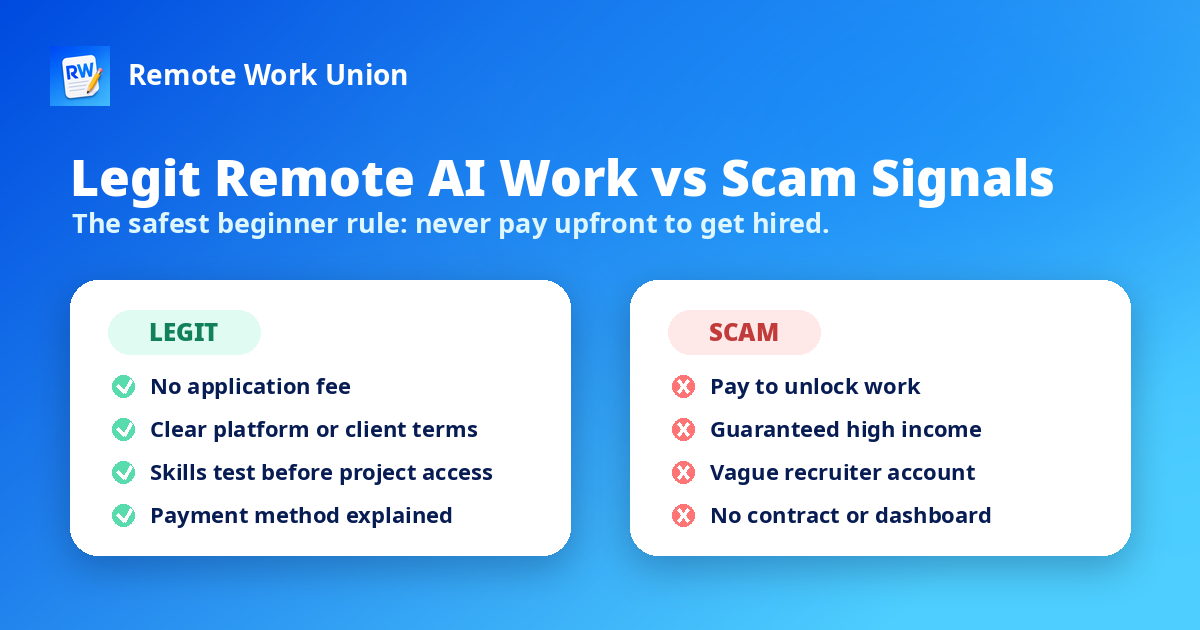
Do not pay for access. Real remote AI platforms should not require an upfront fee just to unlock work. A job itself should not require you to pay to be hired.
Do not ignore location rules. Some roles are US-only, Canada-only, UK-only, or restricted by work authorization. Applying to the wrong region wastes time.
Do not rush through guidelines. AI evaluation work is guideline-heavy. The best beginner habit is reading the rubric carefully and applying it exactly.
Do not quit after one no-response. No response is normal in remote work. Apply broadly, keep records, improve your profile, and treat each assessment as practice.
A Simple Seven-Day Plan
Day 1: Pick your lane. Choose one main direction: AI evaluator, data annotation, prompt writing, content editing, research, or search quality.
Day 2: Rewrite your resume summary. Add keywords related to remote AI work, but keep them honest. Focus on writing, judgment, research, accuracy, and following instructions.
Day 3: Create two proof samples. Compare two AI answers. Write one prompt-testing example. Save both in a simple document.
Day 4: Apply to platforms. Apply to several legitimate remote AI platforms and remote work job boards. Track each application in a simple spreadsheet.
Day 5: Prepare for assessments. Practice explaining your reasoning in short, clear sentences. Review examples of good versus bad AI answers.
Day 6: Complete assessments carefully. Do not rush. Follow the instructions. Prioritize accuracy.
Day 7: Follow up and improve. Update your tracker. Add stronger examples. Apply to more targeted roles based on what you learned.
How to Move From Beginner to Better-Paying Work
Your first task is not the finish line. Once you have experience, you can move toward better projects by becoming more specific.
Beginner level: general AI response rating, basic data labeling, simple content review, search result evaluation.
Intermediate level: prompt writing, fact-checking, multi-step reasoning evaluation, domain-specific content review, bilingual evaluation.
Advanced level: legal, medical, finance, engineering, coding, science, or specialist evaluation; complex reasoning tasks; red-team testing; safety evaluation; high-stakes expert review paying $50–$200/hr.
The fastest way up is not claiming every skill. It is building a record in one lane through platforms like Mercor, Handshake AI, micro1, and Outlier, then adding adjacent skills with proof.
Frequently Asked Questions
Can I get a remote AI job without coding?
Yes, many remote AI jobs do not require coding. Look for AI evaluation, data annotation, prompt testing, content editing, search quality, and human feedback roles. Coding is helpful for technical projects, but it is not required for every AI training job. Many of the most in-demand roles reward writing, research, fact-checking, and judgment.
Do I need a degree to get a remote AI job?
Some platforms and projects require a degree. Others do not. Many roles care more about your writing, judgment, subject knowledge, location, work authorization, and assessment performance than your formal credentials. Read the requirements for each role before applying.
What is the easiest remote AI job to get with no experience?
AI response evaluation and data annotation are typically the most beginner-accessible remote AI roles. They reward reading comprehension, attention to detail, and clear judgment — skills that do not require prior AI experience. Search quality rater positions and basic prompt testing work are also good entry points.
What is the biggest mistake beginners make applying for remote AI jobs?
Applying with a generic profile. A beginner profile should still be specific: what you can evaluate, what skills you bring, what tools you can use, and what proof you can show. "I will do anything" gives a platform nothing to match. "I can evaluate writing quality and check facts, and I have research experience" gives them something to route.
How do I move from beginner AI work to better-paying roles?
Start with general AI response rating, basic data labeling, or content review. Use that experience to add specific language to your profile: "Evaluated AI responses for accuracy, compared model outputs, wrote rationales for rubric-based scoring." Then apply to intermediate and advanced tracks — prompt writing, fact-checking, domain-specific evaluation, or expert review in your professional background area.