Leaving a 9-to-5 office job does not always mean leaving your experience behind. Most office jobs teach habits that remote teams need: clear writing, task ownership, email judgment, follow-through, calendar discipline, document review, customer awareness, and the ability to make decisions without perfect information. Those skills matter in remote work, especially in AI training, AI evaluation, remote operations, customer success, content support, project coordination, and research-heavy roles.
The hard part is translation. A person who has spent years in an office may describe their work as administrative, general, or basic. A remote hiring platform may describe the same ability as asynchronous communication, task triage, quality review, documentation, annotation, workflow management, or subject matter judgment. The work did not disappear. The language changed.
This guide is for people who are leaving, or thinking about leaving, a traditional office job and want a realistic path into work from home jobs. It focuses on practical steps, remote job categories, application strategy, and how to use your existing office background to qualify for better online work without pretending to be a software engineer.
In This Article
- Why office workers often underestimate their remote value
- The best remote work categories for people leaving office jobs
- How to translate office experience into remote keywords
- Build a remote profile before you quit
- A practical application strategy for the first month
- How to avoid taking the wrong remote job
- Common mistakes people make when leaving office work
- A 30-day plan for leaving a 9-to-5 office job
- What a realistic transition can look like
- Frequently asked questions
Why office workers often underestimate their remote value
A traditional office job can make useful skills feel invisible because many tasks are treated as part of the daily routine. You answer questions, update spreadsheets, organize information, write emails, review documents, spot mistakes, follow processes, coordinate with teams, and decide what needs attention first. In a remote setting, those same actions become valuable because managers cannot rely on someone physically watching the room.
Remote work rewards people who can understand instructions, communicate status, make clean decisions, and deliver finished work without constant supervision. That is why people from office administration, operations, sales support, HR, customer support, finance support, legal support, marketing coordination, and general business roles can often move into remote jobs faster than they expect.
The key is to stop selling yourself as someone who merely showed up to an office and start presenting yourself as someone who can manage information, judgment, and execution from anywhere.
The best remote work categories for people leaving office jobs
Not every remote job is a good first step. Some roles require deep technical experience, a portfolio, or years of direct remote background. Others are much more accessible for people with office experience.
AI training and AI evaluation work is one of the strongest categories for office workers because many tasks require judgment, writing, research, accuracy, and the ability to compare answers. Platforms and companies working around AI systems, including ecosystems connected to OpenAI, Anthropic, Google, Meta, Grok, and other major AI companies, need human reviewers to evaluate outputs, write examples, check facts, organize data, improve prompts, and judge whether responses are useful. These roles are often described with keywords like AI trainer, AI evaluator, AI data annotation, AI model evaluation, search quality rater, writing evaluator, research reviewer, and prompt evaluator. Many do not require coding.
Remote operations roles are another natural fit. If you have worked with spreadsheets, SOPs, customer records, internal tools, reporting, scheduling, vendor coordination, or cross-team communication, you may fit remote operations coordinator, business operations assistant, virtual operations associate, project coordinator, executive assistant, workflow specialist, or remote office manager roles.
Customer success and account support can also work well, especially for people who want to stay close to clients without returning to a call-center environment. Look for customer success associate, client onboarding specialist, account coordinator, support operations, customer research, and implementation assistant. Some roles involve calls, but many also include email support, documentation, training materials, product feedback, and account organization.
Writing, editing, and content operations roles are useful for people who have written internal documents, emails, summaries, proposals, reports, social posts, newsletters, or training materials. Remote content assistant, AI content editor, proofreader, documentation assistant, SEO content coordinator, and editorial reviewer roles can be reachable if you can show clean writing and attention to detail.
Research and data review roles are also strong options. Many office workers are used to checking records, comparing sources, cleaning lists, verifying details, and summarizing information. Those skills fit remote research assistant, data quality reviewer, AI research evaluator, web research specialist, data annotation reviewer, and fact-checking roles.
How to translate office experience into remote keywords
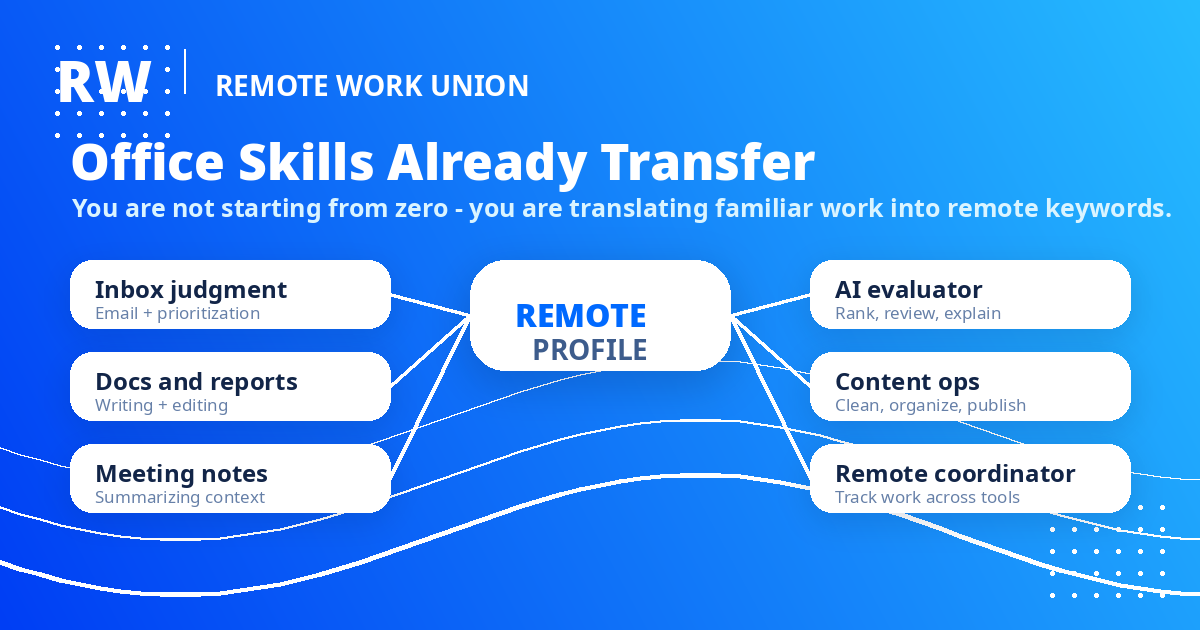
Most people leaving a 9-to-5 office job make the same mistake: they list duties instead of capabilities. A duty sounds like "answered emails." A capability sounds like "managed high-volume written communication, prioritized requests, and resolved issues without direct supervision."
A duty sounds like "updated spreadsheets." A capability sounds like "maintained structured records, audited data for accuracy, and created reports used for business decisions."
A duty sounds like "took meeting notes." A capability sounds like "summarized complex discussions into action items, ownership, deadlines, and follow-up documentation."
Remote applications depend on this translation because hiring teams are scanning for evidence that you can operate outside a physical office. Use keywords that connect your background to remote work: asynchronous communication, written judgment, documentation, task management, quality control, research, workflow coordination, data accuracy, customer support, content review, AI evaluation, AI training, remote collaboration, and independent execution.
Before (duty framing): "Handled customer inquiries and updated the CRM."
After (capability framing): "Managed high-volume customer communication asynchronously, resolved issues using documented processes, and maintained accurate CRM records across multiple account types."
Build a remote profile before you quit
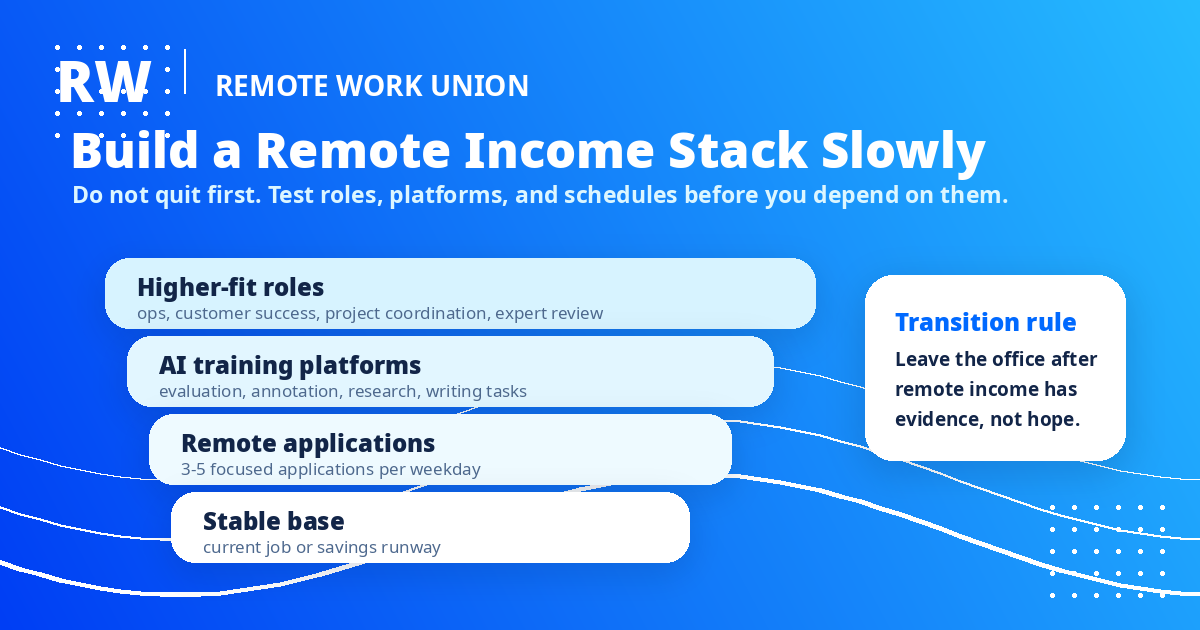
The safest transition is not to quit first and hope remote work appears. The safer approach is to build your remote profile while you still have a paycheck. That gives you time to test platforms, improve applications, learn what roles respond, and build proof without financial panic.
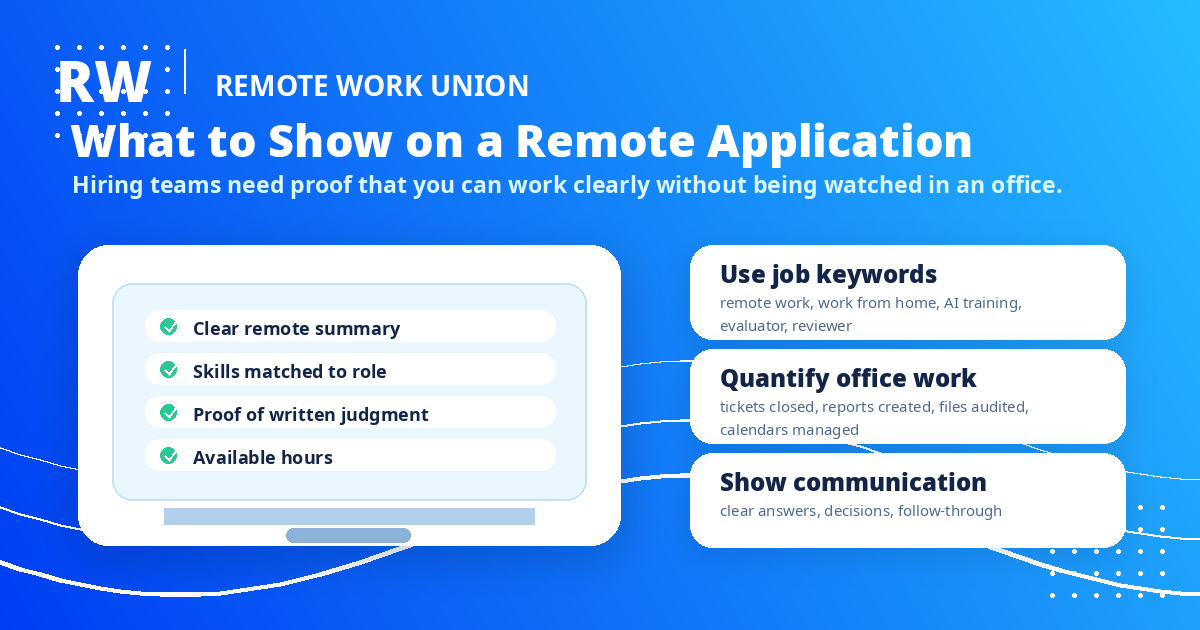
Start with a one-page remote profile. This does not need to be complicated. It should explain who you are, what you are good at, which remote roles you are targeting, and why your office experience transfers. Include a concise headline such as "Remote Operations and AI Evaluation Candidate" or "Office Administration Professional Moving Into Remote AI Training and Content Review."
Then add a short summary that uses remote language: "I have experience managing written communication, organizing records, reviewing documents, following detailed processes, and coordinating tasks across teams. I am applying for remote roles in AI training, content review, operations support, research, and project coordination."
Next, list the tools and skills that matter for remote work: Google Workspace, Microsoft Office, spreadsheets, Slack, Zoom, CRM tools, ticketing systems, Canva, Notion, Airtable, ChatGPT, research, proofreading, SOPs, task tracking, writing, and data review. Only include tools you can discuss honestly.
Finally, add two or three proof points. These can be simple: "Created weekly reporting spreadsheet," "managed customer follow-up by email," "reviewed documents for accuracy," "maintained records across multiple systems," or "summarized internal meetings into action items." Proof beats vague motivation.
A practical application strategy for the first month
For the first month, apply like a system, not like a lottery ticket. Choose three to five role categories and repeat them daily. For a person leaving an office job, a strong starting mix might be AI evaluator, AI data annotation, remote operations assistant, content reviewer, customer success associate, and research assistant.
Apply to remote platforms as well as traditional job boards. Platforms such as micro1, Mercor, Handshake AI, and other AI training marketplaces may match people to project-based work that uses writing, research, domain knowledge, or general judgment. Traditional job boards can be better for full-time remote roles like operations coordinator, customer success associate, virtual assistant, and project coordinator. Remote Work Union can help you find roles hiring now and understand where to apply.
Track every application in a spreadsheet. Include company, platform, role title, pay range if listed, date applied, status, follow-up date, and notes about what the role asked for. After two weeks, patterns will appear. If AI evaluation roles respond more than customer success roles, lean into AI evaluation. If operations roles respond but writing roles do not, adjust the writing samples or keywords.
Do not rewrite your entire resume for every job. Create a strong base resume and then adjust the top summary, skills section, and first few bullet points for each category. A remote operations role should see operations keywords immediately. An AI training role should see writing, judgment, research, annotation, and evaluation keywords immediately.
How to avoid taking the wrong remote job
The goal is not just to escape the office. The goal is to build a better work structure. Some remote roles recreate the worst parts of office work: constant meetings, low autonomy, unclear expectations, surveillance software, unpredictable scheduling, or phone-heavy support with little flexibility.
Before accepting a role, ask what the daily work looks like. Ask whether the role is asynchronous or meeting-heavy. Ask how performance is measured. Ask whether hours are flexible or fixed. Ask whether work is project-based, hourly, or salaried. Ask how training works. Ask whether there is a steady flow of tasks.
For AI training and remote platform work, understand that project availability can change. A platform may pay well, but task volume may not be perfectly steady. This is why it is smart to join multiple platforms and keep applying to traditional remote jobs at the same time. A stable remote career often comes from a mix of options, not one single platform.
Want to transition your office skills into remote AI work? Find opportunities hiring now.
Find Roles Hiring Now →Common mistakes people make when leaving office work
The first mistake is quitting before testing demand. Wanting remote work is not the same as having a reliable pipeline. Build the pipeline first.
The second mistake is applying too broadly. If every application is generic, none of them are strong. Pick a few categories and build targeted versions of your resume and profile.
The third mistake is hiding generalist experience. Many office workers think generalist means unfocused. In remote work, being a strong generalist can be valuable if you can write clearly, learn tools quickly, manage tasks, and make good decisions.
The fourth mistake is chasing only high-pay listings. Remote AI jobs that pay high hourly rates — such as $50–$200/hr for expert-tier evaluation work — usually expect strong writing, expertise, speed, accuracy, or specialized knowledge. Apply for them if you qualify, but also build momentum with realistic roles that prove you can work remotely.
The fifth mistake is ignoring scams. Real remote work platforms and employers do not charge you just to start, do not require you to buy equipment from a suspicious vendor, do not ask for banking details before a legitimate hiring process, and do not pressure you through private messaging apps with vague job descriptions.
Rule of thumb: If a remote opportunity asks you to pay anything before you receive your first paycheck, or contacts you through a personal messaging app with an offer you never applied for, treat it as a scam signal and move on.
A 30-day plan for leaving a 9-to-5 office job
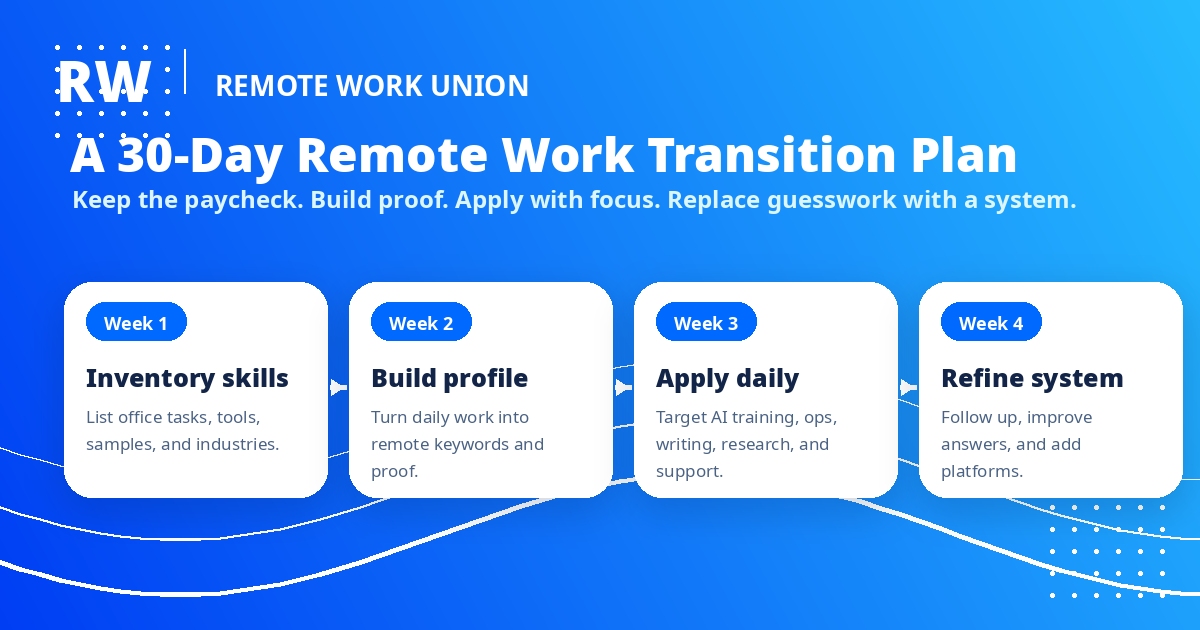
Days 1 through 7: inventory your office skills. Write down every task you do in a normal week. Translate each task into a remote keyword. Email becomes written communication. Spreadsheets become data accuracy. Meeting notes become summarization. Process work becomes operations. Checking details becomes quality review.
Days 8 through 14: build your remote profile. Update your resume summary, skills section, and top bullet points. Create a simple spreadsheet for applications. Prepare one short writing sample, one example of organized work, and one explanation of how you make decisions.
Days 15 through 21: apply with focus. Submit applications to AI training platforms, remote operations roles, content review roles, research roles, and customer success roles. Aim for quality and consistency. A small number of well-targeted applications each weekday is better than a burst of generic applications once a month.
Days 22 through 30: evaluate signals. Which roles responded? Which applications stalled? Which platforms asked you to test? Which keywords appeared most often? Adjust your resume and profile based on evidence. Add a second or third platform so your remote income does not depend on one source.
What a realistic transition can look like
A realistic transition usually happens in stages. First, you learn which remote categories fit your background. Then you start receiving tests, interviews, or project access. Then you build small wins. Then you use those wins to apply for better remote work.
For some people, the first remote income comes from AI data annotation, search evaluation, writing review, or short-term project work. For others, it comes from a full-time remote coordinator, customer success, or operations role. For others, the path is a hybrid of platform work and job applications.
The point is to avoid treating remote work as one single job type. Remote work is a delivery method. AI training, customer success, operations, writing, research, data review, project coordination, and content quality are job types. Your job is to find the category where your existing skills become obvious.
Frequently Asked Questions
Do I need coding experience to get remote AI work?
Not always. Some AI roles require engineering or data science backgrounds, but many AI training, AI evaluation, writing, research, and annotation roles rely on judgment, language ability, accuracy, and subject knowledge. Office workers with strong writing and organizational skills are well-positioned for these roles.
Can office administration experience help me get remote work?
Yes. Office administration often includes communication, scheduling, document control, data accuracy, customer awareness, and process management. Those skills are directly relevant to remote operations, virtual assistant, project coordination, content review, and AI training roles.
Should I quit my office job before applying for remote work?
Usually no. It is safer to apply, test platforms, build proof of your remote capabilities, and understand your response rate before depending on remote income. Build the pipeline first, then leave when the evidence supports it.
What remote role should I try first when leaving an office job?
Start with the role that most closely matches your actual daily work. If you write and review documents, try content review and AI evaluation. If you organize systems and people, try remote operations. If you support customers, try customer success or support operations. If you check information carefully, try research and data review.
How many remote platforms should I join when transitioning from office work?
Enough to reduce dependence on one source, but not so many that you cannot complete tests or respond quickly. Beginners often do best with a focused list of platforms and job categories, then expand after they learn what is working. Platforms like micro1, Mercor, and Handshake AI are good starting points for AI training and evaluation work.