A lot of people are not afraid of remote work. They are afraid of what happens if the job they already know how to do gets automated, downsized, or turned into a lower-paid version of itself. That fear is not irrational. AI is already changing how companies write, research, support customers, analyze data, review content, build software, and manage everyday workflows. But the answer is not to freeze, ignore AI, or assume every good job now requires coding.
The better move is to shift toward remote work that uses the parts of your experience AI cannot fully replace: judgment, taste, context, accountability, communication, subject-matter knowledge, and the ability to tell when an output is wrong. The safest workers are not always the most technical workers. They are often the people who can use AI without blindly trusting it.
That is why remote AI jobs, AI training jobs, model evaluation work, data annotation projects, prompt review, search quality evaluation, content editing, QA testing, customer success, and research-heavy remote roles are becoming important options for people who want to stay employable.
In this guide
- AI Usually Replaces Tasks Before It Replaces Entire Workers
- The Best Remote Work Shift: From Task-Doer to Quality Judge
- Remote Roles to Consider If You Are Worried About AI Replacement
- Do Not Chase Only One Platform or One Job Title
- How to Identify Which of Your Skills Are Still Valuable
- A Practical 30-Day Plan
- What Makes a Worker Harder to Replace
AI Usually Replaces Tasks Before It Replaces Entire Workers
When people say AI will replace jobs, they often talk as if one system will instantly replace one person. In real workplaces, the process is usually less dramatic. AI starts by absorbing pieces of a job: drafting first versions, summarizing calls, organizing notes, answering simple tickets, creating outlines, finding patterns, generating spreadsheet formulas, or rewriting standard emails.
That means the first risk is not always total unemployment. The first risk is task compression. A company may need fewer people to do the same amount of routine work. A manager may expect one employee to handle what used to require three.
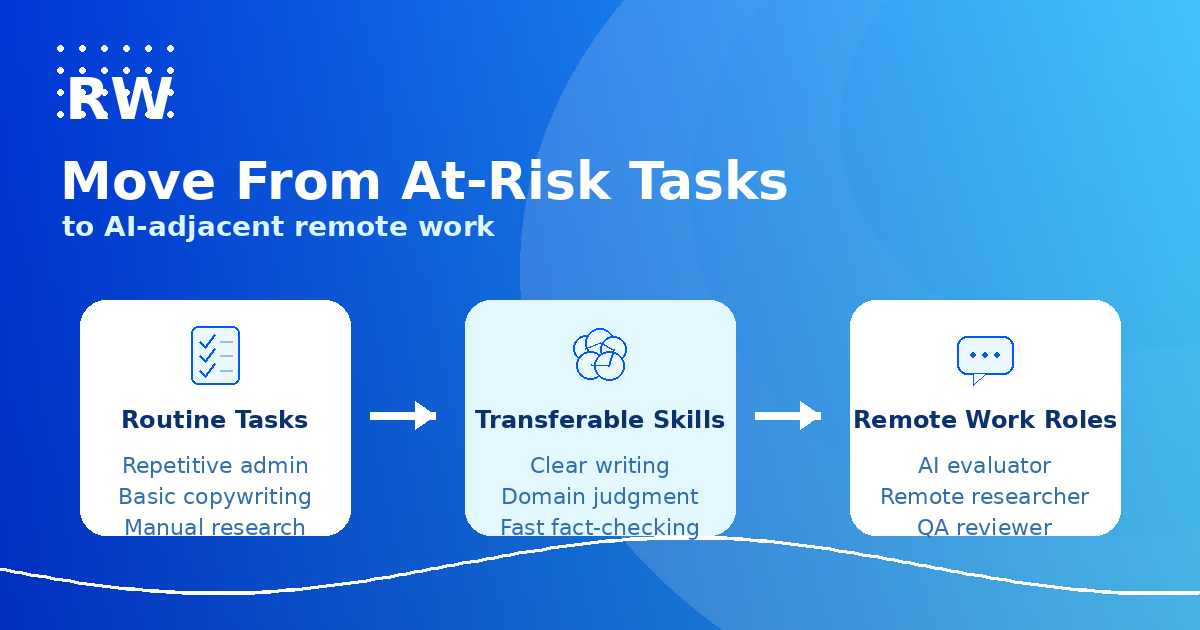
The Best Remote Work Shift: From Task-Doer to Quality Judge
If your current job involves writing, research, customer communication, analysis, operations, reviewing documents, training new employees, managing projects, checking details, or making judgment calls, you may already have skills that transfer into AI-adjacent remote work.
A traditional task-doer completes the work. A quality judge decides whether the work is correct, useful, safe, clear, and appropriate for the audience. That distinction matters because AI can generate a lot of output, but someone still has to decide whether that output is good. In many AI training and evaluation projects, the human worker is not competing with the model. The human worker is helping improve it.
This is where AI model evaluation, AI response rating, prompt evaluation, data annotation, search quality rating, content moderation, rubric-based review, and fact-checking come in.
Remote Roles to Consider If You Are Worried About AI Replacement
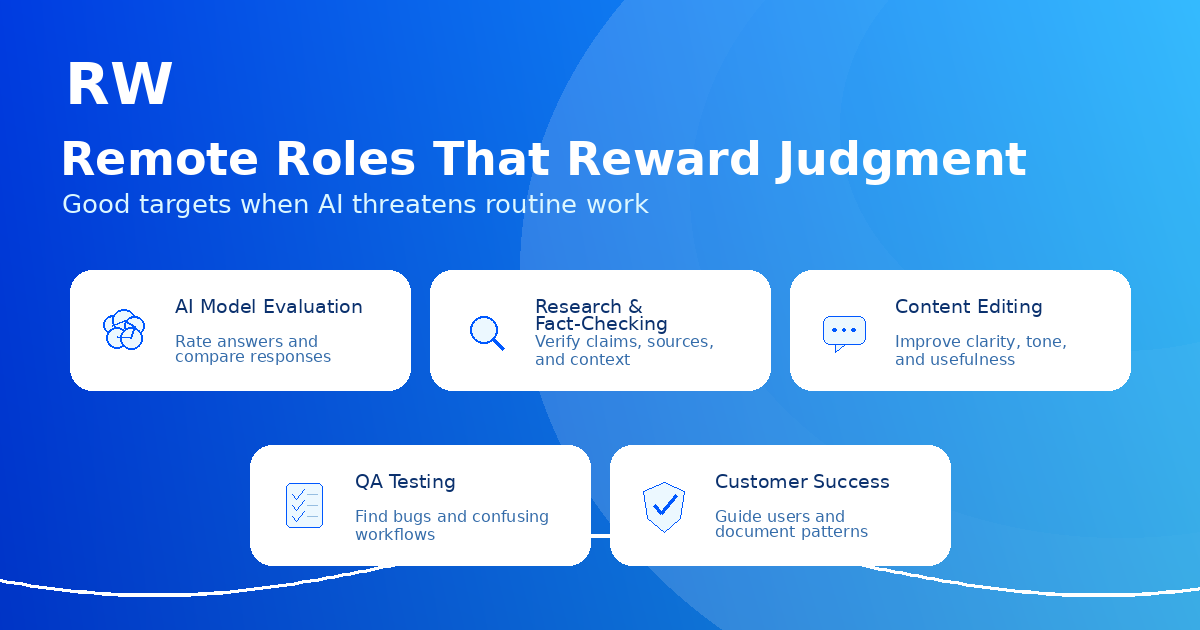
1. AI Model Evaluation and AI Training Jobs
AI model evaluation is one of the most direct paths for people who want to work near AI without becoming engineers. These roles may involve rating chatbot answers, comparing model responses, testing prompts, checking whether a response follows instructions, identifying hallucinations, or explaining why one answer is better than another.
This work can be a fit for writers, editors, researchers, teachers, consultants, analysts, legal professionals, finance professionals, marketers, medical professionals, engineers, coders, and strong generalists. Major AI companies and AI-related platforms connected to OpenAI, Anthropic, Google, Meta, xAI, Grok, and other model developers all depend on human feedback in some form.
2. Research and Fact-Checking Roles
AI makes research faster, but it also makes mistakes faster. Remote research jobs, fact-checking jobs, search quality evaluator roles, and AI accuracy review projects are strong fits for people who can verify information rather than simply collect it.
A good research worker does not just paste a question into a chatbot. They check whether the answer is supported, whether the source is credible, whether the conclusion is overstated, and whether important context is missing.
3. Content Editing and Response Improvement
Basic writing is easier to automate than high-quality editing. AI can draft, but it often needs a person to make the result more accurate, natural, concise, persuasive, or appropriate for the intended reader. Remote content editing, AI content review, response rewriting, prompt writing, and editorial QA roles can fit people who are strong with language.
4. QA Testing and Product Feedback
Quality assurance is another remote-friendly path because AI tools, apps, websites, and internal workflows all need testing. QA testers look for broken steps, confusing instructions, bad user experiences, edge cases, and inconsistent results. This can overlap with AI evaluation when the product being tested includes a chatbot, voice AI, automation tool, or recommendation system.
5. Customer Success, Support Operations, and Documentation
AI will automate parts of customer support, but companies still need people who can handle unclear problems, upset customers, complex accounts, onboarding, training, documentation, and process improvement. If your background is in customer service, sales support, account management, recruiting, operations, or admin work, look for remote roles that move you toward documentation, onboarding, support operations, help center content, or customer research.
Ready to find remote work that rewards your human judgment?
Join Remote Work Union Free →Do Not Chase Only One Platform or One Job Title
One mistake anxious workers make is looking for one perfect platform that will solve everything. That is risky. Remote work is more stable when you build an income stack: one primary path, several backup platforms, and a clear record of what you have applied for.
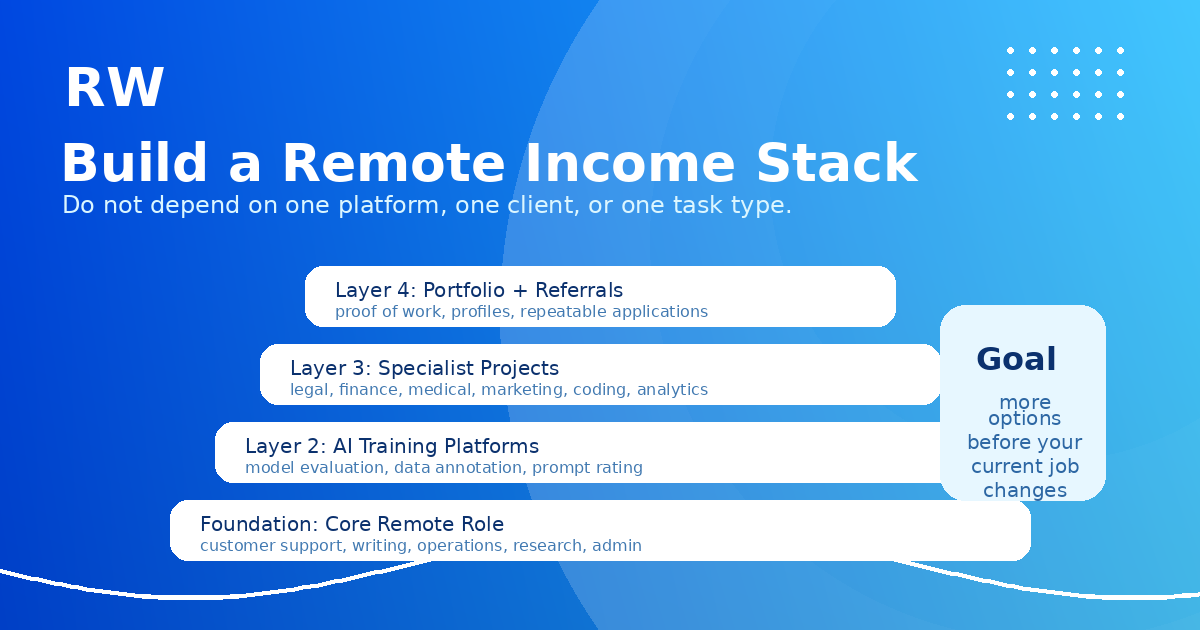
For example, someone worried about AI replacing their office job might apply to remote operations roles while also creating profiles on AI training platforms, testing data annotation projects, and learning how to write stronger applications for model evaluation work. A writer might combine content editing, prompt review, AI response rating, and SEO research. A finance professional might look for expert AI training projects, remote analyst work, and business operations roles.
How to Identify Which of Your Skills Are Still Valuable
Start with your current job and separate it into two lists. The first list is routine output: tasks that are repetitive, template-based, low-context, or easy to check. These are the tasks most exposed to automation. The second list is judgment work: tasks where you make decisions, resolve ambiguity, understand a customer, catch errors, manage tradeoffs, or know when something feels wrong.
Here are examples:
- If you write emails, your durable skill may be persuasive communication — not just typing.
- If you create reports, your durable skill may be knowing which numbers matter — not just formatting.
- If you answer customer questions, your durable skill may be handling exceptions and explaining products clearly — not just answering simple tickets.
- If you manage projects, your durable skill may be getting people aligned when the plan changes — not just updating tasks.
Use the language of judgment work in your remote work profiles and applications. Instead of "administrative assistant," say you are strong in documentation, scheduling, customer communication, process organization, CRM accuracy, and AI-assisted workflow support.
A Practical 30-Day Plan for People Worried About AI
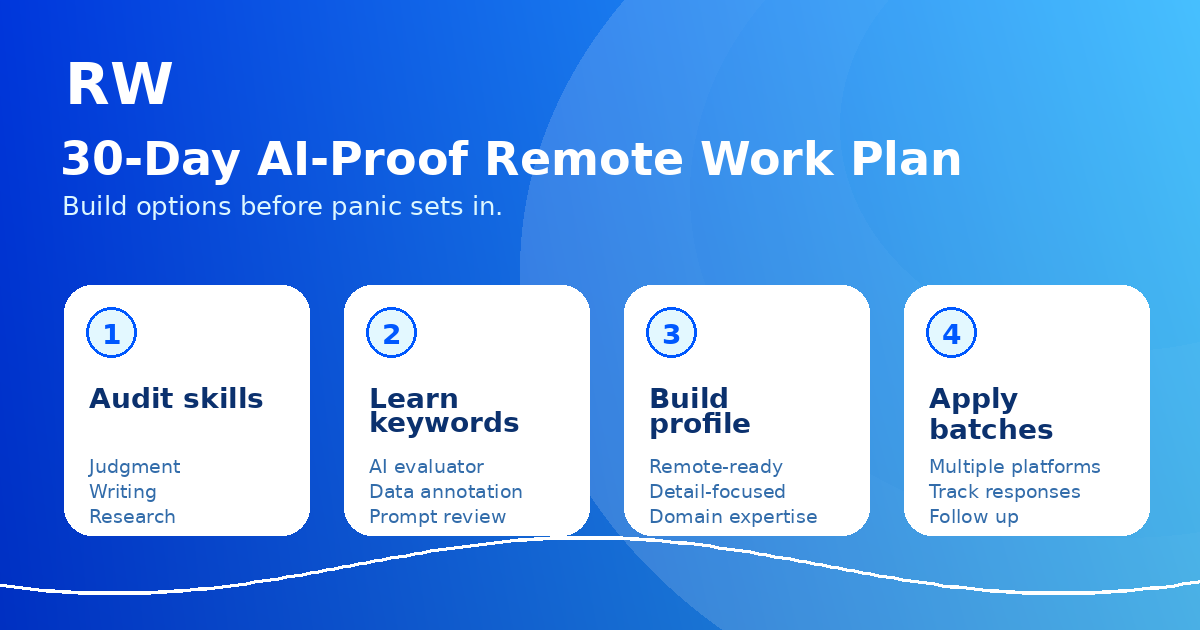
Week 1 — Audit your skills: Write down the work you have done, the tools you have used, the industries you understand, and the problems people usually ask you to solve. Highlight anything involving writing, research, review, customer judgment, quality control, compliance, training, sales, operations, or subject-matter expertise.
Week 2 — Learn the language: Search for job descriptions using terms like AI evaluator, AI trainer, AI data annotation, model response reviewer, prompt evaluator, search quality rater, content quality analyst, remote researcher, QA tester, AI content editor, and human feedback reviewer. You are learning how companies describe the skills you already have.
Week 3 — Build or update your remote work profile: Lead with the skills that matter for remote AI jobs: clear written communication, accuracy, attention to detail, independent work, strong reasoning, reliable availability, and any industry expertise. If you have experience in law, finance, healthcare, coding, education, marketing, sales, or operations, make that obvious.
Week 4 — Apply in batches: Apply to several relevant roles, track responses, improve your profile, and follow up where appropriate. A small number of focused applications every week is better than panic-applying once and quitting.
What Makes a Worker Harder to Replace
The workers who adapt best are not the people who pretend AI does not exist. They are the people who learn to work with it while staying responsible for the final result. AI can generate an answer, but it cannot take accountability in a workplace. It cannot fully understand a company culture, a customer relationship, a legal risk, a brand reputation, or a subtle communication problem the way a trained person can.
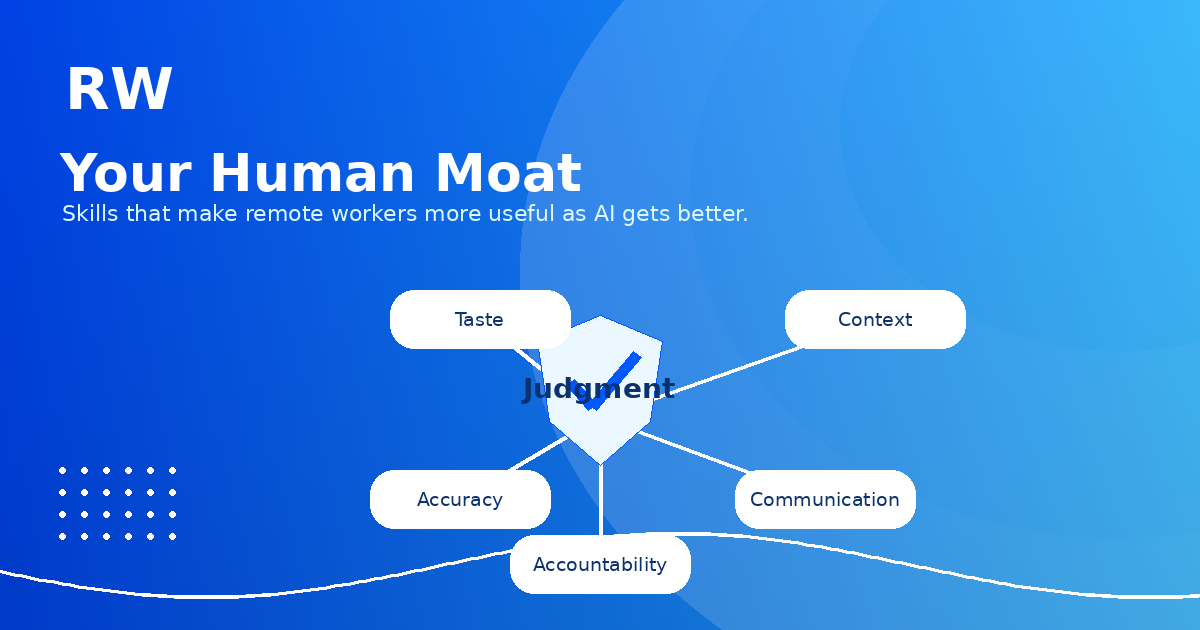
Your human moat is the combination of judgment, taste, context, accuracy, communication, and accountability:
- Judgment — you can choose between options
- Taste — you know what good work looks like
- Context — you understand the situation beyond the prompt
- Accuracy — you verify instead of guessing
- Communication — you can explain your reasoning
- Accountability — someone can trust you with work that matters
These traits are especially valuable in remote jobs because remote teams cannot watch you all day. They need people who can read instructions, ask smart questions, document decisions, meet deadlines, and produce work that does not create more work for everyone else.
FAQs
Will AI replace remote work jobs?
AI is more likely to automate specific tasks within jobs than entire roles at once. The first risk is task compression — a company may need fewer people to do the same routine work. Roles that require judgment, context, communication, accountability, and specialized knowledge are harder to automate.
What remote jobs are hardest for AI to replace?
Roles that require human judgment, context, and accountability are more durable. These include AI model evaluation, research and fact-checking, content editing and response improvement, QA testing, customer success, documentation, and any role requiring domain expertise in law, finance, healthcare, education, or business.
How do I get started with AI evaluation work?
Start by auditing your existing skills for judgment-based work: writing, research, review, customer communication, quality control, industry expertise. Then learn the language of AI-adjacent roles by reading job descriptions for AI evaluator, AI trainer, model response reviewer, and prompt evaluator positions. Apply to platforms like micro1, Mercor, Handshake AI, and Outlier AI.
What is the human moat in remote work?
The human moat is the combination of judgment, taste, context, accuracy, communication, and accountability that makes a worker hard to replace. AI can generate output, but it cannot fully take accountability for results, understand organizational nuance, or be trusted with work that requires human responsibility.


