Remote work in Ghana is not limited to software engineering. Many of the best work from home jobs now pay for writing, research, judgment, operations, customer support, editing, translation, data quality, and AI model evaluation. That matters because a Ghana-based applicant does not need to wait for a traditional local office job to start earning online. The better strategy is to apply for roles that are remote-first, skill-based, and open to international or worldwide applicants.
This guide is written for people in Accra, Kumasi, Takoradi, Tamale, Cape Coast, Tema, and anywhere else in Ghana who want to apply from home. It focuses on legitimate remote work jobs — not survey apps, reshipping schemes, fake WhatsApp jobs, or roles that ask you to pay before you can work. It also focuses heavily on remote AI jobs because AI companies and AI platforms need people who can evaluate outputs, write prompts, check facts, review answers, label data, and explain why one response is better than another.
The key is to think like a remote applicant, not just a job seeker. You need a clear profile, a strong application, proof of skill, stable internet, a realistic payment plan, and a way to track every platform you apply to. If you do those things, Ghana can be a practical base for remote work.
What remote work from Ghana actually means
Remote work from Ghana can mean several different things. Some people want a full-time employee job with one company. Others want contract work, freelance projects, part-time remote jobs, or task-based platform work. The application process is different for each one, so it helps to separate them before you apply.
A full-time remote job usually has a long interview process, fixed hours, a manager, a contract, and regular pay. These jobs can be harder to get internationally because some companies restrict hiring to specific countries for payroll, legal, tax, or time zone reasons. Freelance work is more flexible. You may write articles, manage social media, edit content, build spreadsheets, provide customer support, or help a business with admin work. Platform-based AI work is different again. You apply to a platform, pass assessments, and then receive projects when your skills match available tasks.
For many beginners in Ghana, the best approach is not to choose one path only. Apply to remote job boards for stable roles, freelance platforms for client work, and AI training platforms for flexible skill-based projects. One platform can pause. One client can disappear. A multi-platform setup gives you more chances to keep steady work.
Best remote work jobs in Ghana to target first
The strongest remote jobs for Ghana-based applicants are usually the ones that do not require a local license, physical presence, or a company phone system. These roles reward clear communication, attention to detail, judgment, and reliability.
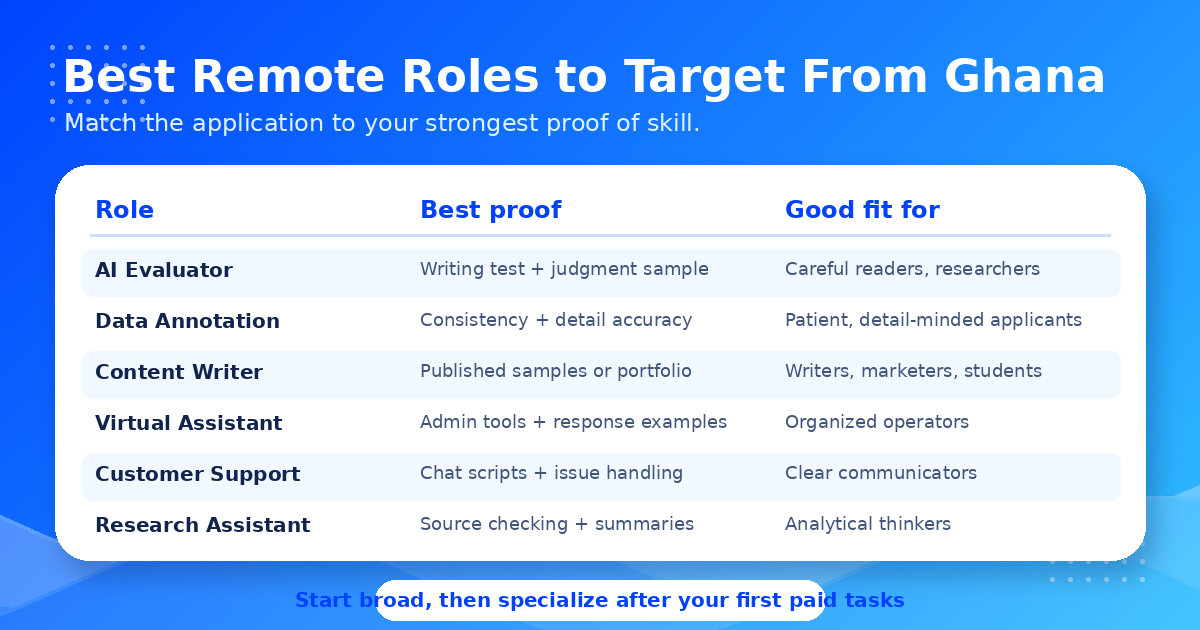
AI evaluator and AI training jobs are among the most important categories to understand. In these roles, you might compare two AI responses, check whether an answer is accurate, write prompts, review chatbot replies for safety, label text, rate reasoning, or explain why a model made a mistake. These jobs can be called AI trainer, AI evaluator, AI data annotator, AI reviewer, search quality rater, prompt writer, model response evaluator, or AI content specialist.
Writing and editing jobs are also strong targets. Many businesses need blog posts, product descriptions, newsletters, landing pages, social captions, proofreading, and content updates. A Ghana-based writer can compete well if the application includes clean samples and a clear niche, such as finance, health, education, technology, music, travel, business, or AI.
Virtual assistant and operations roles are another practical category. These jobs may include inbox management, scheduling, data entry, CRM updates, lead research, document formatting, spreadsheet cleanup, customer follow-ups, and project coordination. They are especially useful for applicants who have office, admin, school, nonprofit, church, retail, banking, telecom, education, or customer service experience.
Customer support jobs can also work, but applicants should be selective. Phone support roles may require a quiet environment, specific hours, strong internet, and sometimes country-specific calling tools. Chat support, email support, community moderation, ticket support, and no-phone support roles are often better fits for remote applicants who want flexible work from home.
Research assistant roles are underrated. AI companies, content teams, investors, marketing agencies, and founders need people who can find information, verify sources, summarize documents, compare options, build lists, and turn messy research into usable notes. If you are patient and careful, research can be one of the best paths into higher-quality remote work.
Why remote AI jobs are a strong fit for many Ghana-based applicants
Remote AI jobs are growing because AI systems still need human judgment. A model can generate an answer quickly, but people are needed to decide whether that answer is accurate, useful, safe, complete, and appropriate for the user. That is why AI training work is not only for coders. It can be a fit for writers, teachers, researchers, students, lawyers, finance professionals, marketers, customer support workers, translators, editors, doctors, engineers, and generalists with strong reading skills.
The biggest AI companies and model builders — including OpenAI, Anthropic, Google, Meta, and Grok — create demand for better AI evaluation, data quality, safety review, multilingual support, and expert feedback. Many workers do not contract directly with those companies. Instead, work often flows through AI training platforms, vendors, evaluation marketplaces, and specialist contractors. That is why your application should focus less on the famous company name and more on the actual task: can you evaluate, explain, write, research, compare, and follow instructions?
A good AI training applicant does not simply say "I want remote work." A good applicant says "I can evaluate written answers, identify factual errors, explain reasoning clearly, follow rubrics, and submit consistent work." That is the difference between a weak application and one that looks useful to a platform.
How to apply for remote work from Ghana
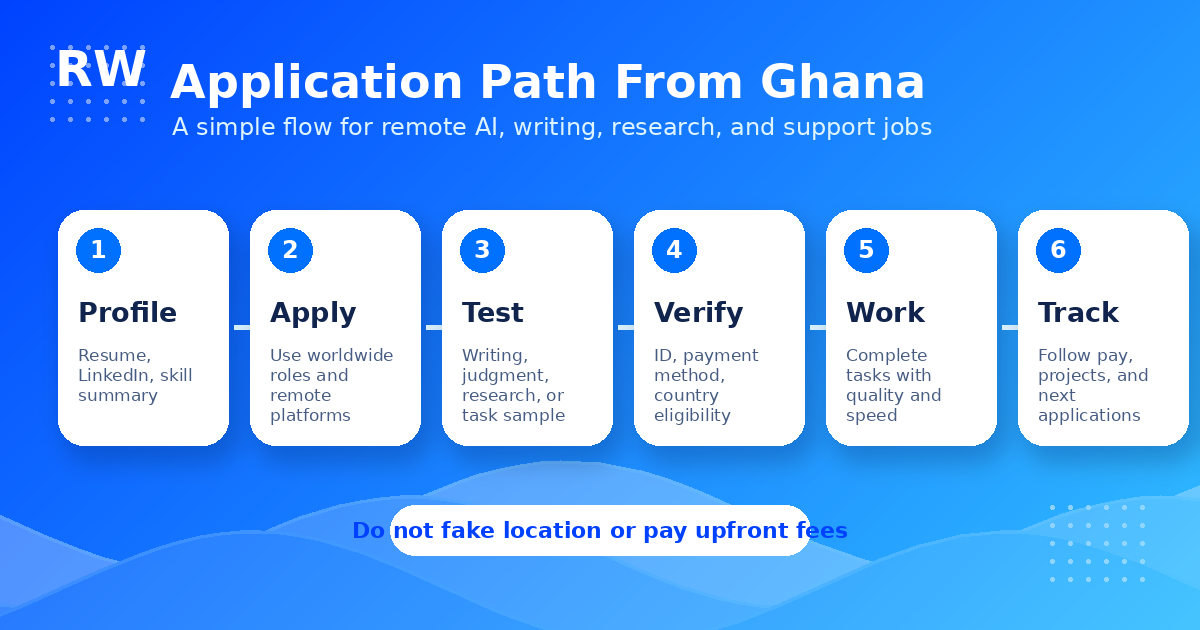
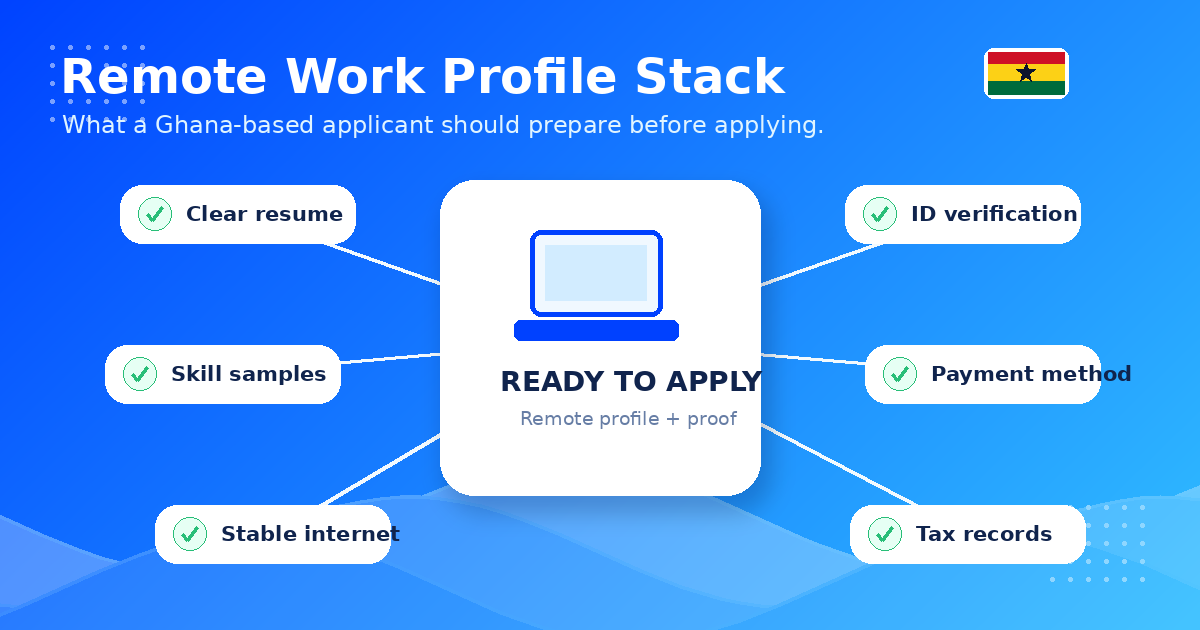
Start with your remote work profile. Use one professional email address, one updated resume, one LinkedIn profile, and one short skills summary. Your profile should clearly state your location, time zone, strongest skills, education or work background, tools you can use, and the type of work you want. Do not make the profile too broad. "I can do anything" is less convincing than "I can write, edit, research, check facts, manage spreadsheets, and review AI outputs."
Next, prepare a resume built for remote work. The resume should include remote-friendly keywords: AI training, AI evaluation, data annotation, research, content writing, content editing, quality review, customer support, virtual assistant, project coordination, Google Workspace, Microsoft Office, Slack, Notion, Airtable, Canva, ChatGPT, prompt writing, fact-checking, and online communication. Only include tools you can actually use. Recruiters and platforms often scan for keywords, but you still need to pass assessments after the resume is reviewed.
Then apply through multiple channels. Use RemoteWorkUnion.com to find roles hiring now. Also use major job boards, remote-specific boards, freelance marketplaces, and AI training platforms. Search terms like "remote AI evaluator," "AI data annotation," "online writing jobs," "virtual assistant remote," "remote research assistant," "chat support remote," "content editor remote," "prompt writer," and "worldwide remote jobs" can surface the right opportunities. When a platform asks whether you are eligible from Ghana, answer honestly. Do not use a VPN or fake location to access a role that is not available in your country.
When you apply, write like someone who understands the work. Instead of saying "I am hardworking and need a remote job," say "I have strong written English, can compare AI responses using rubrics, can check factual claims against sources, and can explain quality issues clearly." For support roles, emphasize response quality and reliability. For writing roles, include samples. For research roles, include a source-based summary. For virtual assistant roles, include a list of tools and a short example of how you organize tasks.
Finally, track everything. Create a simple spreadsheet with the platform or company, role title, date applied, country eligibility, payment method, assessment status, login email, follow-up date, and notes. Remote applications are easy to lose track of because many platforms respond slowly or only send projects later. A tracker prevents duplicate applications and helps you see what is actually working.
Where to find remote jobs that may accept Ghana-based applicants
No single job board is enough. Some jobs are US-only, UK-only, Canada-only, or restricted to payroll countries. Others are worldwide, contract-based, or open to applicants who can work asynchronously. Your search should include several categories.
Start with remote job boards and general job sites. Search for roles marked worldwide, international, contractor, freelance, or remote anywhere. Use filters carefully. If a role says "remote" but lists a city or country requirement, read the details before applying. Many jobs are remote within one country only.
AI training platforms are worth testing because many projects are skill-based. Examples of platforms and marketplaces people commonly research include Handshake AI, Mercor, micro1, Outlier AI, DataAnnotation-style platforms, search quality projects, and specialized annotation vendors. Availability changes by country, skill, language, project demand, and verification requirements, so check each platform directly before assuming you qualify.
Freelance marketplaces can also work, but they require patience. The first client is usually the hardest. Start with a focused offer: blog editing, AI content review, data cleanup, spreadsheet formatting, customer email templates, social media scheduling, research summaries, transcription review, or virtual assistant support. A focused offer is easier to sell than a generic profile.
Ready to apply? Find remote AI training platforms accepting Ghanaian applicants on RemoteWorkUnion.com.
Find Roles Hiring Now →How to apply with no remote work experience
No experience does not mean no skills. Many Ghana-based applicants already have useful experience from school, internships, customer service, teaching, sales, church administration, student organizations, banking, telecom, writing, social media, or small business operations. The mistake is failing to translate that experience into remote work language.
If you have school experience, turn it into research, writing, deadlines, presentations, and analysis. If you have customer service experience, turn it into ticket handling, empathy, response quality, escalation, and problem solving. If you have sales experience, turn it into lead research, CRM updates, outreach, and follow-up. If you have teaching experience, turn it into explanation, grading, feedback, and curriculum review. If you have social media experience, turn it into content calendars, caption writing, audience research, and performance review.
Build proof before you apply. Create one writing sample, one research summary, one spreadsheet sample, one customer support response sample, and one AI evaluation sample. These do not need to be paid client work. They need to show that you can think clearly and produce clean work. A simple portfolio folder can make a beginner look much more credible.
Ghana-specific setup: internet, power, payments, tax, and data protection
A remote job depends on reliability. Before applying heavily, test your internet speed, make sure your laptop can handle browser-based work, set up a backup data option, and create a quiet workspace. If power interruptions are common where you live, plan for charging, mobile hotspot access, or a backup location. You do not need a luxury setup, but you do need a setup that lets you meet deadlines without constant excuses.
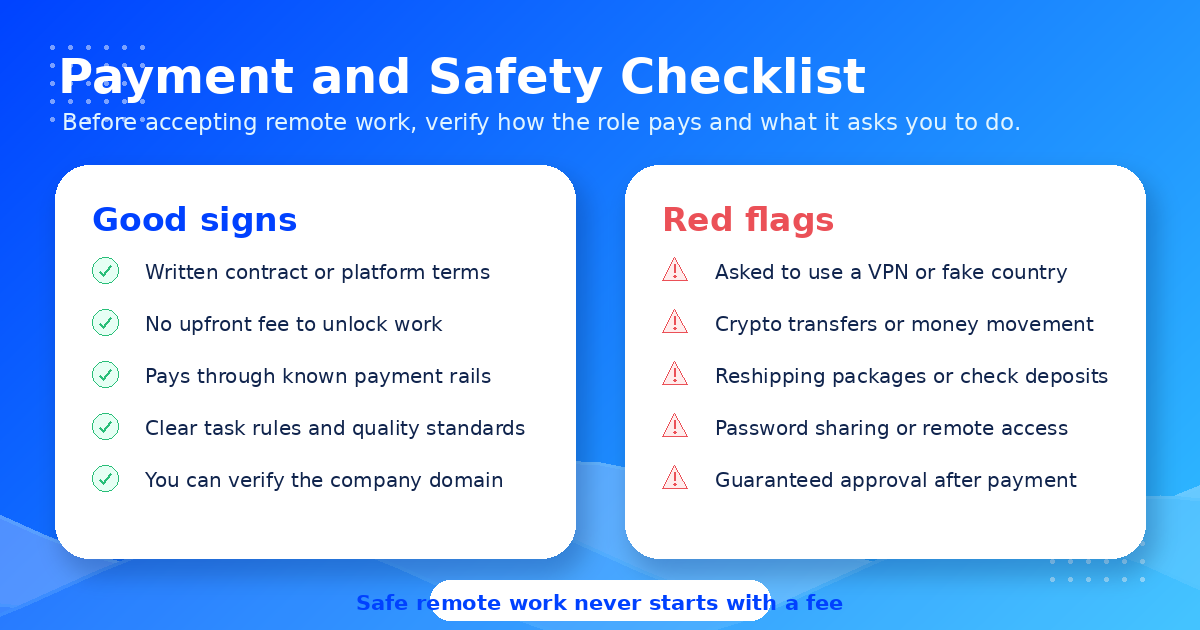
Payment setup matters. Different platforms use different payment methods, and eligibility can vary. Before spending hours on an application, check whether the platform pays workers in Ghana and what identity or banking information it requires. Keep screenshots or notes of payment terms, minimum payout amounts, fee schedules, and payout timing. Never accept a job that asks you to move money for someone else, receive unknown funds, process crypto, deposit checks, or reship goods.
Tax planning also matters. Ghana Revenue Authority materials describe personal income tax as applying to income from employment, business, and investment, and they provide online options for filing and payment. Remote workers with meaningful income should keep records of invoices, platform payouts, bank deposits, fees, and business expenses, then confirm their obligations with the GRA or a qualified tax professional. This guide is not tax advice.
Data privacy matters as well. Ghana has a Data Protection Act and a Data Protection Commission. If a remote role gives you access to customer records, personal data, health data, financial data, private documents, login credentials, or internal company materials, treat that information carefully. Do not store client data casually on shared devices. Do not post screenshots of private work. Do not use client information in a portfolio unless you have permission.
How to write a stronger application
A strong remote application is specific. It proves you understand the task and gives the reviewer a reason to trust you. Weak applications talk mostly about needing work. Strong applications talk about the work itself.
Here is a simple structure: first, name the role and your relevant skill. Second, give proof. Third, explain how you work remotely. Fourth, close with availability and willingness to complete an assessment.
Example application paragraph: "I am applying for remote AI evaluation and content review work. I have strong written English, experience researching topics online, and the ability to compare answers against instructions. I can identify unsupported claims, unclear explanations, tone problems, and formatting issues. I am comfortable using Google Docs, spreadsheets, Slack-style communication, and browser-based platforms. I am based in Ghana and can work independently with clear deadlines. I am ready to complete any writing, research, or evaluation assessment required."
That paragraph is not complicated, but it is much better than a generic application. It uses remote work keywords, explains the applicant's value, and directly matches the kind of work that AI training platforms and remote teams need.
Common mistakes to avoid
The first mistake is applying to everything without reading eligibility. Remote does not always mean worldwide. Apply where you are genuinely eligible, and move on quickly when a role is restricted.
The second mistake is using a vague resume. A resume that says "hardworking, punctual, team player" does not show whether you can write, edit, research, evaluate, annotate, or support customers. Replace vague language with proof of skills and tools.
The third mistake is ignoring assessments. Many AI training platforms care more about your test than your resume. Slow down during assessments. Follow instructions exactly. Explain your reasoning. Do not use AI to write answers when the platform is testing your own judgment.
The fourth mistake is accepting unsafe work. If a job asks for a fee, a password, your bank account for transfers, crypto movement, package reshipping, or a fake identity, leave. Legitimate remote work pays you for work. It does not make you pay to prove you deserve work.
A practical 30-day plan for Ghana-based applicants
Week 1: Build your application base. Update your resume, write a remote profile summary, create a simple portfolio folder, list your strongest skills, and set up an application tracker. Prepare one writing sample, one research sample, and one remote support sample.
Week 2: Apply broadly but carefully. Apply to a mix of AI training platforms, writing roles, virtual assistant roles, research roles, and support roles that appear open to international applicants. Do not spend the entire week on one platform. The goal is to create multiple chances.
Week 3: Take assessments and improve your samples. If an assessment is difficult, note what it tested. Was it grammar, reasoning, factual accuracy, instructions, speed, or attention to detail? Improve that skill and reuse the lesson on the next application.
Week 4: Follow up and specialize. Look at your tracker. Which applications moved forward? Which roles ignored you? Which samples seemed strongest? Choose two or three categories to focus on next month. Remote work becomes easier when you stop applying randomly and start building a repeatable system.
Frequently Asked Questions
Can I get remote work from Ghana?
Yes, but you need to focus on roles that are open to Ghana-based, international, worldwide, contractor, or freelance applicants. Always check each company's eligibility rules before investing time in the application process.
Do I need a degree for remote work in Ghana?
Not always. A degree can help, especially for expert, research, finance, legal, science, technical, or education roles. But many remote jobs care more about writing ability, task quality, reliability, and assessment performance than formal credentials.
Are AI training jobs only for coders?
No. Some AI jobs require coding, but many AI evaluation, writing, annotation, and content review roles are designed for non-technical professionals with strong reading and reasoning skills. Writers, researchers, teachers, marketers, and other professionals can qualify.
Can I do remote work from my phone?
A phone can help you communicate, but most serious remote jobs require a laptop or desktop. Assessments, writing, spreadsheets, research, and platform work are much easier and more reliable on a computer.
How many platforms should I join?
Beginners should test several, not just one. A good target is three to six serious platforms or job channels, then double down on the ones that respond or provide assessments. Depending on a single platform is risky because work can pause or slow down.