Remote work jobs in Kenya are real, but the best opportunities rarely look like the old internet ads promising easy money. The stronger path is more practical: build a clear remote work profile, apply to platforms that accept worldwide or Kenya-based applicants, avoid anything that asks you to pay first, and target jobs where your English, judgment, research ability, writing, subject knowledge, or attention to detail can be evaluated online.
For Kenyan applicants, the remote work market is especially relevant because many global companies now need distributed workers for AI training, AI evaluation, data annotation, content review, research, customer support, virtual assistance, design, and technical support. Some roles are freelance. Some are contract. Some are part-time. Some can eventually become full-time remote jobs. The key is knowing which categories are worth pursuing and which ones are mostly noise.
This guide focuses on legitimate online work, not hype. It is written for someone in Kenya who wants to earn from home or from anywhere with a reliable laptop and internet connection. It also focuses on work that can compound: remote AI jobs, writing jobs, research jobs, online support, operations work, and specialized reviewer roles that reward accuracy instead of begging for clicks.
The remote work market in Kenya is bigger than one platform
A common mistake is treating remote work like a single website. A better way to think about it is as a system. You want a few types of opportunities running at the same time: AI training platforms, freelance marketplaces, remote job boards, direct company applications, and local digital-work programs. If one source slows down, another can keep you moving.
Kenya also has public digital work infrastructure, including Ajira Digital, which is connected to the Ministry of Information, Communications and the Digital Economy. These programs do not replace private platforms, but they are useful signals that online work and digital outsourcing are not fringe ideas. They are part of a broader employment and skills-development push.
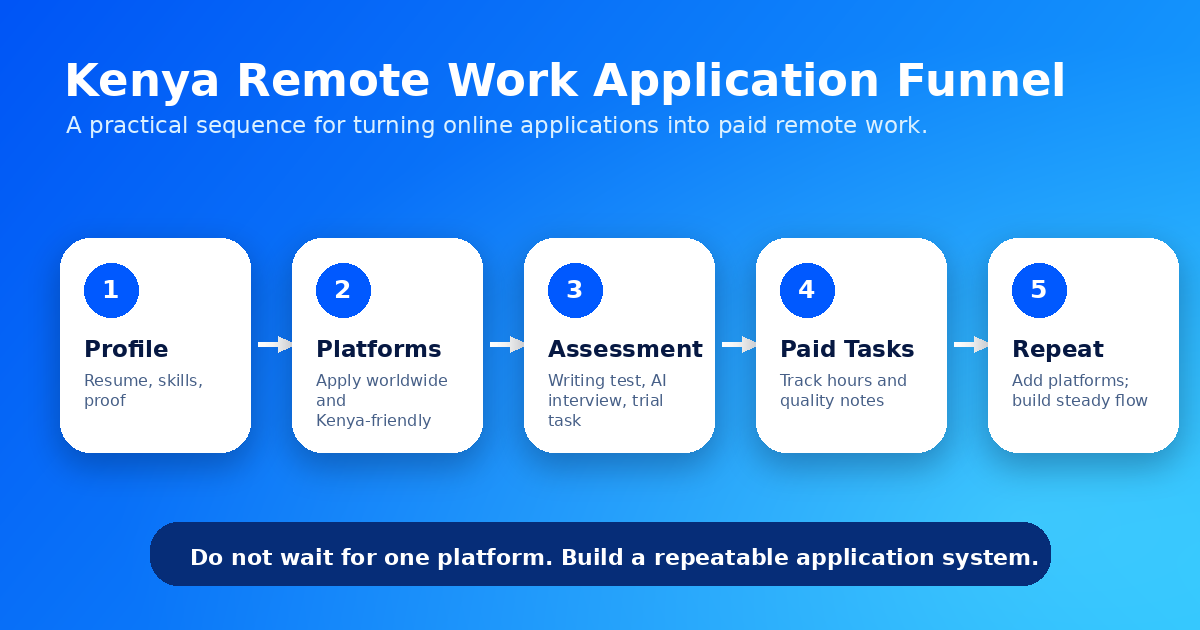
Still, the best remote workers do not wait for a program to hand them a job. They build an application stack. That means they have a clean resume, a profile that explains what they can do, examples of their work, a spreadsheet of applications, and a rule against paying anyone who claims they can unlock a job.
Best remote work jobs in Kenya to start with
The best job category depends on your skills. A beginner should not chase every online job. The goal is to find the role where you can prove quality quickly.
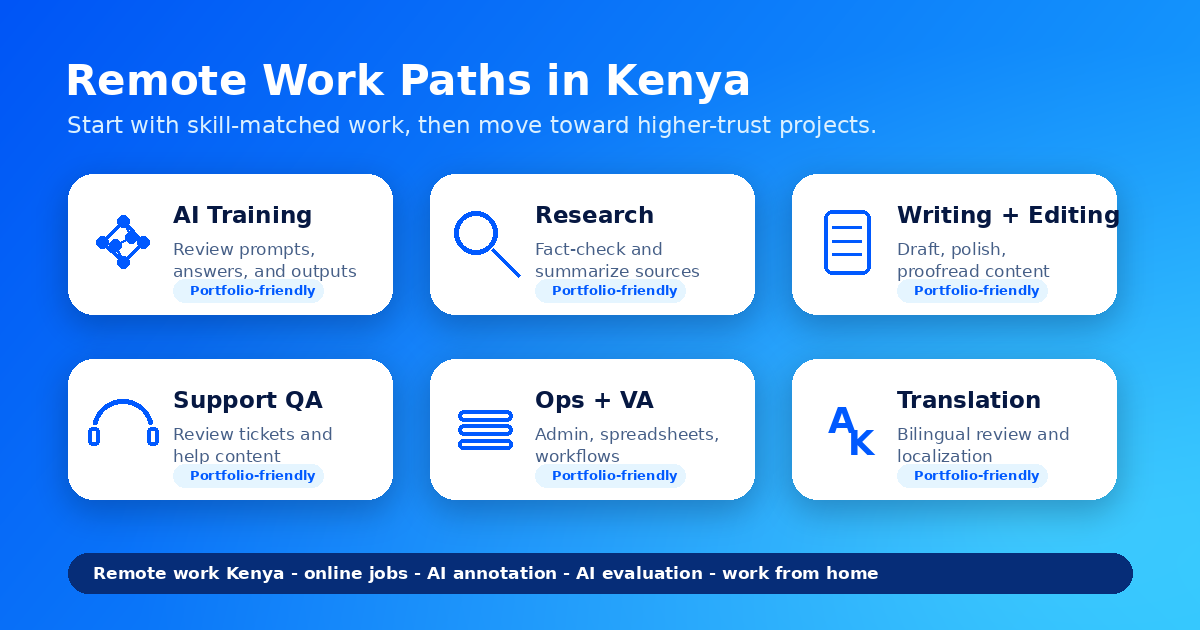
AI training and AI evaluation are some of the most important remote categories for non-technical applicants. In these roles, workers review AI answers, compare model responses, label data, write prompts, fact-check outputs, judge whether an answer follows instructions, or explain why one answer is better than another. These jobs can be called AI evaluator, AI trainer, AI data annotator, AI content reviewer, prompt evaluator, search quality rater, or model response reviewer. The work may support AI systems built by major companies such as OpenAI, Anthropic, Google, Meta, and Grok, usually through vendors, contractors, and specialized platforms rather than direct employment with the AI company.
Writing and editing jobs are another strong fit. Many remote platforms need people who can write clearly, edit messy drafts, improve grammar, structure articles, summarize documents, and check whether text sounds natural. For Kenyan applicants with strong English, this can be a practical entry point. You do not need to call yourself a novelist. You need to show that you can produce clean, useful writing.
Research and fact-checking jobs are good for people who like verifying information. These roles may involve finding sources, checking claims, comparing documents, summarizing market information, or reviewing AI-generated answers for accuracy. If you are careful and skeptical, this is a real advantage.
Data annotation jobs are a common starting point. Some tasks involve labeling images, categorizing text, tagging search results, reviewing audio, or checking whether data belongs in a certain category. The work can be repetitive, but it helps beginners build a remote work history.
Virtual assistant and operations jobs can work well for organized applicants. These roles include email support, calendar support, data cleanup, spreadsheet work, CRM updates, project tracking, and administrative coordination. The strongest applicants show that they are reliable, responsive, and comfortable with tools like Google Workspace, Microsoft Office, Airtable, Notion, Slack, Zoom, and ChatGPT.
Customer support jobs are available, but not all are equal. Some require phone calls and fixed shifts. Others are chat, email, help desk, or quality assurance roles. If you want no-phone remote work, search specifically for email support, chat support, customer operations, help desk analyst, support QA, community support, and trust and safety roles.
Translation and localization work can be useful for bilingual or multilingual applicants. English plus Swahili can be relevant, but competition varies by platform and project. The broader opportunity is language quality review: checking whether translated content sounds natural, identifying errors, and reviewing local context.
Design, social media, and content operations jobs can also be legitimate, especially for applicants who can show examples. Instead of saying you are creative, build a small portfolio with sample graphics, captions, content calendars, ad variants, landing page copy, or social media audits.
Where Kenyan applicants should look for remote online work
Start with platforms that make the application process clear. For AI training and reviewer work, check platforms such as micro1, Mercor, Handshake AI, Outlier, DataAnnotation-style platforms, Remotasks-style platforms, and other AI evaluation companies that list contractor projects. Availability changes often, so the safest habit is to search by role type, not by one company name.
Use search terms like remote AI evaluator, AI trainer, AI data annotation, prompt evaluator, search quality rater, AI content reviewer, language model evaluator, fact-checking contractor, and remote research assistant. Add Kenya, worldwide, global, international, remote, or contractor to narrow the results.
For freelance work, marketplaces such as Upwork and Fiverr can be useful, but they are not instant. They reward proof, niche positioning, and patience. A weak profile that says "I can do anything" usually performs poorly. A stronger profile says, for example, "I help AI teams and startups with research summaries, data cleanup, and content review." That gives buyers a reason to choose you.
For remote job boards, search for worldwide remote roles and Africa-friendly roles. Use LinkedIn, Wellfound, Remote OK, We Work Remotely, FlexJobs, Remotive, Working Nomads, and company career pages. Filter carefully. Many listings say remote but are limited to the US, UK, EU, or a specific time zone. Do not waste hours applying to jobs that clearly exclude Kenya.
Use local and official resources as support, not your only plan. Ajira Digital can be a useful place to learn about online work, training, and digital job pathways. But your strongest strategy is still to build a profile and apply widely.
How to know if an online job is legit
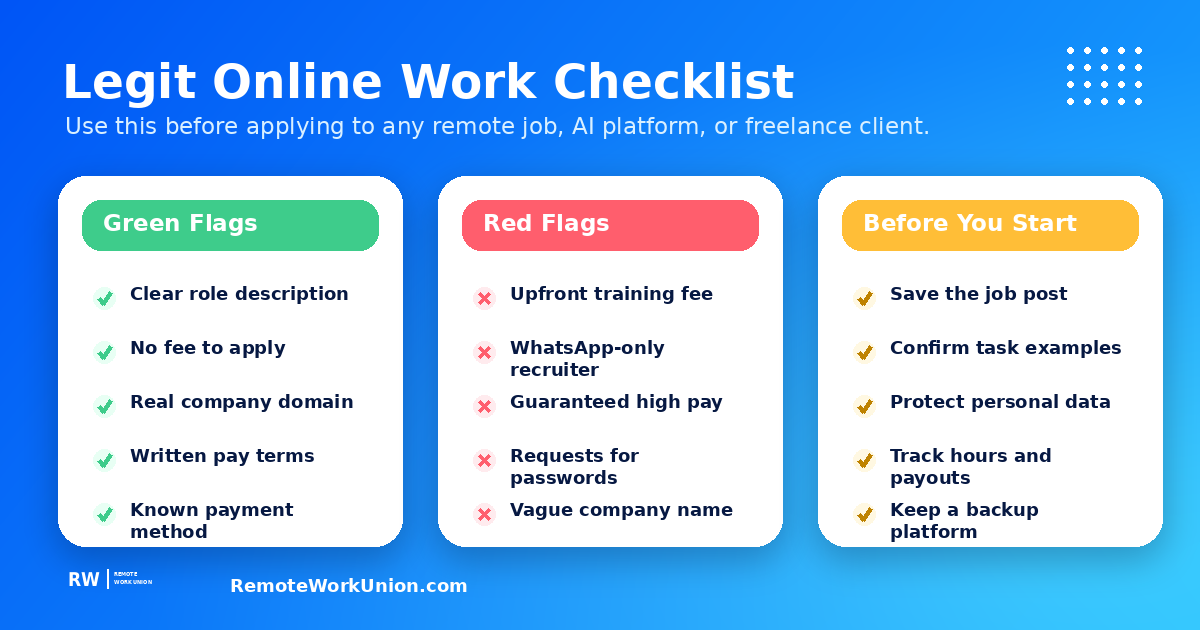
A legitimate remote job does not require you to pay to apply. It does not ask for your bank password. It does not require you to buy a starter kit. It does not promise guaranteed high earnings with no skill, no assessment, and no work sample.
Green flags include a real company domain, a clear job description, written pay terms, a defined application process, a contract or platform agreement, realistic task examples, and a payment method you can verify before starting. A legitimate platform may ask for identity verification or tax information, but it should explain why and use secure systems.
Red flags include WhatsApp-only recruiters, copied job posts, fake screenshots of earnings, pressure to pay quickly, requests for crypto deposits, vague company names, unrealistic promises, and recruiters who refuse to answer basic questions. Be especially careful with anyone who says they can guarantee approval on micro1, Mercor, Handshake AI, or any AI training platform if you pay them. That is not how serious remote platforms work.
Before you start a project, save the job post, screenshot the pay terms, confirm how payment works, confirm the expected workload, and keep a private record of completed tasks. This matters because remote work can be flexible, but it can also be inconsistent. Documentation protects you.
Ready to apply? Find remote AI training platforms currently accepting Kenyan applicants on RemoteWorkUnion.com.
Find Roles Hiring Now →Build a profile that looks credible in five seconds
Remote hiring is fast. A reviewer may only spend a few seconds deciding whether your profile deserves more attention. Your first job is to make the obvious things obvious.
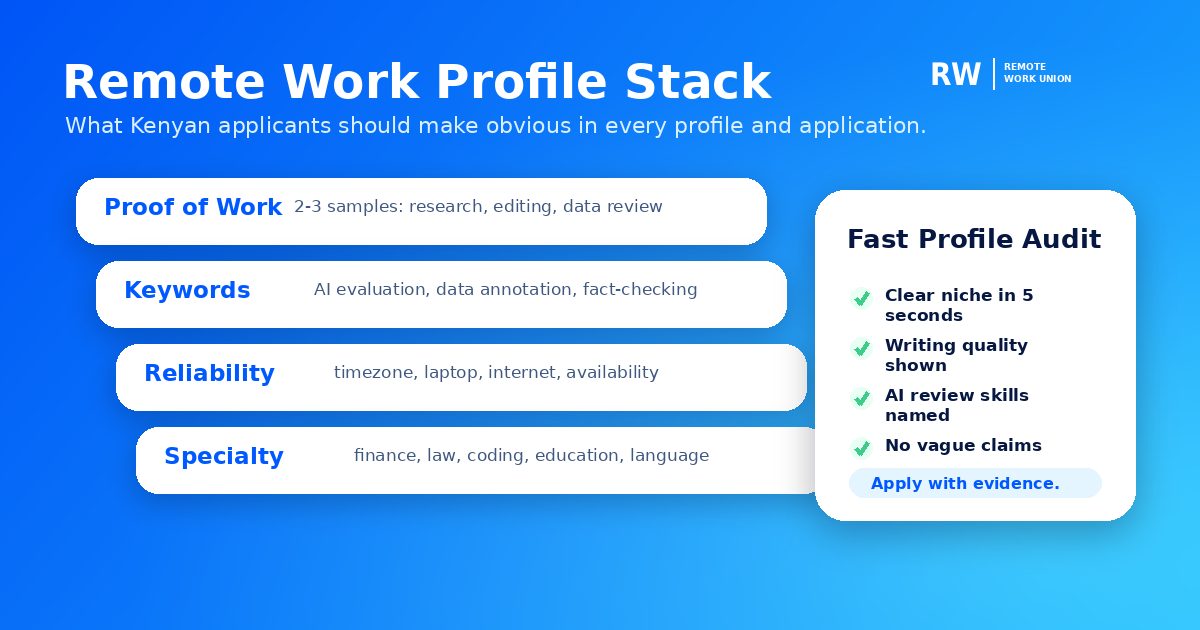
Your profile should state your strongest remote-work category near the top. Examples: AI content reviewer, research assistant, data annotation specialist, English editor, virtual assistant, customer support QA, or social media content coordinator. Do not lead with generic phrases like hardworking, passionate, or ready to learn. Those can be true, but they do not tell the reviewer what work you should receive.
Add proof. If you want research work, include a short research sample. If you want writing work, include a before-and-after edit or a short article sample. If you want AI evaluation work, create a sample showing how you would compare two AI answers and explain which one is better. If you want virtual assistant work, show a sample spreadsheet, project tracker, or workflow checklist.
Use keywords naturally. Strong profile keywords include remote work, AI evaluation, AI training, data annotation, prompt writing, content review, fact-checking, research, English editing, quality assurance, customer support, virtual assistant, operations, spreadsheet management, and attention to detail. Do not stuff keywords randomly. Use them where they describe your actual skills.
Mention your setup briefly. A reliable laptop, stable internet, quiet work environment, availability window, time zone, and communication tools can all help. Do not overexplain. The point is to remove doubt.
A simple seven-day plan for finding remote work from Kenya
Day one: Choose two job categories. Do not chase ten. Pick one primary category and one backup category. For example: AI evaluation plus research, or virtual assistant plus customer support QA.
Day two: Rebuild your resume for remote work. Put skills and proof near the top. Add a short summary that names the exact roles you want. Remove irrelevant details that make the resume look unfocused.
Day three: Create two work samples. Keep them simple. A research summary, edited article, AI answer comparison, spreadsheet cleanup sample, or customer support response sample is enough to start.
Day four: Apply to AI training and evaluation platforms. Search for micro1, Mercor, Handshake AI, Outlier, and other remote AI reviewer platforms. Check whether each role accepts applicants in Kenya or worldwide. If the application is closed, save the platform and check again later.
Day five: Apply to ten remote job listings. Use LinkedIn and remote job boards. Filter for worldwide, contractor, Africa-friendly, and remote-first jobs. Do not spend time on roles that require a local US address or region-specific authorization you do not have.
Day six: Create or improve one freelance profile. Choose a specific offer. For example: "I will fact-check AI-generated articles and provide source notes" is stronger than "I can do writing, design, data entry, and admin."
Day seven: Follow up, track, and repeat. Use a spreadsheet with columns for platform, role, date applied, status, test required, payment method, and next action. Remote work becomes easier when it is a system instead of a mood.
How to get paid safely from Kenya
Payment methods vary by platform and client. Some pay by bank transfer, some by PayPal, some by Payoneer, some through a freelance marketplace, and some through regional or mobile-money-linked systems. The important rule is to confirm payment before doing significant work.
Ask three questions before committing: What payment method is used? When are payments released? Are there minimum payout thresholds or fees? If a platform cannot answer those questions, be cautious.
Keep records of invoices, platform statements, payment confirmations, and expenses. If online work becomes meaningful income, treat it like a real business activity. Kenya Revenue Authority guidance says individuals should declare income from employment and additional sources such as freelance, consultancy, online services, or other income-generating activities. For serious or growing income, consider getting advice from a qualified tax professional.
Data privacy and account safety matter
Remote work often involves accounts, personal data, client documents, and platform credentials. Treat that seriously. Kenya has a data protection framework and an Office of the Data Protection Commissioner. Even when you are a freelancer, basic privacy habits matter: do not share client files publicly, do not upload confidential work to random tools, do not reuse passwords, and do not send identity documents through unsecured chats.
Use a password manager, enable two-factor authentication, keep your work files organized, and separate personal browsing from work accounts where possible. If a project gives you access to private data, follow the platform rules exactly. Losing access because of careless data handling is one of the fastest ways to damage a remote work path.
Mistakes that keep Kenyan applicants stuck
The first mistake is applying with a generic profile. Remote platforms need to know what you are good at. Be specific.
The second mistake is only applying once. Many remote applicants give up after one platform rejects them or goes silent. That is normal. Build a list of platforms and keep applying.
The third mistake is chasing only the highest advertised pay. High-paying remote AI jobs usually require subject-matter expertise, strong writing, coding ability, legal knowledge, medical knowledge, finance knowledge, or advanced reasoning. Beginners can still start, but they should not ignore entry-level reviewer, annotation, and support roles.
The fourth mistake is paying for access. Real remote work platforms make money from clients, not from desperate applicants. Training can be valuable, but paying a stranger for guaranteed approval is different. Avoid it.
The fifth mistake is not improving after rejections. If you fail an assessment, improve the skill that was tested. If your applications get no response, improve your profile and samples. If you get interviews but no offer, practice clearer answers about your skills, availability, and work setup.
Final takeaway
Remote work jobs in Kenya are not limited to data entry or low-paid gig tasks. Kenyan applicants can compete for AI training jobs, AI data annotation, research work, writing and editing, virtual assistance, customer support QA, translation, design, and other online roles. The best results come from a practical system: choose the right category, build proof, apply widely, avoid scams, confirm payment terms, and keep improving your profile.
The opportunity is real, but it is not magic. Treat remote work like a professional search. Build the evidence that makes a platform trust you. Apply to roles that match your skills. Track everything. Stay away from anyone asking you to pay before you work.
Frequently Asked Questions
Can Kenyan workers apply to micro1, Mercor, and Handshake AI?
Yes, micro1, Mercor, and Handshake AI accept applications from many countries, including Kenya. Availability for specific projects can vary, and some roles may be limited to certain regions. The best approach is to apply, complete any required assessments, and check whether the role lists your location as eligible.
What remote work jobs pay well in Kenya?
AI training, AI evaluation, expert review, and model evaluation jobs can pay $20/hr or more for experienced applicants, with expert-tier roles reaching $50–$200/hr. Writing, editing, research, and virtual assistant roles vary widely. The highest-paying roles typically require subject-matter expertise in fields like law, finance, medicine, software engineering, or advanced research.
How do I avoid remote work scams in Kenya?
Legitimate remote platforms never charge you to apply. Avoid any recruiter who asks for payment, crypto deposits, or a starter kit. Look for clear company domains, written pay terms, defined application processes, and realistic task descriptions. Be especially careful with WhatsApp-only recruiters, fake earnings screenshots, and anyone claiming they can guarantee acceptance to micro1, Mercor, or other AI training platforms for a fee.
Do I need coding skills to get remote AI jobs in Kenya?
Not for most roles. Many remote AI training and evaluation jobs are open to applicants with strong English, clear writing, research ability, attention to detail, or subject-matter expertise in non-technical fields like finance, law, education, healthcare, marketing, and operations. Coding helps for technical roles but is not required for data annotation, content review, fact-checking, or general AI evaluation work.
How do I get paid for remote work from Kenya?
Payment methods vary by platform and client. Common options include Payoneer, PayPal, bank transfer, and freelance marketplace payouts. Always confirm the payment method, release schedule, and any minimum payout thresholds before starting work. Platforms like micro1, Mercor, and Outlier have their own payment systems — check each platform's documentation for Kenya-specific details.