Re-entering the workforce can feel harder than starting from scratch. You may have been out of paid work because of caregiving, parenting, relocation, health, school, burnout, a layoff, or a personal reset. You may have useful skills, but your resume might not look current. You may be ready to work, but not ready to commute every day, take low-paid shift work, or explain your career break over and over again.
Remote work can be one of the better paths back in.
The reason is simple: many remote jobs care less about where you were every month for the last few years and more about whether you can communicate clearly, complete tasks, use basic digital tools, follow instructions, and make good decisions. That is especially true in remote AI training, AI evaluation, online research, editing, administrative support, customer support, data quality, and project coordination roles.
For people re-entering the workforce, the goal should not be to apply randomly to every work from home job. The goal is to choose roles where your existing judgment, patience, communication, organization, and life experience actually matter.
This guide explains the best remote work jobs for people re-entering the workforce, how to present a career break, which keywords to use, and how to build a realistic path back into paid remote work.
What This Article Covers
- Why Remote Work Is a Strong Re-Entry Path
- The Best Remote Work Jobs for People Re-Entering the Workforce
- 1. Remote AI Training and AI Evaluation Jobs
- 2. Online Research and Fact-Checking Jobs
- 3. Editing, Proofreading, and Content Review Jobs
- 4. Virtual Assistant and Remote Administrative Jobs
- 5. Remote Customer Support Without Phone-Heavy Work
- 6. Data Entry, Data Quality, and Quality Assurance Jobs
- 7. Bookkeeping and Accounting Assistant Jobs
- 8. Recruiting, HR Support, and Talent Coordination Jobs
- 9. Community Moderation and Trust and Safety Support
- 10. Tutoring, Education Support, and Curriculum Review
- How to Translate Your Career Break Into Remote Work Skills
- Why AI Training Can Be the Best Starting Point
- How to Write Your Resume When Re-Entering the Workforce
- Keywords to Use in Remote Work Profiles
- Where to Apply First
- How to Handle Interviews After a Career Break
- The First 30 Days: A Realistic Plan
- Red Flags to Avoid
- What Makes Re-Entry Applicants Competitive
- The Best Mindset for Returning to Work
- Frequently Asked Questions
Why remote work is a strong re-entry path
Remote work gives returning workers three advantages.
First, it reduces the friction of restarting. You do not need to rebuild your entire life around a commute, a rigid office schedule, or a local job market that may not fit your skills. You can begin with part-time work, flexible projects, or contract roles while rebuilding confidence and recent experience.
Second, remote jobs often reward written communication. If you can explain your thinking, follow a process, write clearly, review details, organize information, and respond professionally, you already have skills that matter in remote environments.
Third, the growth of AI has created new remote jobs that are not traditional coding roles. AI companies and their partners need people to help evaluate model responses, review outputs, label data, check facts, write prompts, improve instructions, and judge whether an AI answer is useful, accurate, safe, and clear. That type of work can be a strong fit for people who are careful, curious, and good at reading.
When people hear names like OpenAI, Anthropic, Google, Meta, and Grok, they often assume the only opportunities are for engineers. That is not true. Large AI ecosystems also create work for writers, researchers, editors, subject matter experts, language reviewers, safety evaluators, and detail-oriented generalists.
The best remote work jobs for people re-entering the workforce
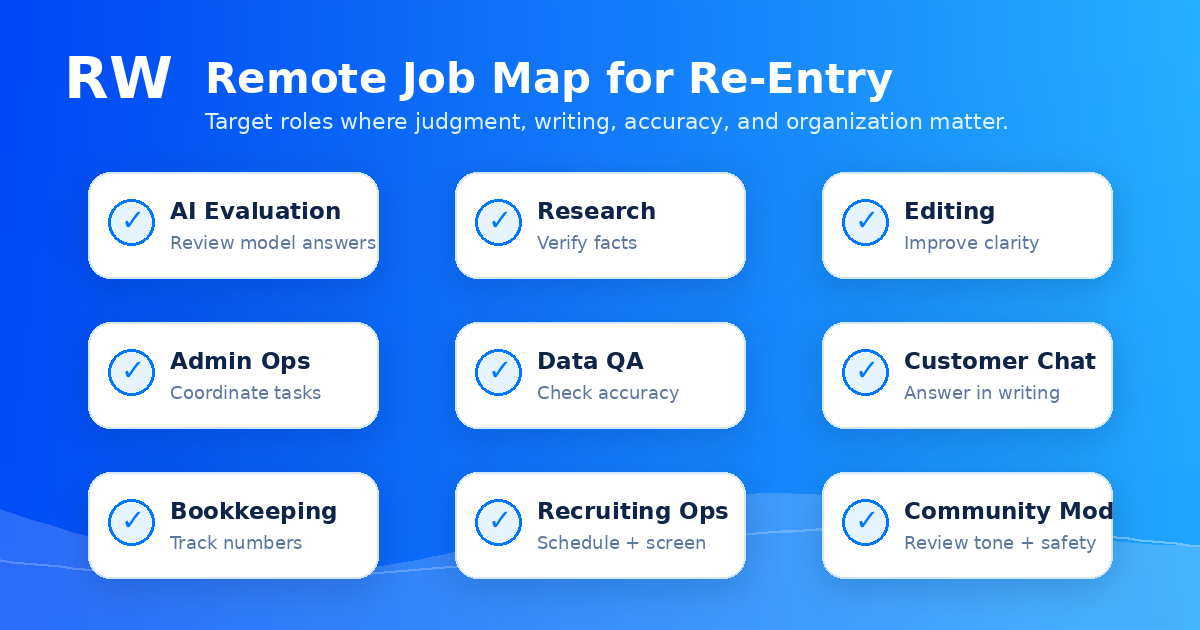
The strongest re-entry jobs usually have three traits: they can be done from home, they value transferable skills, and they do not require you to pretend your career break never happened.
Below are remote job categories worth targeting.
1. Remote AI training and AI evaluation jobs
Remote AI training jobs are among the best options for people re-entering the workforce because many of them reward judgment more than recent job titles.
In these roles, you may review AI-generated answers, compare two model responses, label examples, write better prompts, identify mistakes, check whether an answer follows instructions, or rate whether a response is helpful. Some roles are general. Others are specialized by background, such as law, finance, medicine, education, coding, writing, math, science, marketing, or business.
Common job titles include:
- AI evaluator
- AI trainer
- AI response reviewer
- AI data annotator
- AI content reviewer
- Search quality evaluator
- Prompt evaluator
- Model behavior reviewer
- AI fact-checker
- AI writing evaluator
These jobs can be a good fit if you are re-entering the workforce because they often test ability through assessments or sample tasks. A recent traditional job is helpful, but it is not always the only factor. Platforms and AI evaluation companies often care whether you can reason clearly, write strong explanations, follow rubrics, and spot errors.
Use keywords like remote AI jobs, AI training jobs, AI evaluation, data annotation, model review, prompt evaluation, and AI response rating in your profile.
Pay range: General AI evaluation roles often pay $20+/hr. Expert-tier roles in law, finance, medicine, coding, and business can pay $50–$200/hr. Re-entry applicants with domain expertise may qualify for higher-value projects sooner than they expect.
2. Online research and fact-checking jobs
If you are good at finding information, comparing sources, checking claims, and summarizing what you found, remote research work can be a strong re-entry path.
These roles may involve researching companies, verifying facts, building lists, checking product information, reviewing search results, or supporting AI training projects with source-based research. The work requires patience and accuracy, not just speed.
Relevant job titles include:
- Online researcher
- Research assistant
- Fact-checker
- Data researcher
- Search evaluator
- Content researcher
- AI research reviewer
This category is especially useful for people who have been away from the workforce but have stayed informed, organized, and comfortable learning new topics.
3. Editing, proofreading, and content review jobs
Many people re-entering the workforce underestimate how valuable editing skills are. If you can catch mistakes, improve clarity, and make writing more useful, you can target remote content roles.
This can include proofreading blog posts, editing AI-generated content, reviewing product descriptions, checking training data, improving help center articles, or evaluating whether AI writing sounds natural.
Relevant job titles include:
- Proofreader
- Content editor
- AI content reviewer
- Copy editor
- Quality reviewer
- Editorial assistant
- AI writing evaluator
These roles are a strong fit if you enjoy reading, notice inconsistencies, and can explain why something is unclear.
4. Virtual assistant and remote administrative jobs
Virtual assistant work is one of the most practical re-entry options because it maps directly to skills many people use during a career break: scheduling, email management, organization, travel planning, document cleanup, record-keeping, and follow-through.
Remote administrative roles may involve calendar management, inbox organization, data entry, customer follow-up, file management, basic research, spreadsheet updates, or coordinating simple projects.
Relevant job titles include:
- Virtual assistant
- Administrative assistant
- Executive assistant
- Operations assistant
- Remote office assistant
- Project coordinator
- Scheduling coordinator
The key is to avoid presenting yourself as "just looking for anything." Present yourself as organized, reliable, and able to remove small problems before they become large ones.
5. Remote customer support without phone-heavy work
Many people returning to work do not want a call center job. That is reasonable. But remote customer support is not always phone-based.
Some companies hire for chat support, email support, help desk ticket review, customer success support, moderation, and knowledge base updates. These jobs require calm writing, patience, and clear explanations.
Relevant job titles include:
- Remote customer support specialist
- Email support specialist
- Chat support representative
- Customer success associate
- Help desk assistant
- Support operations coordinator
- Community support specialist
Look for listings that mention email, chat, tickets, asynchronous support, documentation, or no phone calls.
6. Data entry, data quality, and quality assurance jobs
Data work can be a good fit for re-entry applicants who are accurate, patient, and comfortable with repetitive detail.
This does not always mean advanced analytics. Many remote data roles involve checking records, cleaning spreadsheets, verifying information, categorizing entries, reviewing forms, or testing whether information is complete.
Relevant job titles include:
- Data entry specialist
- Data quality reviewer
- Quality assurance assistant
- Operations data associate
- Data annotation specialist
- Catalog quality reviewer
- Form review specialist
These jobs are often a bridge into better remote work because they give you recent experience, measurable output, and digital workflow practice.
7. Bookkeeping and accounting assistant jobs
If you have experience with numbers, household budgeting, small business administration, finance, taxes, invoicing, or office records, remote bookkeeping can be a useful re-entry path.
You may need to refresh tools like QuickBooks, Excel, Google Sheets, or basic accounting software, but many assistant-level roles value reliability and attention to detail.
Relevant job titles include:
- Remote bookkeeper
- Accounting assistant
- Billing assistant
- Accounts payable assistant
- Accounts receivable assistant
- Payroll assistant
- Finance operations assistant
This is a better path for people who like structured work and clear processes.
Re-entering the workforce and ready to find remote work that fits your schedule? Start on RemoteWorkUnion.com.
Find Roles Hiring Now →8. Recruiting, HR support, and talent coordination jobs
People re-entering the workforce often have strong communication skills. Recruiting and HR support roles can use those skills without requiring you to be a senior HR professional.
Tasks may include scheduling interviews, screening applications, updating candidate records, sending follow-up emails, maintaining job boards, or helping remote teams coordinate hiring.
Relevant job titles include:
- Recruiting coordinator
- HR assistant
- Talent operations assistant
- Candidate experience coordinator
- Remote staffing assistant
- Onboarding coordinator
This can be a strong fit if you are organized, responsive, and comfortable communicating with different types of people.
9. Community moderation and trust and safety support
Remote communities, marketplaces, social platforms, learning platforms, and AI products need people to review content, enforce guidelines, and escalate issues.
This work often values judgment, patience, tone, and consistency. It may also connect to AI safety and AI evaluation work, where reviewers help identify harmful, low-quality, or policy-violating outputs.
Relevant job titles include:
- Community moderator
- Trust and safety reviewer
- Content moderation specialist
- Policy reviewer
- Safety evaluator
- Online community assistant
This role is not for everyone, because some content review can be repetitive or unpleasant. But for detail-oriented applicants, it can be a legitimate remote entry point.
10. Tutoring, education support, and curriculum review
If your background includes teaching, tutoring, parenting, coaching, training, writing, or explaining concepts, education-related remote work can be a good re-entry category.
This may include tutoring, grading, lesson review, curriculum support, AI education evaluation, test prep support, or reviewing educational content for clarity and accuracy.
Relevant job titles include:
- Online tutor
- Education content reviewer
- Curriculum assistant
- Academic evaluator
- Test prep reviewer
- AI education evaluator
- Learning support specialist
AI training platforms also need subject matter experts who can judge whether an answer in math, science, history, writing, business, or language is correct and well explained.
How to translate your career break into remote work skills
A career break is not the same thing as a skill gap.
Many people who have been outside traditional employment have still been managing schedules, solving problems, making decisions, using technology, communicating with institutions, researching options, organizing documents, handling budgets, supporting family members, volunteering, learning new tools, or coordinating complicated life logistics.
The mistake is writing a resume as if none of that counts.
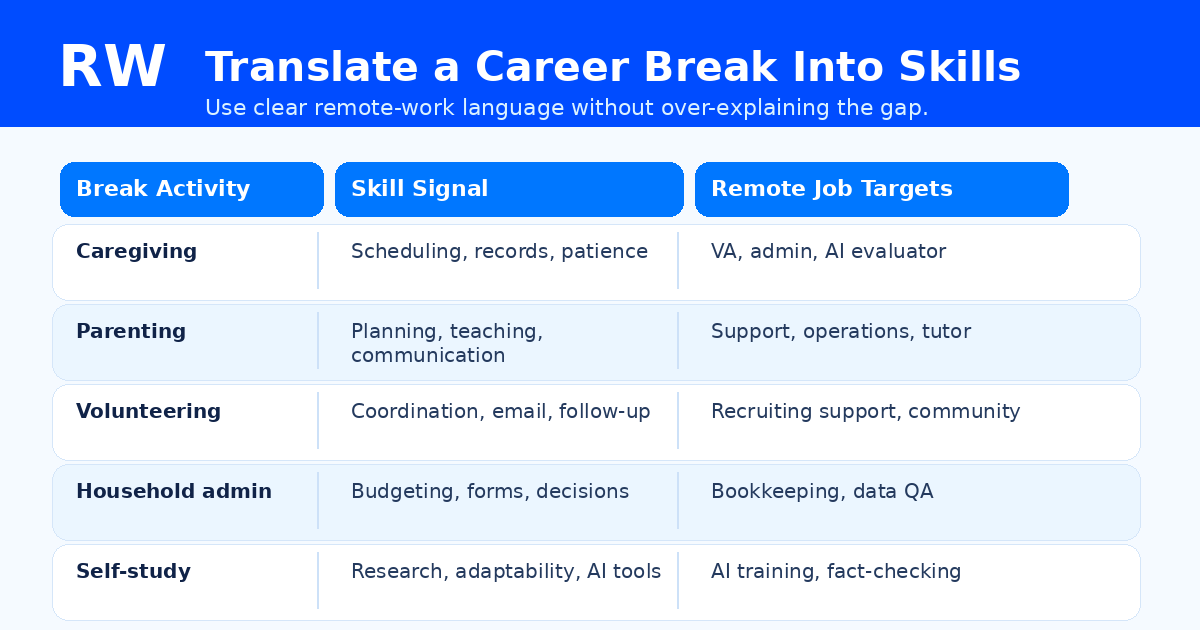
Here are examples of how to translate time away from paid work into remote job language:
Caregiving can translate into scheduling, documentation, patience, communication, record-keeping, insurance coordination, problem solving, and discretion.
Parenting can translate into planning, prioritization, conflict resolution, teaching, time management, logistics, and written communication.
Volunteering can translate into community management, event coordination, email communication, fundraising support, data entry, social media help, and stakeholder communication.
Household management can translate into budgeting, vendor communication, form completion, research, digital organization, and decision-making.
Self-study or online learning can translate into adaptability, research ability, digital tool fluency, and motivation.
Do not exaggerate. Do not turn normal life into fake corporate language. But do not erase real skills either.
Why AI training can be the best starting point
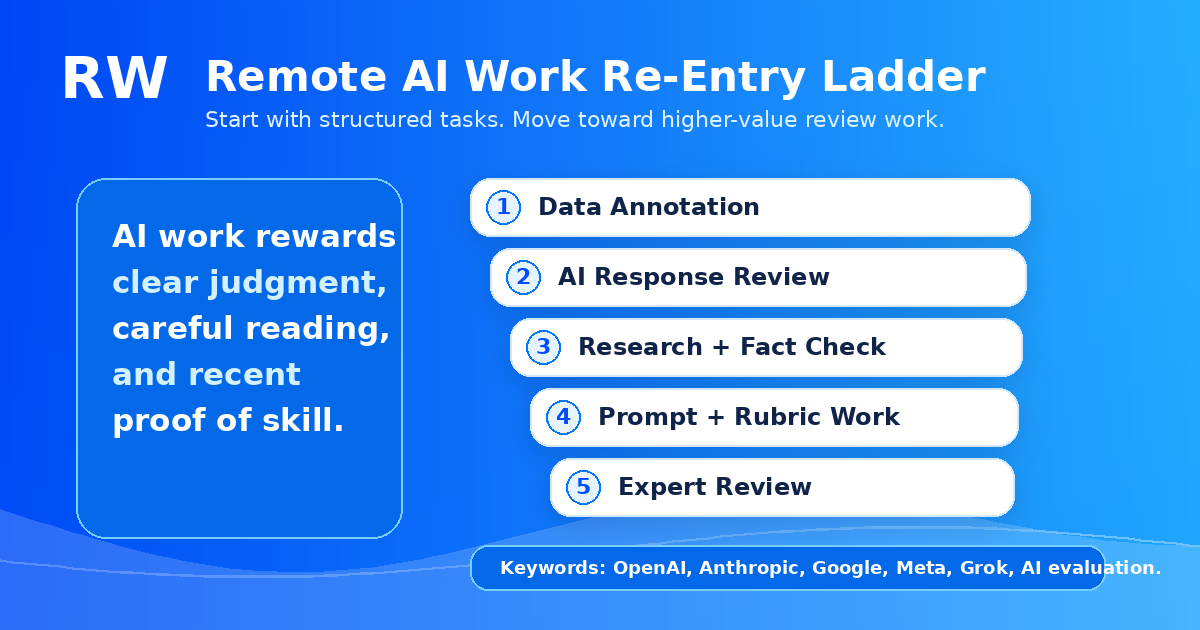
Remote AI training is one of the most practical categories for re-entry applicants because it can turn general judgment into paid work.
Many AI evaluation tasks ask simple but important questions:
- Did the AI follow the instructions?
- Is the answer accurate?
- Is the writing clear?
- Which response is better and why?
- Are any claims unsupported?
- Is the tone appropriate?
- Did the AI refuse when it should have answered?
- Did the AI answer when it should have been cautious?
- Is the result useful to a real person?
Those questions do not always require a computer science degree. They require reading, reasoning, judgment, writing, and attention to detail.
That is why remote AI jobs can work well for returning professionals, former teachers, writers, caregivers, office workers, customer support reps, operations people, researchers, editors, analysts, translators, and subject matter experts.
The strongest applicants usually show three things: clear writing, careful reasoning, and reliability.
How to write your resume when re-entering the workforce
The biggest resume mistake is leading with the gap.
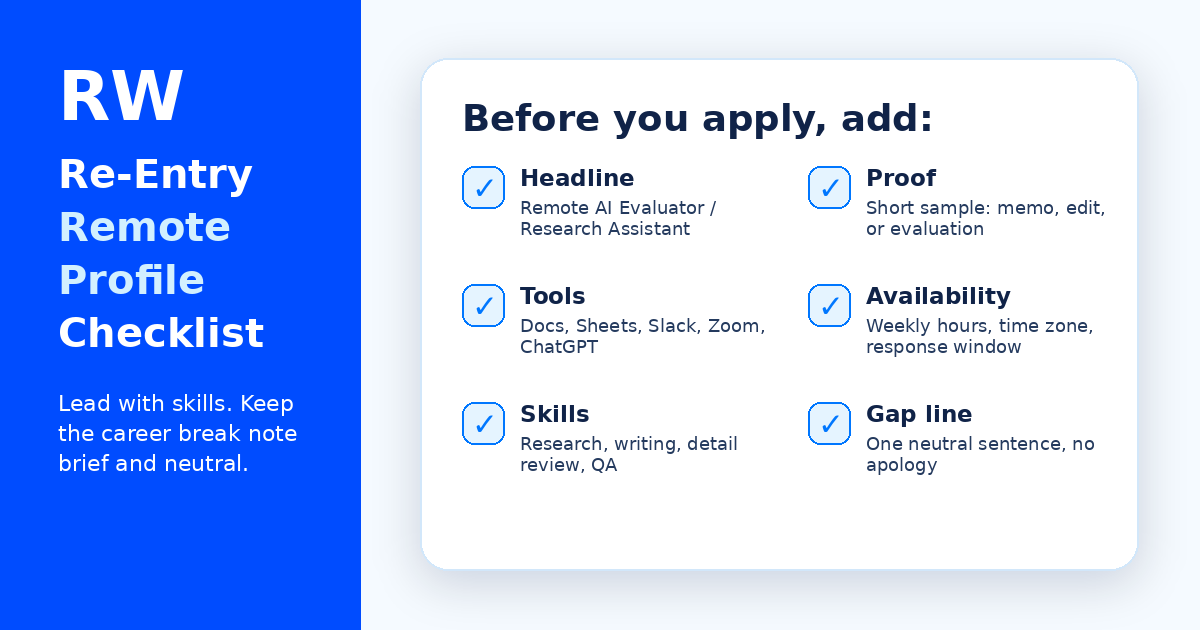
Your resume should lead with the role you are targeting and the skills that match it. The gap can be handled briefly and neutrally. You do not need to over-explain.
A strong re-entry resume structure looks like this:
- Headline — State the remote role category you want.
- Summary — Two or three lines about your skills and work style.
- Skills — Use keywords that match remote job descriptions.
- Recent projects or experience — Include freelance work, volunteer work, learning projects, prior employment, or relevant life logistics if appropriate.
- Tools — List tools you can actually use.
- Career break note — Keep it brief if needed.
Example headline:
Remote AI Evaluator | Research Assistant | Detail-Oriented Content Reviewer
Example summary:
Detail-oriented remote work candidate with strong written communication, research, scheduling, document review, and quality control skills. Comfortable following detailed instructions, comparing information, using AI tools, and completing independent work with accuracy.
Example career break line:
Career break for family caregiving; maintained strong organization, research, scheduling, and digital communication skills while preparing to return to remote work.
That is enough. The rest of the resume should focus on fit.
Keywords to use in remote work profiles
Remote job platforms and applicant tracking systems often search for keywords. Use accurate keywords that match your real skills.
Good keywords for re-entry remote applicants include:
- Remote work
- Work from home
- AI training
- AI evaluation
- Data annotation
- AI response review
- Prompt evaluation
- Online research
- Fact-checking
- Written communication
- Content review
- Editing
- Proofreading
- Quality assurance
- Data quality
- Customer support
- Email support
- Chat support
- Virtual assistant
- Administrative support
- Operations support
- Google Docs
- Google Sheets
- Microsoft Excel
- Slack
- Zoom
- Notion
- ChatGPT
- AI tools
- Remote collaboration
Do not stuff keywords randomly. Use them naturally in your summary, skills section, and project descriptions.
Where to apply first
People re-entering the workforce should not rely on one application or one platform. A better strategy is to apply across several categories at once.
Start with three lanes:
Lane 1: AI training and evaluation
Apply to platforms and companies that offer remote AI evaluation, AI training, data annotation, model review, and prompt evaluation work. This can include platforms such as Handshake AI, Mercor, micro1, and other AI data and evaluation companies.
Lane 2: Remote research, editing, and quality review
Apply to roles that use writing, research, fact-checking, and detail review. These roles are often a natural fit for AI-adjacent work.
Lane 3: Remote admin, support, and operations
Apply to virtual assistant, operations assistant, recruiting coordinator, customer support, and data quality roles that value organization and communication.
This approach gives you more chances to get interviews, assessments, trial tasks, and paid work.
How to handle interviews after a career break
You do not need to apologize for re-entering the workforce. You need a simple, calm explanation and then a quick pivot to the work.
A strong answer sounds like this:
"I took time away from traditional employment for family and personal responsibilities. I am now ready to return to consistent remote work. During that time, I continued using digital tools, managing schedules and documents, researching information, and handling detailed communication. I am especially interested in roles where accuracy, writing, organization, and independent follow-through matter."
Then stop. Do not keep defending the gap.
The rest of the interview should focus on what you can do now.
The first 30 days: a realistic plan
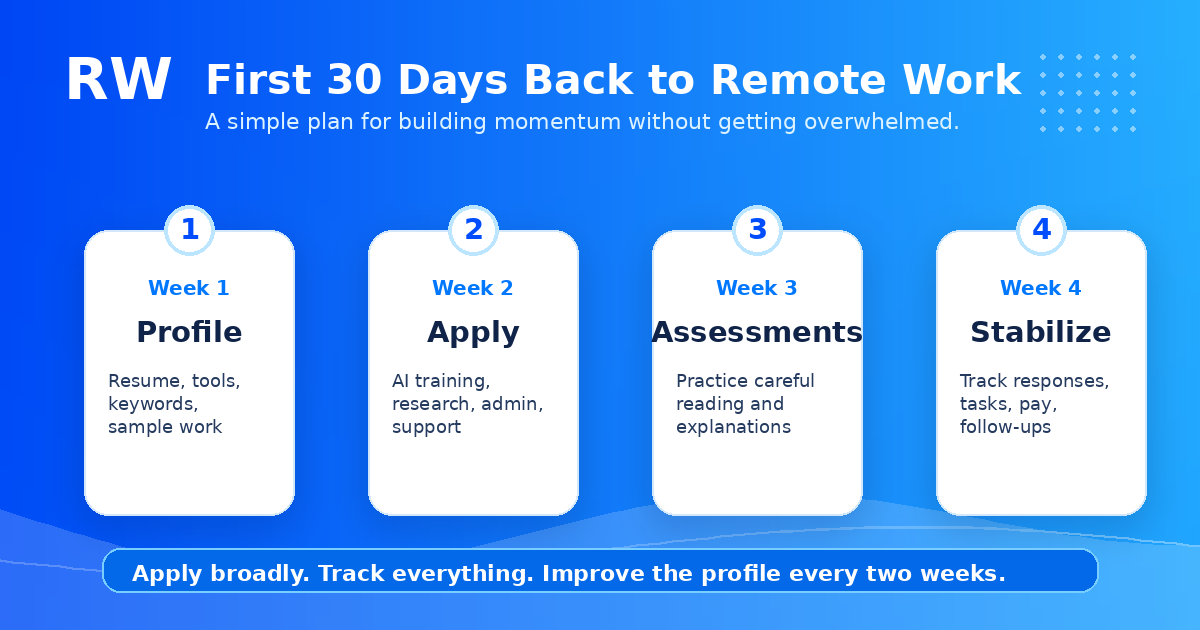
Re-entry works best when you treat it like a project, not a panic.
Week 1: Build the foundation
Update your resume, create a remote work profile, choose three job categories, list your tools, and write a short career break explanation. Create one or two samples if you do not have recent work examples. A sample can be a cleaned-up spreadsheet, a short research memo, a proofread article excerpt, or an AI response evaluation.
Week 2: Apply broadly
Apply to AI training platforms, remote research roles, editing roles, virtual assistant jobs, data quality jobs, and support roles. Track every application in a spreadsheet. Note the company, role, date applied, status, and next step.
Week 3: Practice assessments
Many remote AI jobs require tests. Practice reading instructions carefully, explaining decisions clearly, checking facts, and avoiding rushed answers. Quality matters more than speed at this stage.
Week 4: Improve and diversify
Update your profile based on what gets responses. Apply to more than one platform. Follow up where appropriate. Keep building recent proof of work. The first goal is not your perfect long-term job. The first goal is momentum.
Red flags to avoid
People re-entering the workforce are often targeted by low-quality job posts and scams. Be careful with any opportunity that:
- Charges you a fee to start
- Guarantees high pay with no assessment
- Asks for crypto, gift cards, or wire transfers
- Sends a check and asks you to send money back
- Requires your bank password
- Uses vague job descriptions with no real company details
- Promises $200 per hour for basic data entry
- Refuses to explain how payment works
Legitimate remote work platforms may require identity verification, tax forms, assessments, or payment setup. But they should not ask you to pay them for access to basic work.
What makes re-entry applicants competitive
Returning workers can be strong remote candidates because they often bring maturity, patience, accountability, and practical judgment. Many remote jobs need people who can work independently without constant supervision.
You can stand out by showing:
- Clear writing
- Fast but careful communication
- Reliable availability
- Comfort with digital tools
- Ability to follow instructions
- Strong attention to detail
- Willingness to learn AI workflows
- Accurate research habits
- Calm problem solving
- Professional follow-through
These qualities matter in remote AI jobs, online research, customer support, operations, editing, and administrative work.
The best mindset for returning to work
Do not think of re-entering the workforce as asking someone to overlook a gap. Think of it as rebuilding proof.
The first remote job or project may not be perfect. It may be part-time. It may be contract-based. It may begin with assessments or small tasks. That is fine. Once you have recent work, recent feedback, and recent income, every next application becomes easier.
Your goal is to create a current track record.
For many people, the best path is to start with flexible remote work, build confidence, learn AI tools, apply to multiple platforms, and move toward higher-quality roles over time.
Remote work is not a shortcut. But it can be a practical, flexible, and realistic way back into the workforce.
Practical tip: The first remote job does not have to be your best remote job. It has to be your current remote job. One completed project, one paid assessment, one recent reference — that is what makes the next application easier.
Frequently Asked Questions
Can I get remote AI work with no recent job experience?
Yes. Many AI training and evaluation platforms test your ability through assessments and sample tasks, not just your recent job titles. If you can reason clearly, write strong explanations, follow rubrics, and spot errors, you can qualify for remote AI evaluation work even after a career break.
How do I explain a career gap on my resume for remote jobs?
Keep it brief and neutral. You can add a single line such as: "Career break for family caregiving; maintained strong organization, research, scheduling, and digital communication skills while preparing to return to remote work." Then let the rest of your resume focus on skills and fit. You do not need to over-explain or apologize.
What remote jobs are easiest to get after a career break?
The most accessible remote jobs for re-entry applicants include AI evaluation and AI training roles, online research and fact-checking, virtual assistant and administrative work, email-based customer support, data quality and data entry, and editing or proofreading. These roles often value transferable skills like writing, organization, attention to detail, and clear communication more than a recent job title.
What pay can I expect from remote work when re-entering the workforce?
General remote AI evaluation and data quality roles often pay $20+/hr. Expert-tier AI training roles in law, finance, medicine, education, and business can pay $50–$200/hr. Virtual assistant and administrative roles vary, but typically pay $15–$30/hr depending on scope. Pay generally increases as you build a recent track record.
How long does it take to get remote work after a career break?
It depends on how broadly you apply and how quickly you pass assessments. Some people complete an AI training assessment and begin paid tasks within two to four weeks. Others take longer to get a first response. The best approach is to apply across multiple platforms and categories at the same time and treat the search like a structured project, not a one-time event.