Remote work can be life-changing for parents and caregivers, but only when the job is built for the reality of caregiving. A job that simply happens on a laptop is not automatically flexible. Many remote jobs still expect strict shifts, phone coverage, meetings, surveillance software, or instant replies. That can be impossible when you are managing school pickup, feeding schedules, medical appointments, elder care, childcare gaps, or unpredictable household needs.
The better target is remote work that is asynchronous, task-based, and measured by output. That is why remote AI jobs, AI training work, AI evaluation, content review, data annotation, research rating, writing, editing, and other flexible work from home jobs have become important options for people who need to earn money without pretending they have a clean eight-hour block every weekday.
This guide is for parents, guardians, family caregivers, and anyone whose schedule is real life first. It explains which remote jobs fit around caregiving, which ones usually do not, how to build a realistic weekly system, and how to apply without hiding your constraints or overselling your availability.
In this guide
- What makes remote work caregiver-friendly?
- The care block schedule
- The remote jobs that fit best
- Why AI training work can be a practical fit
- How to tell if a remote role will actually fit your schedule
- A realistic weekly schedule for parents and caregivers
- How to present caregiving constraints professionally
- The best skills to highlight
- Common mistakes to avoid
- How to build long-term remote income around caregiving
What makes remote work caregiver-friendly?
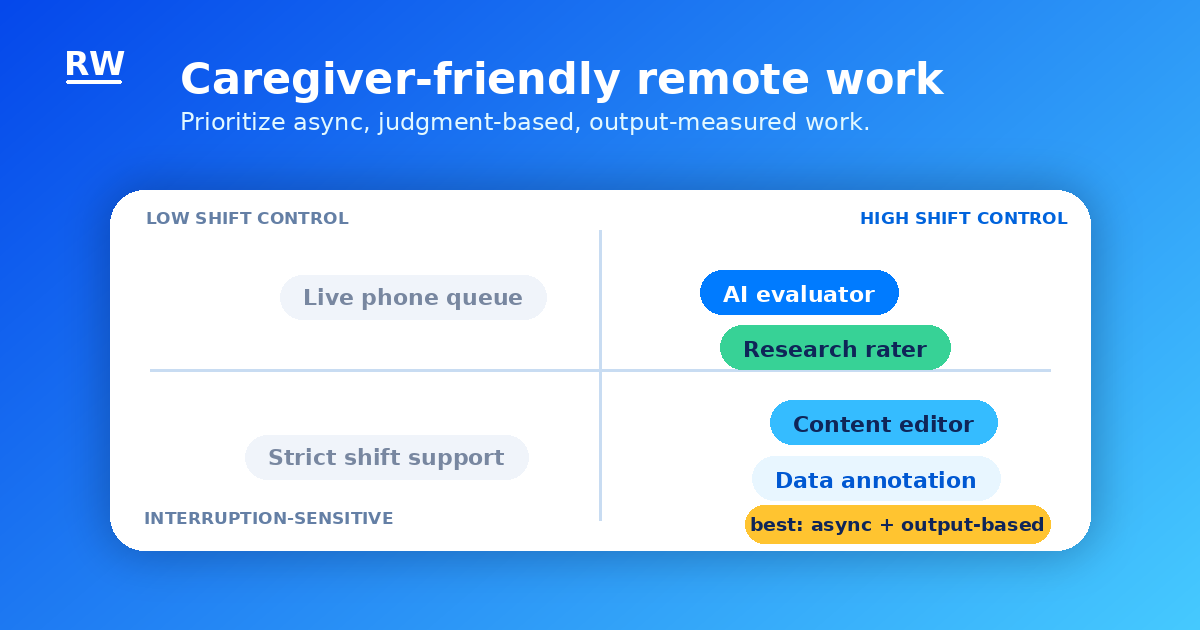
Caregiver-friendly remote work has one core trait: the work can be done in focused blocks instead of constant coverage. The more a job depends on being instantly available, the harder it is to combine with parenting or caregiving. The more a job depends on clear output, written judgment, research, accuracy, or task completion, the easier it is to fit into the day you actually have.
A flexible work from home job should let you start, pause, and resume without destroying the whole shift. It should not punish you for having quiet time in the morning, a school window in the afternoon, and another focused block after bedtime. It should also be clear about expectations. You should know whether you are paid per hour, per task, per project, or per completed milestone.
The best remote work for caregivers usually has at least three of these features:
- Asynchronous tasks that do not require constant live meetings.
- Written instructions instead of phone-heavy communication.
- Output-based performance, such as completed reviews, annotations, edits, ratings, or research tasks.
- Flexible hours or self-scheduled blocks.
- Low commute, no relocation, and no daily office requirement.
- Realistic deadlines that allow you to plan around care needs.
- Skills-based evaluation rather than degree-only screening.
Key signal: If a job description emphasizes output, deliverables, or asynchronous collaboration, it is more likely to fit caregiving than one that emphasizes coverage hours, live queues, or constant availability.
The care block schedule
Instead of building your schedule around an eight-hour workday, build it around four care-safe blocks that already exist in your week. These are the windows when interruptions are least likely and focused work is most possible.
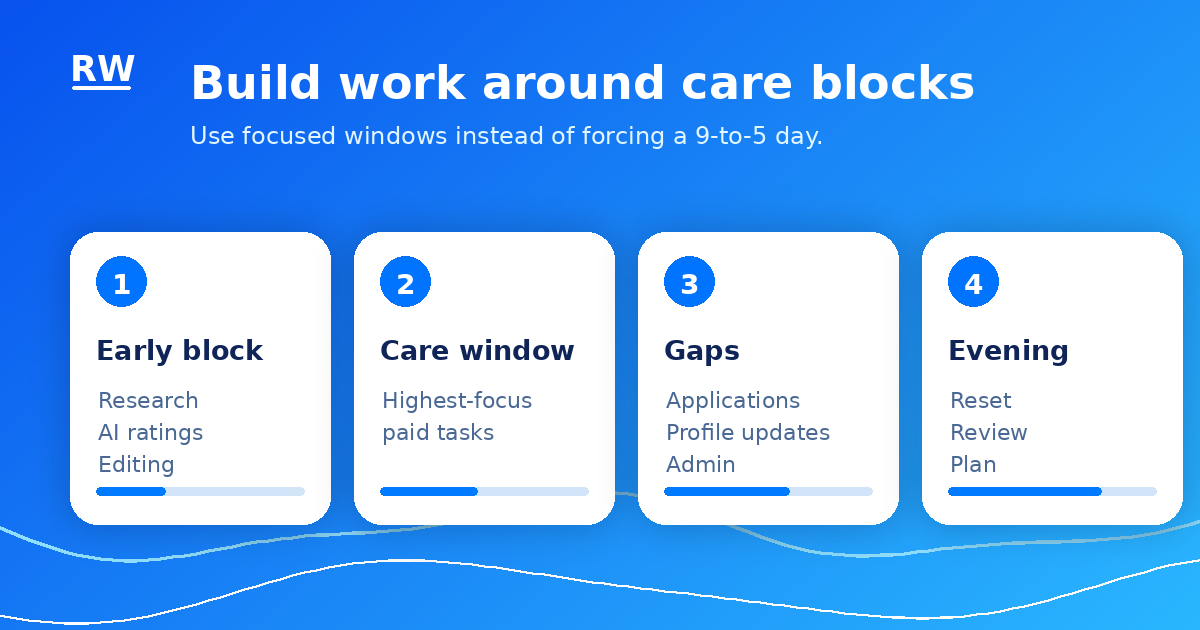
Block 1 — Early morning: Before care demands begin. Good for research, AI ratings, and editing tasks that require attention but not a perfect environment.
Block 2 — Care window: The highest-focus paid work block. School hours, nap time, or any window when another adult is covering care. Prioritize paid tasks, assessments, and applications during this time.
Block 3 — Gaps: Short windows throughout the day. Good for submitting applications, updating profiles, checking messages, and handling admin rather than deep work.
Block 4 — Evening: After caregiving duties end. Use this to reset, review completed work, plan the next day, and handle anything that does not require top-level focus.
A simple weekly target works better than a perfect daily schedule. Aim for eight to twelve focused hours per week at first. That could be four two-hour blocks, six ninety-minute blocks, or a mix of short and long sessions. Once you know what is realistic, apply for work that matches your actual capacity.
The remote jobs that fit best around parenting and caregiving
The strongest fit is often not the most glamorous job title. It is the work structure. A role can sound impressive and still be bad for a caregiver if it requires live coverage all day. A simpler title can be much better if it allows deep work in short blocks.
Remote AI training and AI evaluation are strong options because many projects are task-based. AI companies and AI platforms need people to judge responses, compare outputs, label data, review writing, evaluate research quality, test model behavior, and explain why one answer is better than another. This work may support systems used by major AI companies and AI ecosystems connected to OpenAI, Anthropic, Google, Meta, Grok, and other large AI labs. The actual hiring may happen through platforms, vendors, contractors, or partner companies, but the underlying skill is the same: careful human judgment.
Content writing and editing can also fit well. Parents and caregivers who can write clearly, check facts, improve structure, or edit for tone can often work around a nontraditional schedule. The key is to avoid roles that disguise a full-time newsroom pace as freelance work. Look for project scopes, word counts, revision expectations, and deadline windows before accepting.
Research and fact-checking jobs are another good category. These roles reward curiosity, accuracy, source comparison, and careful judgment. They can include AI research tasks, search quality evaluation, market research, data verification, source collection, or content quality review. Many of these tasks are easier to complete during quiet windows than during a chaotic full day.
Non-phone customer support, community support, and back-office operations can work if they are ticket-based rather than live queue-based. The difference matters. Ticket-based support can be done in batches. Live chat and phone support often require uninterrupted availability. For caregivers, "remote customer service" is not enough information. Search for words like async, email support, ticket support, back office, operations support, quality assurance, content moderation, knowledge base, and documentation.
Virtual assistant and administrative work can be flexible when expectations are clear. Calendar cleanup, inbox sorting, data entry, document formatting, CRM updates, and research lists can fit around caregiving. But executive assistant roles that require instant responses all day may be less realistic. The same title can mean two very different lifestyles.
Why AI training work can be a practical fit
Remote AI jobs are not only for coders. Many AI training jobs need people who can read carefully, write clearly, compare two answers, identify mistakes, test reasoning, evaluate tone, or judge whether an AI response would actually help a user. That opens the door for teachers, writers, editors, paralegals, researchers, accountants, nurses, operations managers, customer service professionals, consultants, students, and stay-at-home parents with strong general knowledge.
For parents and caregivers, AI evaluation work can be useful because it often breaks into smaller tasks. You may review a prompt, compare two responses, rate accuracy, write a short explanation, or label a piece of data. Some projects require longer focus, but many do not require sitting in a meeting for hours. That makes it easier to use a predictable care window: early morning, school hours, nap time, evening, or a weekend block.
Apply to more than one platform, keep your profile updated, track which skills get matched, and build a backup list of remote work categories that use the same strengths. Platforms such as Handshake AI, Mercor, micro1, and Outlier AI all list AI evaluation and training work. Applying to several and tracking your results is more effective than waiting on one.
How to tell if a remote role will actually fit your schedule
Before applying, read the job post for control words. Some words suggest flexibility. Others suggest a job that is remote in location only.
Good signs include: asynchronous, flexible hours, task-based, project-based, self-paced, independent work, written communication, deliverables, no phone, ticket-based, part-time, contract, freelance, remote-first, and work from anywhere. These phrases do not guarantee a good job, but they suggest the structure may fit caregiving better.
Warning signs include: required shift, live queue, phone support, immediate availability, high-volume calls, always online, time tracking with screenshots, camera on, strict schedule, weekend coverage required, rotating shifts, and "must be available during all business hours." A job can still be legitimate with these requirements, but it may not fit parenting or caregiving unless you have reliable coverage during those exact hours.
Three questions to ask before applying: Can this job be done in blocks of 45 to 120 minutes? Does it require live coverage or mainly completed output? Will interruptions create minor inconvenience or serious job risk? If the answer is serious job risk, it may not be the right remote work for your current season.
A realistic weekly schedule for parents and caregivers
Do not build your remote work plan around an ideal week. Build it around a normal messy week. Start by identifying your care-safe blocks: times when interruptions are least likely and you can think clearly. For many people, that means early morning, school hours, nap time, after bedtime, or a weekend window when someone else can cover care.
Use different blocks for different types of tasks. High-focus blocks should go to paid work, AI evaluations, writing tests, assessments, editing, or research. Low-focus blocks can go to applying, updating profiles, checking messages, organizing documents, reading instructions, or tracking income. This prevents you from wasting your best mental energy on admin work.
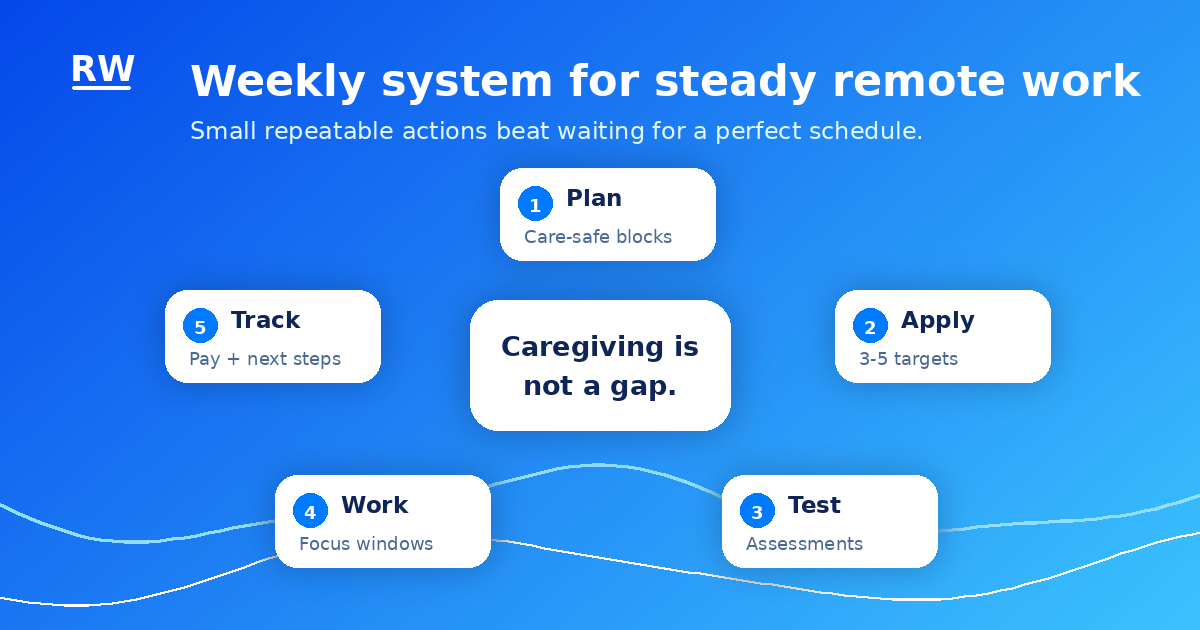
A caregiver-friendly remote work week might look like this:
- Sunday: Choose target roles, prepare applications, update your profile.
- Monday: Apply to two or three roles or platforms.
- Tuesday through Thursday: Use best focus blocks for assessments or paid tasks.
- Friday: Track responses, payments, project status, and follow-ups.
- Weekend: Use one backup block only if needed, not as the foundation of the plan.
Parents and caregivers can apply for flexible remote AI roles and task-based work that fits a real schedule. Find opportunities hiring now.
Find Roles Hiring Now →How to present caregiving constraints professionally
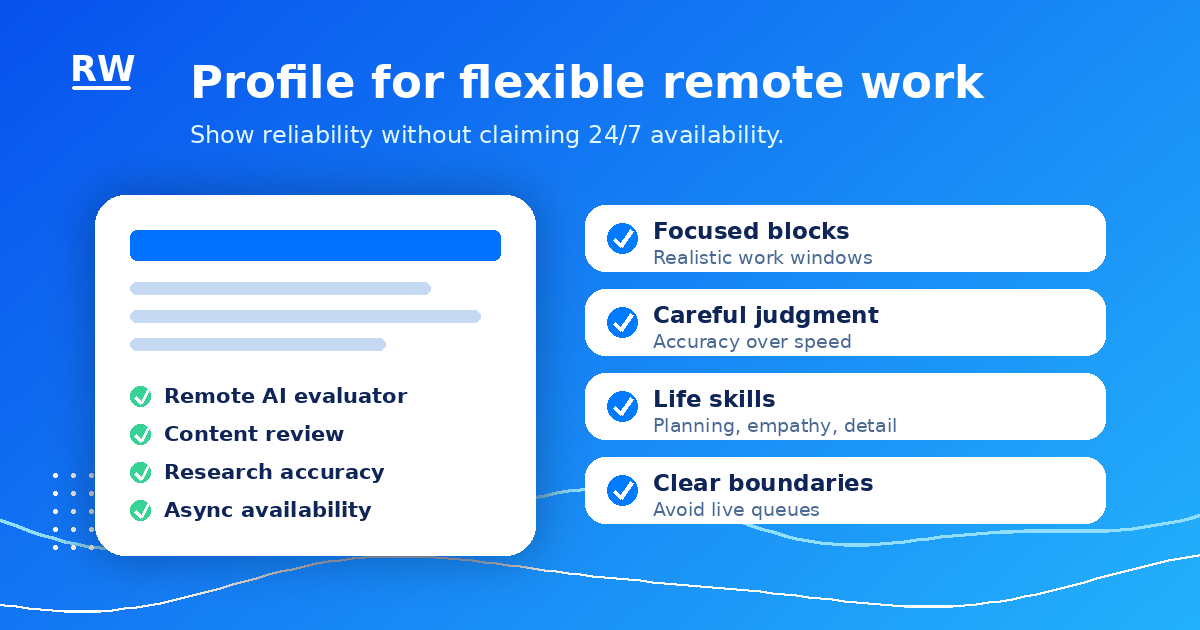
You do not need to over-explain your personal life in a remote work application. The goal is to show that you are reliable, accurate, and realistic. Employers and platforms care about whether you can do the work. Your application should make your availability clear without turning it into an apology.
Instead of writing, "I have kids so my schedule is difficult," write, "I am available for focused asynchronous work in scheduled blocks and can consistently complete writing, research, evaluation, and review tasks by deadline." Instead of saying, "I cannot be on calls all day," write, "I am strongest in written, task-based, independent work with clear deliverables."
Your profile should emphasize the strengths caregiving often builds: planning, prioritization, patience, attention to detail, clear communication, emotional judgment, risk awareness, and follow-through. These are useful in remote AI evaluation, content review, customer research, support documentation, operations, and quality assurance.
Useful profile phrases include:
- Experienced with careful written review, research, and quality checks.
- Strong fit for asynchronous remote work, AI evaluation, content review, and data annotation.
- Comfortable comparing responses, identifying errors, and explaining decisions clearly.
- Reliable with deadline-based work and independent task completion.
- Available for focused project work in scheduled blocks.
The best skills to highlight
Caregiver-friendly remote work often rewards skills that are easy to underestimate. You do not need to present yourself as a tech expert if that is not your background. You need to show how your existing skills translate into remote output.
For AI training jobs, highlight writing, editing, research, fact-checking, analytical thinking, subject matter knowledge, attention to detail, prompt writing, evaluating AI outputs, rating responses, and explaining your reasoning. For content and operations roles, highlight organization, documentation, spreadsheets, CRM work, process improvement, inbox management, customer empathy, and quality assurance.
If you have professional experience in education, law, finance, healthcare, marketing, sales, customer support, HR, real estate, logistics, or management, do not bury it. AI platforms and remote employers often need people who understand real-world domains. Your caregiving season does not erase your expertise. It may simply mean you need a work structure that uses that expertise more flexibly.
Common mistakes to avoid
The first mistake is applying only to jobs with the word "parent" or "caregiver" in the title. Most good fits will not advertise themselves that way. Search by structure and skill instead: remote AI evaluator, AI trainer, data annotation, content editor, research analyst, quality analyst, search evaluator, remote writing, non-phone support, back-office assistant, operations support, and documentation specialist.
The second mistake is accepting remote work that recreates the least flexible parts of an office job. A strict phone queue from home may remove the commute, but it does not solve the caregiving problem. If you need flexibility, protect that requirement early.
The third mistake is depending on one platform. AI training platforms and remote contractor marketplaces can pause, slow down, or change project availability. Join several legitimate platforms, keep applications moving, and track which skills create the most responses.
The fourth mistake is ignoring scams. Real remote work platforms should not charge you to apply, force you to buy equipment from a specific vendor, ask for sensitive financial information too early, or promise guaranteed income for no real work. A legitimate opportunity may require identity verification or tax forms after acceptance, but it should not require an upfront payment to start.
How to build long-term remote income around caregiving
The long-term goal is not just to find one flexible task. It is to build a remote work system that survives schedule changes. Children get sick. Care recipients have appointments. School calendars change. Projects pause. A strong system gives you more than one path to income.
Start with one primary category and one backup category. For example, your primary category might be remote AI evaluation, while your backup category is content editing or research support. Or your primary category might be non-phone support, while your backup is data annotation. This keeps your search focused without making you dependent on a single company.
Track every platform, application date, assessment, response, pay rate, project type, and payment status. This sounds basic, but it matters. Caregivers often have fragmented time. A simple spreadsheet prevents lost opportunities and helps you see patterns. If research roles respond more than support roles, apply to more research roles. If AI writing tests lead to better matches than data labeling, adjust your profile.
Over time, aim to move from beginner tasks to better-matched work. That can mean specializing in a domain, improving writing samples, building a stronger remote profile, learning how AI evaluation rubrics work, or collecting examples of your editing, research, and analysis. The more clearly you show judgment, the easier it is to qualify for better remote work.
Bottom line
Remote work that fits around parenting and caregiving is not about finding a perfect job with no stress. It is about finding work with the right structure: async, task-based, output-driven, and realistic about human schedules. Remote AI jobs, AI training work, writing, editing, research, data annotation, non-phone support, and back-office operations can all fit if the expectations are clear.
Do not measure yourself against someone with unlimited availability. Build around the blocks you have. Apply to roles that respect those blocks. Show your reliability through clear written communication, careful work, and consistent follow-through. Parenting and caregiving do not make you less capable of remote work. They make it more important to choose work that is designed for real life.
Ready to apply for jobs? Go to RemoteWorkUnion.com to find roles hiring now.
Frequently asked questions
What remote work is best for parents and caregivers?
Remote AI evaluation, AI training tasks, content writing and editing, research and fact-checking, non-phone customer support, and virtual assistant work are among the strongest fits. The key is finding work that is asynchronous, task-based, and measured by output rather than constant availability.
Can I do AI training work around an unpredictable caregiving schedule?
Many AI training tasks are designed to be completed in short blocks rather than during fixed hours. If the work is task-based and asynchronous, it can fit around caregiving. Check whether a specific platform requires fixed availability windows before applying, and treat the income as part of a portfolio rather than a single source.
How do I write a remote work application profile as a caregiver?
Focus on reliability, accuracy, and your specific availability rather than apologizing for your schedule. Phrases like "available for focused asynchronous work in scheduled blocks" or "strong fit for written, task-based, independent work with clear deliverables" communicate your value without over-explaining your personal situation. Highlight skills caregiving builds: planning, prioritization, attention to detail, and follow-through.
How do I know if a remote job will actually fit caregiving?
Ask three questions before applying: Can this job be done in blocks of 45 to 120 minutes? Does it require live coverage or mainly completed output? Will interruptions create minor inconvenience or serious job risk? Look for positive words like asynchronous, flexible hours, task-based, self-paced, or written communication. Warning signs include required shift, live queue, always online, or must be available during all business hours.
How do I avoid remote work scams as a parent or caregiver?
Real remote work platforms do not charge you to apply, force you to buy equipment from a specific vendor, ask for sensitive financial information too early, or promise guaranteed income for no real work. A legitimate opportunity may require identity verification or tax forms after acceptance, but it should never require an upfront payment to start.