Stellar AI jobs are part of a larger category of remote AI work that has become one of the most searched-for opportunities online: AI training, AI data annotation, model evaluation, prompt writing, response ranking, and human feedback work. These jobs can be attractive because they often use skills that many educated remote workers already have — writing clearly, researching carefully, comparing answers, following instructions, and judging whether an AI response is helpful, accurate, and safe.
The important point is that every new AI work platform should be evaluated before you apply. A new platform may be legitimate, but that does not automatically mean it has steady work, clear pay, strong support, or the right tasks for your background. The same is true whether you are looking at Stellar AI jobs, Mercor, Outlier, Handshake AI, micro1, Surge AI, DataAnnotation, or a job listing that says it supports work connected to AI systems from companies like OpenAI, Anthropic, Google, Meta, Microsoft, or xAI.
This guide explains how to evaluate Stellar AI jobs and similar platforms before applying so you can avoid wasting time, protect your personal information, and focus on the remote AI roles most likely to fit your skills.
What people usually mean by Stellar AI jobs
When job seekers search for Stellar AI jobs, they are usually looking for remote AI training work. That can include generalist AI evaluator tasks, expert review tasks, data annotation, prompt creation, response comparison, quality assurance, or fact-checking work.
The exact tasks can change from platform to platform. Some projects may ask you to write challenging prompts for an AI model. Others may ask you to compare two chatbot answers and explain which one is better. Some roles focus on coding, math, legal, finance, healthcare, education, languages, or other subject matter expertise. Some roles are beginner-friendly, while others require advanced credentials or a strong professional background.
This is why it is better to evaluate the platform and the specific opening instead of relying only on the platform name. A generalist AI evaluator listing, a coding evaluator listing, and a finance expert AI training listing can all live under the same broad category, but they may have completely different tests, pay rates, project availability, and expectations.
Why new AI work platforms keep appearing
AI companies need human judgment. Even when a model can generate fluent answers, it still needs people to review outputs, identify mistakes, test edge cases, write better examples, and compare answers against a rubric. That is especially true for AI assistants, AI search tools, coding copilots, customer support bots, research assistants, and domain-specific systems.
Large AI companies and their contractors use human feedback to improve model behavior. This work can include RLHF-style evaluation, supervised training examples, search quality review, data labeling, safety testing, hallucination detection, and task design for AI agents. The end customer may be a major AI company, but the worker usually applies through a contractor, staffing partner, or specialized AI work platform.
That creates opportunity, but it also creates confusion. Job seekers see names like Stellar AI, Mercor, Outlier, Handshake AI, micro1, Surge AI, and other platforms, then try to figure out which ones are real, which ones are hiring, and which ones actually have work available. The answer can change by country, skill set, project type, and timing.
The first rule: evaluate the job, not just the platform
A recognizable platform name is useful, but it is not enough. Before applying, look at the individual listing and ask five practical questions:
- What work will I actually do?
- How will I be paid?
- What skills or credentials are required?
- How much personal information is requested, and when?
- Is there enough evidence that this is worth my time?
A strong listing should explain the type of AI evaluation work involved. It should give you a reasonable idea of whether the role involves writing, rating, ranking, annotation, fact-checking, coding, domain expertise, or language review. It should also explain the application process, assessment expectations, worker classification, and payment method.
If the listing is vague, that does not automatically mean it is fake. Some platforms keep client details private. But vague listings should make you more careful. Verify the official website, check whether the application link matches the company, and avoid handing over sensitive information too early.
What to look for before applying to Stellar AI or a similar platform
1. Official website and application path
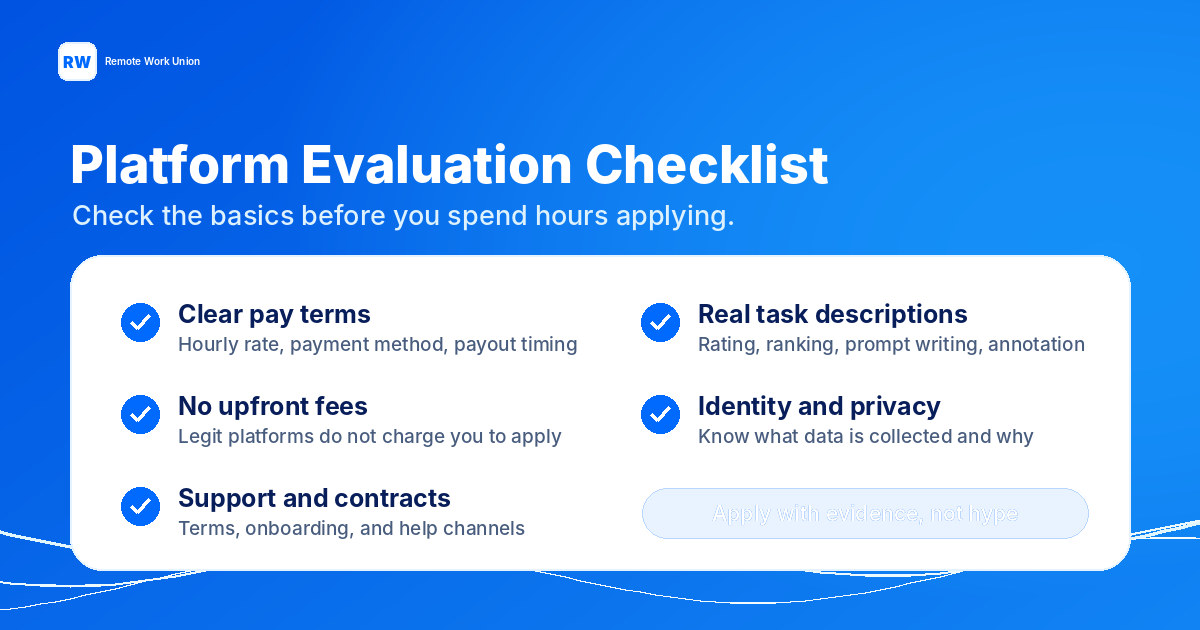
Start with the official site, not a random post, comment, short link, or reposted job board listing. Scam postings often copy real company names and logos, then route applicants into unofficial forms, messaging apps, or fake onboarding pages. A legitimate application path should feel consistent — the company name, domain, job title, application page, and email communication should match.
2. Clear role type
Look for specific language such as AI data evaluator, AI trainer, model evaluator, data annotator, response rater, prompt writer, coding reviewer, or subject matter expert. The clearer the task type, the easier it is to know whether the job fits you. A strong writer might fit general response evaluation. A software engineer might fit coding evaluation tasks. A domain expert may fit specialized projects where the model needs professional judgment.
3. Pay clarity
Good platforms usually explain whether pay is hourly, task-based, project-based, or assessment-based. They may not guarantee unlimited work, but they should give basic information about rates, payment method, payment timing, and whether unpaid testing is part of the application. Be careful with listings that promise unusually high income with no skill requirements and no explanation of the work.
4. Country and eligibility rules
Remote does not always mean worldwide. Some platforms restrict applications by country, payment method, tax paperwork, language, client requirements, or legal classification. An applicant in the United States, Canada, the United Kingdom, Australia, India, the Philippines, South Africa, or the European Union may see different opportunities, rates, and onboarding steps. A platform can be real and still not be a fit for your location.
5. Task availability
The biggest misunderstanding in remote AI training work is assuming that acceptance equals steady work. Many AI platforms operate by project demand. You might pass an assessment and still wait for tasks. Treat every new platform as one part of a broader remote work pipeline rather than relying on any single dashboard until you have a consistent track record.
Green flags in an AI work platform
A platform is more promising when it has several of these signals:
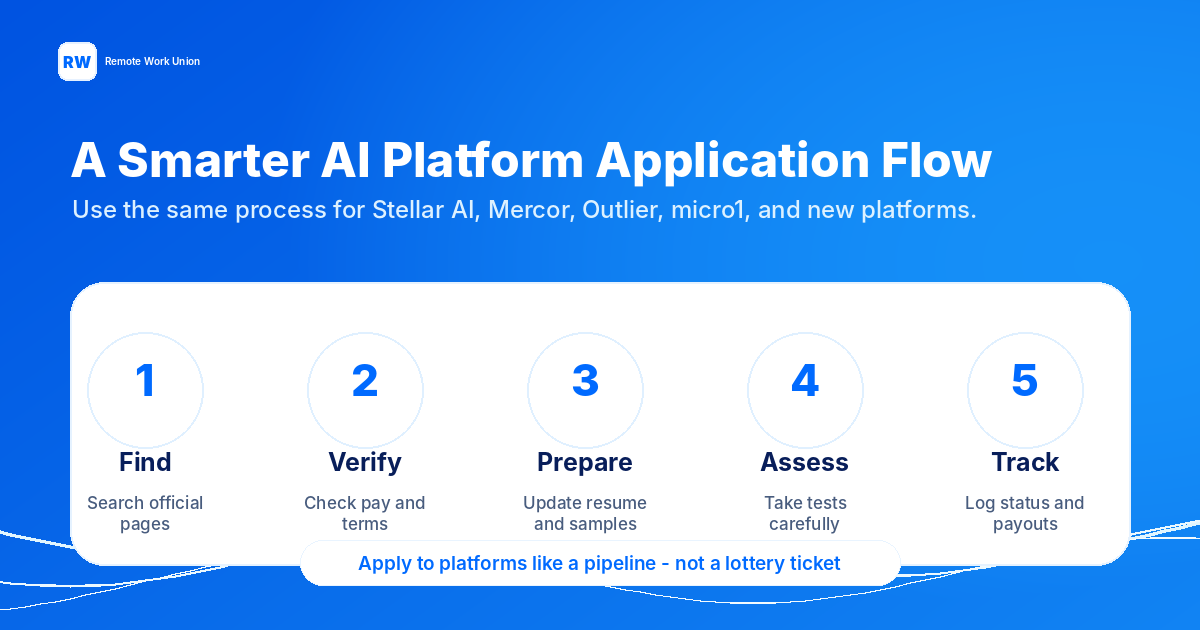
- A clear official website and consistent application flow.
- Specific task categories like AI evaluation, data annotation, prompt writing, coding review, or expert feedback.
- Written terms for pay, worker classification, confidentiality, privacy, and project rules.
- Normal payment methods such as bank transfer, PayPal, Stripe, or another recognized payment rail.
- A realistic assessment process that tests writing, reasoning, coding, language ability, or domain expertise.
- Support documentation, onboarding materials, guidelines, or a worker dashboard.
- No upfront fee to apply.
- No pressure to recruit other applicants as the main way to earn.
No single green flag proves a platform is perfect. The best approach is to collect enough evidence before you commit major time.
Remote Work Union tracks legitimate remote AI training roles across top platforms. Find opportunities that match your background without sorting through scam listings.
Find Roles Hiring Now →Red flags to avoid
Remote work scams often copy the language of real AI training jobs. Be especially careful with any listing that includes these warning signs:
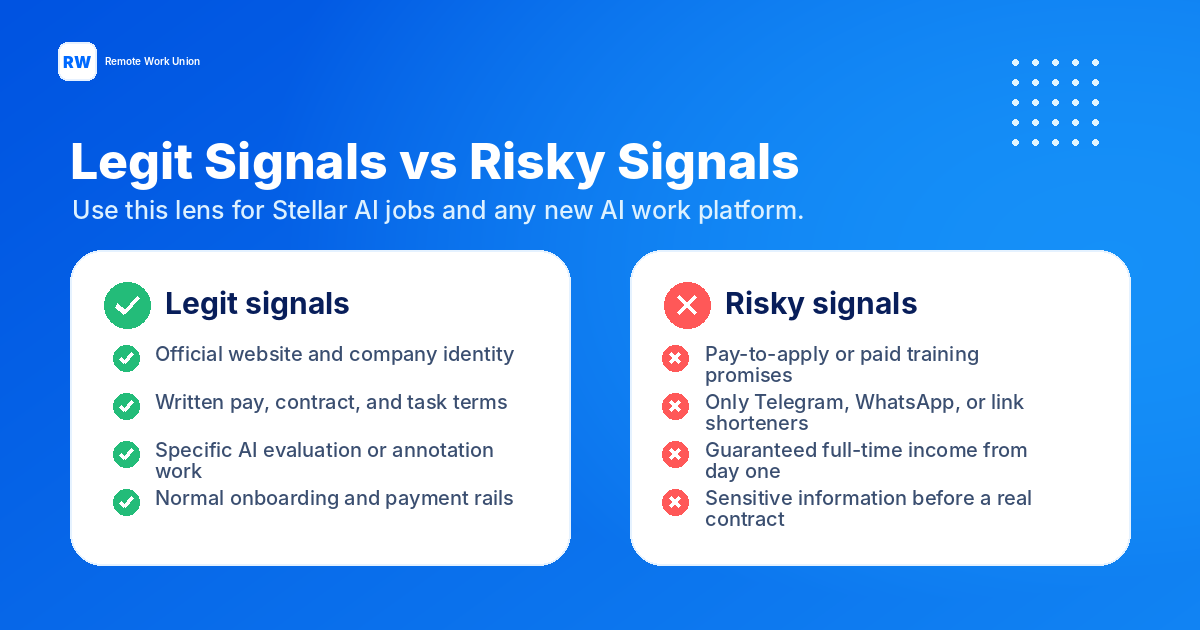
- You must pay to apply, pay for training, or buy a starter kit.
- The job guarantees high income without testing your skills.
- The recruiter only communicates through Telegram, WhatsApp, or a personal account.
- The application link uses a suspicious shortener or unrelated domain.
- You are asked for sensitive personal information before a real contract or verified onboarding process.
- The listing uses stolen logos from major companies like OpenAI, Google, Meta, Microsoft, Anthropic, or xAI without a clear relationship.
- The role description is mostly hype and does not explain the tasks.
- You are pushed to act immediately or lose the job.
How to decide if a platform fits your background
The best AI training platform for you depends on your strengths. Do not apply to every role with the same resume and the same generic pitch. Match your profile to the task.
If you are a strong writer, emphasize clear explanations, editing, research, fact-checking, and judgment. If you have technical skills, highlight coding languages, debugging, software review, math, data analysis, and structured reasoning. If you have professional expertise, make it obvious: legal research, finance, healthcare, accounting, education, product management, consulting, science, or academic research can all matter in specialized AI evaluation roles.
For generalist Stellar AI jobs or similar AI data evaluator roles, the best applicant is usually someone who can read instructions carefully, compare outputs without rushing, write concise feedback, and stay consistent across repetitive tasks. You do not always need to be a machine learning engineer. You do need to be precise.
How to prepare before applying
Before applying to Stellar AI or any new AI training platform, prepare a simple package:
Resume headline: Use a headline that matches the job. Examples:
- AI Content Evaluator | Writing, Research, and Response Quality Review
- Data Annotation and AI Model Evaluation | Strong Research and Writing Skills
- Finance Expert for AI Training | Excel, Analysis, and Business Writing
- Software Reviewer for AI Coding Tasks | Python, JavaScript, and Code Explanation
Skills section: Include relevant keywords naturally. Useful skills may include AI evaluation, prompt writing, response ranking, data annotation, fact-checking, research, editing, rubric-based review, QA, Excel, SQL, Python, legal research, financial analysis, healthcare writing, teaching, tutoring, or technical documentation.
Work samples or assessment mindset: Some platforms do not ask for samples, but many will test you. Practice explaining why one AI answer is better than another. Good feedback is specific — instead of writing "Answer A is better," explain that Answer A follows the instructions, includes accurate details, avoids unsupported claims, and gives a more complete answer in a clearer structure.
Tracking spreadsheet: Keep a simple tracker with columns for platform, role, date applied, email used, assessment status, pay details, country eligibility, onboarding status, and notes. This prevents applying twice by mistake and helps you identify which platforms are worth your time.
Should you apply to more than one AI platform?
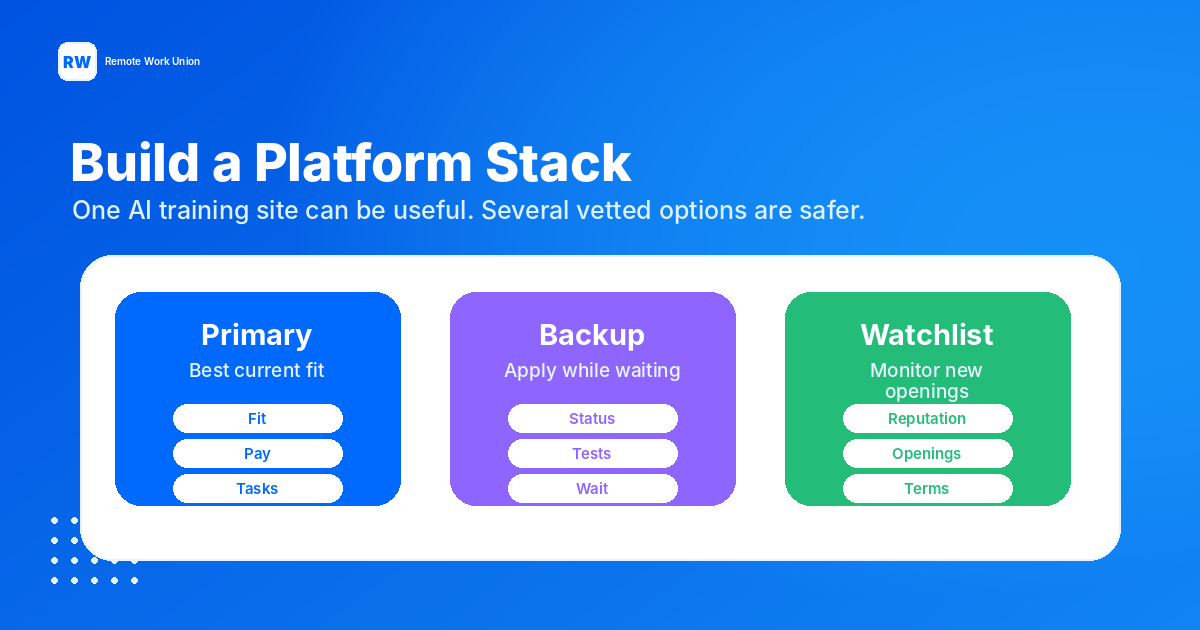
Usually, yes. AI training work is often inconsistent. A smart applicant treats platforms like a portfolio rather than a single employer. One platform can be your primary option, another can be a backup, and several can be on your watchlist.
This does not mean spamming every form online. It means applying carefully to a realistic set of platforms that match your skills. For many applicants, that may include Stellar AI, Mercor, Outlier, Handshake AI, micro1, Surge AI, DataAnnotation, search quality rater companies, and remote job boards like LinkedIn or specialized AI hiring pages.
The goal is not just to get accepted. The goal is to find platforms that give you real tasks, clear pay, reasonable support, and projects that fit your abilities.
A realistic income mindset
Remote AI jobs can be useful, but they are not magic. Some applicants earn strong part-time income. Some pass assessments and wait. Some get a few tasks and then see work slow down. Some never hear back after applying.
This is normal in contract-based AI training. Project supply changes. Client needs change. Quality standards change. Platforms may open and close applications by skill, country, or project category.
A realistic strategy is to treat AI training as flexible remote income until proven otherwise. Track your actual paid hours, not just advertised rates. Build a cushion before relying on one platform. Keep applying to roles that match your strongest skills. See the platform comparison guide for a broader look at where to apply.
Final checklist before you apply
Before applying to Stellar AI jobs or any new AI work platform, ask:
- Is this the official application page?
- Do I understand the task type?
- Is the pay structure clear enough?
- Does the platform ask for reasonable information at the right stage?
- Does this role fit my writing, research, coding, language, or professional expertise?
- Am I prepared for unpaid assessments or a waiting period?
- Have I recorded the application in my tracker?
- Do I have other platforms in my pipeline?
If the answer is yes, apply carefully. If the answer is no, keep researching before you submit personal information or spend hours on a test.
Tip: This checklist works for any new AI platform, not just Stellar AI. Save it and use it every time a new AI training opportunity appears in your search results.
Frequently Asked Questions
What are Stellar AI jobs?
Stellar AI jobs are part of the broader remote AI training and evaluation category. They can include generalist AI evaluator tasks, expert review tasks, data annotation, prompt creation, response comparison, quality assurance, or fact-checking work. The exact tasks depend on the platform and specific listing, so applicants should evaluate each opening carefully rather than relying on the platform name alone.
What should I look for before applying to Stellar AI or a similar platform?
Look for a clear official website and consistent application path, specific task descriptions (like AI evaluator, data annotator, or prompt writer), transparent pay structure, clear country and eligibility rules, and realistic information about task availability. A strong platform should explain the work, pay, and expectations before you invest serious time in an application.
What are the green flags in an AI work platform?
Green flags include a clear official website, specific task categories, written terms for pay and worker classification, normal payment methods (bank transfer, PayPal, Stripe), a realistic assessment process, support documentation and onboarding materials, no upfront fee to apply, and no pressure to recruit others as the main way to earn.
What are red flags to avoid in AI training platforms?
Red flags include paying to apply or access jobs, guaranteed high income with no skill requirements, recruiters who only communicate through Telegram or WhatsApp, suspicious application links, requests for sensitive personal information before a real contract, stolen logos from major companies, vague role descriptions with no task details, and pressure to act immediately.
Should I apply to more than one AI training platform at once?
Usually yes. AI training work is often inconsistent — a smart applicant treats platforms like a portfolio rather than a single employer. Applying carefully to a realistic set that matches your skills — such as Stellar AI, Mercor, Outlier, Handshake AI, micro1, Surge AI, and relevant job boards — gives you backup options when one platform slows down.