A lot of people search for online jobs from home as if every remote worker starts from zero. That is a mistake. Many people already have real-world expertise that can be turned into stronger online work. The challenge is not the lack of useful skill. The challenge is recognizing which types of remote jobs actually reward that skill.
The best work-from-home opportunities for experts usually sit in categories where judgment matters. Writing, finance, legal review, education, marketing, engineering, and analytical work all create value online when they are connected to the right tasks. If you already know how to solve real problems, review quality, or communicate clearly, you should not default to low-ceiling online work.
Why Expertise Matters More Online Than Many People Think
The internet makes low-skill work highly visible, but it also creates demand for capable professionals. Businesses need people who can review content, evaluate results, explain information, improve processes, and contribute subject knowledge from anywhere. This is especially true in remote-first businesses and AI-adjacent workflows, where information quality and judgment are central.
That means the best online jobs from home are often not the flashiest ones. They are the roles where your real-world skill solves a specific problem. The more clearly you can show that connection, the more valuable you become.
Categories That Reward Real-World Expertise
One of the strongest categories is AI training and AI evaluation. These roles often need writers, analysts, teachers, marketers, finance professionals, lawyers, and technical experts who can review outputs and improve quality. Another strong category is specialized freelance or contract work, where domain knowledge gives you an edge over generalists. Research support, editing, operations support, technical review, curriculum support, and analytical consulting can also be strong fits depending on your background.
The main pattern is simple: better online jobs tend to reward interpretation and judgment, not just repetition. That is why real-world expertise matters.
How Writers Can Turn Experience Into Online Work
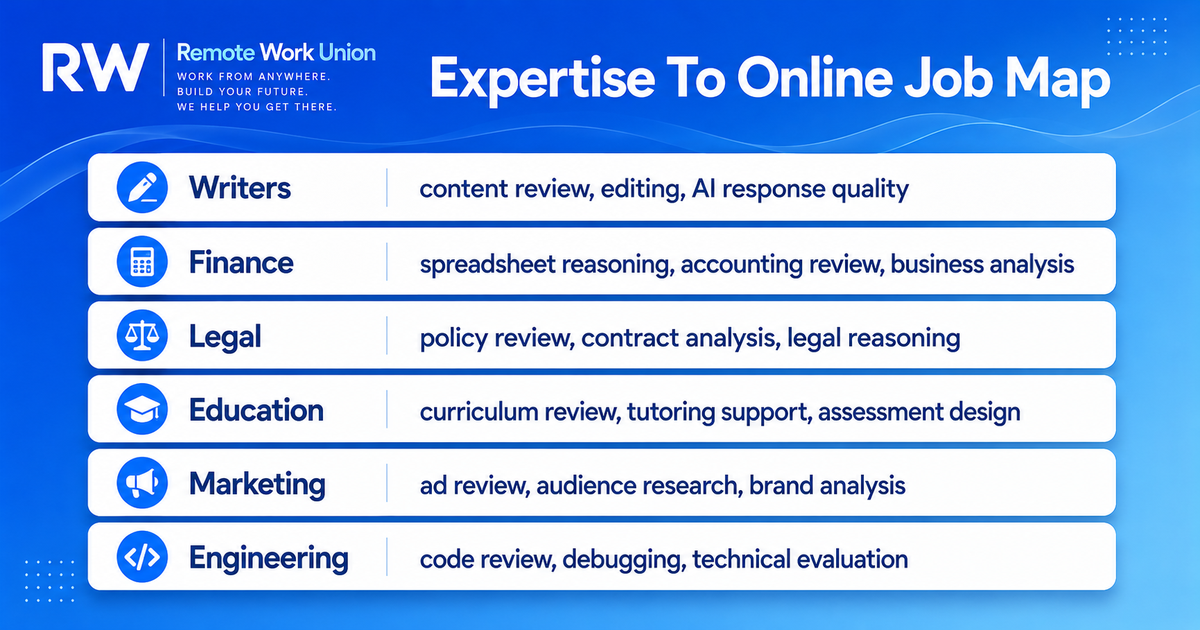
Writers often have more options than they realize. Clear writing translates naturally into editing, AI response evaluation, content review, summarization, research synthesis, and communication-heavy remote roles. Strong writers are also often strong explainers, which makes them useful in support, education, and content strategy work.
The key is to position writing as a professional tool, not just a creative trait. Employers want to know that your writing improves clarity, quality, and decision-making.
How Finance, Legal, and Analytical Backgrounds Translate
Finance professionals can be strong fits for spreadsheet reasoning, accounting review, business analysis, and structured evaluation. Legal professionals often bring language precision, policy review skill, and comfort with nuance. Analysts and operations professionals tend to be good at pattern recognition, process thinking, and quality control.
These backgrounds work especially well in remote jobs where the output needs to be checked rather than merely produced. That includes AI evaluation, decision support, review workflows, and research-oriented work.
How Educators, Marketers, and Subject Experts Fit In
Educators are often well-suited for curriculum review, tutoring support, explanation-based work, assessment design, and AI tasks that require clarity and pedagogy. Marketers can contribute through audience analysis, ad review, brand interpretation, content strategy, and messaging quality. Subject-matter experts in many fields can contribute through expert review, domain verification, and project-based research.
In each case, the value comes from experience meeting judgment. The internet is full of places where that combination matters.
The High-Value Human Skills That Still Matter Most
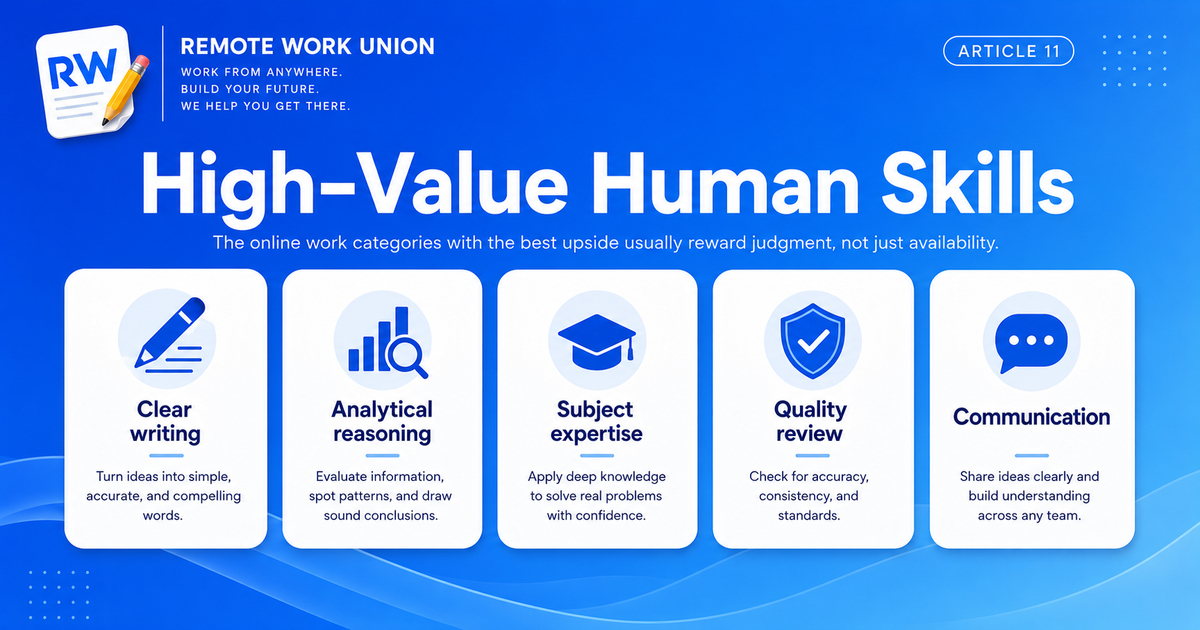
Five human skills continue to have strong pricing power across online work: clear writing, analytical reasoning, subject expertise, quality review, and communication. These skills are valuable because they are difficult to replace with pure availability. A person who can communicate clearly and evaluate quality is far more useful than someone who can only click through repetitive tasks.
This is also why remote AI jobs have become so attractive. Many of them are really markets for human judgment under a new label.
How to Choose the Right Category for Your Background
Start by asking which tasks you already perform well. Do you evaluate quality? Explain complex ideas? Work with numbers? Review documents? Make structured decisions? Once you identify the underlying skill, look for online job categories that depend on it.
This is more effective than searching only by title. Titles can be vague, but tasks reveal where your value actually fits.
How to Present Yourself Better
If you want better online work, your application materials should show proof of useful thinking. That can come through your resume, portfolio, writing samples, analyses, slide decks, reports, lesson materials, or other work product. The strongest applications do not just say "I have experience." They show what kind of thinking that experience trained you to do.
That is how you stand out from generic remote applicants.
Key insight: The strongest applications connect experience to tasks, not just titles. "I analyze financial statements" is more useful to a hiring team than "I work in finance." Make the task fit obvious.
Conclusion
The best online jobs from home for people with real-world expertise are the ones that reward judgment, communication, and domain knowledge. If you already have strong skill in writing, finance, law, education, marketing, engineering, or analysis, there is a good chance you are more qualified for modern remote work than you think. The key is targeting the right categories and presenting your background with clarity.