Remote AI work can feel confusing during the first month because it does not always look like a traditional remote job. You may not have a manager assigning the same work every morning. You may not receive a fixed weekly schedule. You may pass one qualification, wait for a project, complete a few tasks, and then see new instructions appear the next day. That is normal for many AI training, AI evaluation, AI data annotation, and AI model review roles. The first 30 days are less about maximizing income immediately and more about proving that you can follow guidelines, make careful judgments, explain your reasoning, and work independently from home.
The good news is that remote AI work is one of the most accessible ways for writers, researchers, editors, analysts, subject matter experts, bilingual professionals, and detail-oriented generalists to enter the AI economy without becoming software engineers. Many projects need people who can compare AI responses, rate helpfulness, check facts, rewrite unclear answers, label data, review sources, or judge whether an output is safe, useful, and accurate. These tasks help improve systems built by large AI companies and AI products associated with names like OpenAI, Anthropic, Google, Meta, Grok, and other AI labs.
Your first month should be treated as a training period. The workers who usually last are not always the fastest people. They are the people who read the rules, keep notes, submit consistent work, and avoid careless mistakes.
What This Article Covers
- What Remote AI Work Usually Includes
- Days 1–3: Set Up Before You Chase Tasks
- Days 4–7: Qualifications, Small Tasks, and Waiting
- Week 2: Learn the Quality Bar
- Week 3: Build a Repeatable Rhythm
- Week 4: Optimize for Better Matches
- What You Should Not Expect in the First 30 Days
- How to Track Progress During Your First Month
- Common First-Month Mistakes
- A Practical 30-Day Checklist
- The Long-Term View
- Frequently Asked Questions
What Remote AI Work Usually Includes
Remote AI work is a broad category. During your first 30 days, you may see several kinds of projects depending on your background, location, language, and platform approvals. Common project types include AI response rating, prompt writing, data annotation, factual accuracy review, search result evaluation, content editing, reasoning evaluation, safety review, and domain-specific expert review.
For example, a task may ask you to compare two AI answers and decide which one is more helpful. Another task may ask whether an AI answer used a reliable source. A writing project may ask you to improve a response so it sounds natural and complete. A subject matter expert project may ask a lawyer, finance professional, teacher, marketer, engineer, or medical-adjacent professional to judge whether an answer meets a higher knowledge standard.
The first thing to understand is that every project has its own rules. A platform such as micro1, Mercor, Handshake AI, Outlier, DataAnnotation, or another AI training marketplace may use similar words like evaluator, reviewer, trainer, annotator, or AI rater, but the instructions can be very different from project to project. Do not assume that one task standard applies everywhere.
Days 1–3: Set Up Before You Chase Tasks
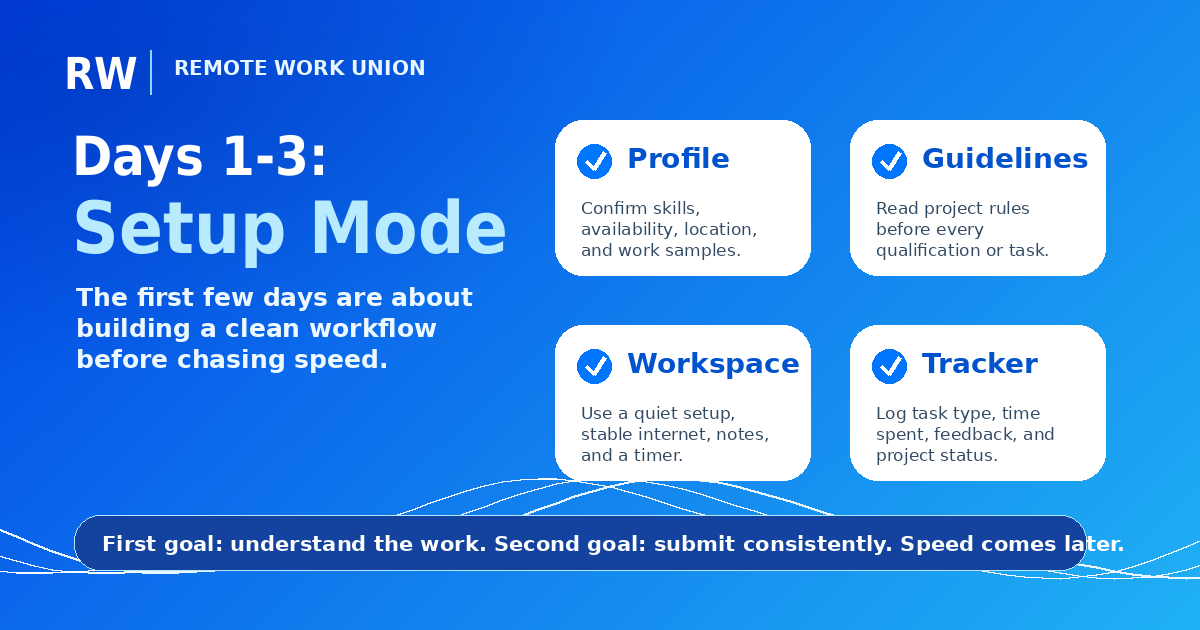
The first three days should be used to get organized. This is where many beginners make mistakes. They create a profile quickly, skim the rules, take a qualification while distracted, and then wonder why they did not get matched with better remote work.
Start by making your profile clear. Include the skills that actually help with remote AI jobs: writing, research, editing, fact-checking, analysis, customer research, legal review, finance knowledge, coding, math, science, marketing, operations, bilingual fluency, or any other area where you can judge quality. Do not overclaim. A strong AI training profile is specific and believable.
Set up a simple work environment. You do not need an expensive home office, but you do need a reliable computer, stable internet, a quiet place to think, and a way to track your work. Create a spreadsheet or notes document with columns for platform, project name, task type, guideline link, pay structure, qualification status, feedback received, and next action. This keeps your remote work from turning into a messy pile of open tabs.
First goal: Your first goal is not speed. Your first goal is understanding. Workers who rush through the setup phase often waste days chasing the wrong qualifications or submitting weak applications that never get matched.
Days 4–7: Expect Qualifications, Small Tasks, and Waiting
During the first week, you may spend more time qualifying than earning. That can be frustrating, but it is part of the process. AI training platforms often use tests, sample tasks, interviews, resume screens, or trial projects to decide who should receive work. You may pass some, fail some, and never hear back from others.
Do not treat every quiet period as rejection. Remote AI platforms often have uneven project supply. A project may fill up. A client may pause work. A task queue may only open to certain locations or skill groups. Your account may be approved before the right task is available.
This is why the first week should include multiple applications. Do not build your entire remote income plan around one platform. Apply to several legitimate AI training and remote work platforms, especially if you are trying to replace part-time or full-time income. Use the same core profile, but tailor each application to the role. A general AI evaluator application should emphasize judgment, writing, and reliability. A research role should emphasize source quality and evidence. A coding role should emphasize languages, projects, and debugging. A legal or finance role should emphasize domain experience and careful reasoning.
Week 2: Learn the Quality Bar
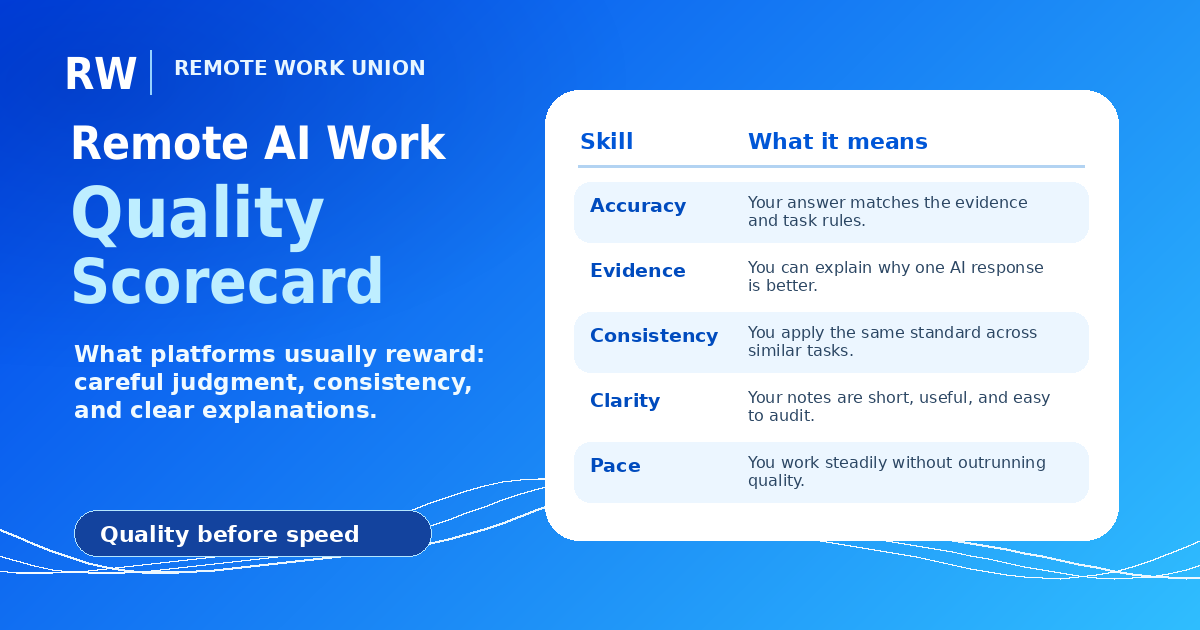
The second week is where you begin to understand what the work actually rewards. Many beginners assume AI work is about giving opinions. It is not. It is about applying a standard.
If a task asks you to compare two AI responses, your answer should usually be based on specific criteria: accuracy, completeness, instruction following, clarity, safety, tone, and usefulness. If a task asks you to label data, you need to follow the exact label definitions. If a task asks for a written explanation, your explanation should be short, clear, and tied to the guideline.
Keep a running decision log. Write down examples of confusing cases and how you handled them. If you receive feedback, add it to your notes. If the platform shows a correction, record the pattern. Over time, this becomes your private training manual.
Platforms can remove workers from projects for low quality, inconsistent ratings, guideline violations, or suspicious work patterns. In remote AI work, your reputation is built task by task.
Week 3: Build a Repeatable Remote Work Rhythm
By the third week, the work should start to feel less random. You may still see uneven task availability, but you should have a better sense of where you fit. Some people discover that they are strongest at writing evaluation. Others are better at research, editing, language review, math, coding, customer support simulation, or business judgment tasks.
Build a schedule around focus, not around panic-refreshing task pages. Remote AI work often rewards deep attention. Two focused hours can beat six distracted hours. Choose a block of time when you can read instructions carefully and avoid interruptions. Use a timer to measure real task time. If a project pays by task, this helps you understand whether the rate is worth it. If it pays hourly, this helps you stay honest about your workflow.
You should also begin separating platforms into categories: active earners, waiting list accounts, qualification targets, and not worth your time. This matters because not every remote AI opportunity is equal. Some projects are well organized. Some are confusing. Some pay well but rarely have work. Some are easy to start but difficult to scale. A serious remote worker learns to manage the portfolio.
Ready to build a steadier remote AI workflow? Find opportunities hiring now on RemoteWorkUnion.com.
Find Roles Hiring Now →Week 4: Optimize for Better Matches
The fourth week is when you should stop thinking like a one-time applicant and start thinking like a long-term remote worker. Review your profile and ask whether it clearly shows what you are best at. If you have completed tasks, passed qualifications, or gained feedback, update your notes and use that experience to apply for better-matched roles.
This is also the time to look for higher-value categories. General data annotation can be a starting point, but expert review may pay better when you have a real skill. Strong writers can look for AI writing evaluator, prompt writer, AI content editor, and response quality reviewer roles. Researchers can look for factuality, search evaluation, and citation review. Lawyers and paralegals can look for legal AI evaluation. Finance professionals can look for business, accounting, investing, or spreadsheet-based review. Engineers and coders can look for code evaluation, debugging, and technical reasoning tasks. Bilingual workers can look for language evaluation and translation quality review.
The goal is not to pretend you are an expert in everything. The goal is to make it easy for platforms to understand where your judgment is strongest.
What You Should Not Expect in the First 30 Days
Do not expect every platform to respond quickly. Do not expect task availability every day. Do not expect one application to become a stable salary immediately. Do not expect high-paying expert work if your profile is vague. Do not expect to be rewarded for rushing.
Remote AI work is real work, but it is often project-based. That means the first month can include onboarding, silence, qualifications, sudden task drops, feedback, and account review. Some workers get strong projects quickly. Others need weeks of applications before they find a reliable fit.
You should also avoid any platform that asks you to pay to start. Legitimate remote AI work platforms may ask for applications, assessments, identity checks, tax forms, or payment setup, but they should not require a startup fee for access to basic work. A fee-based promise of guaranteed AI jobs is a red flag.
How to Track Progress During Your First Month
A simple tracking system can make your first 30 days much more productive. Track every platform you apply to, the date you applied, the role, whether you completed a test, whether you passed, the pay structure if listed, task availability, and any feedback.
Also track your own performance. Which tasks felt easy? Which tasks took too long? Which instructions confused you? Which projects paid fairly for the time required? Which ones drained your attention? This is how you move from beginner remote work to better remote work.
Key insight: The best remote AI workers are not just completing tasks. They are learning which tasks they are best suited for. That self-knowledge compounds over months and leads to better work, better pay rates, and better matches.
Common First-Month Mistakes
The most common first-month mistake is treating remote AI work like a quick gig app. AI training is not the same as filling out surveys or clicking through simple microtasks. The quality bar can be higher, especially when you are reviewing AI outputs that require judgment.
Another mistake is ignoring confidentiality. Many AI projects have strict rules about sharing task details, screenshots, prompts, client names, or internal guidelines. Treat every project as confidential unless the platform clearly says otherwise.
A third mistake is using AI tools when the project rules do not allow it. Some projects may allow assistance in limited ways. Others prohibit it. Always follow the platform instructions. If the work is meant to measure human judgment, outsourcing that judgment to another AI tool can get your account removed.
Finally, do not quit after one rejection or one quiet week. The remote AI market is uneven. A better approach is to keep applying, improve your profile, and build a portfolio of platforms.
A Practical 30-Day Checklist
Use this checklist to guide your first month:
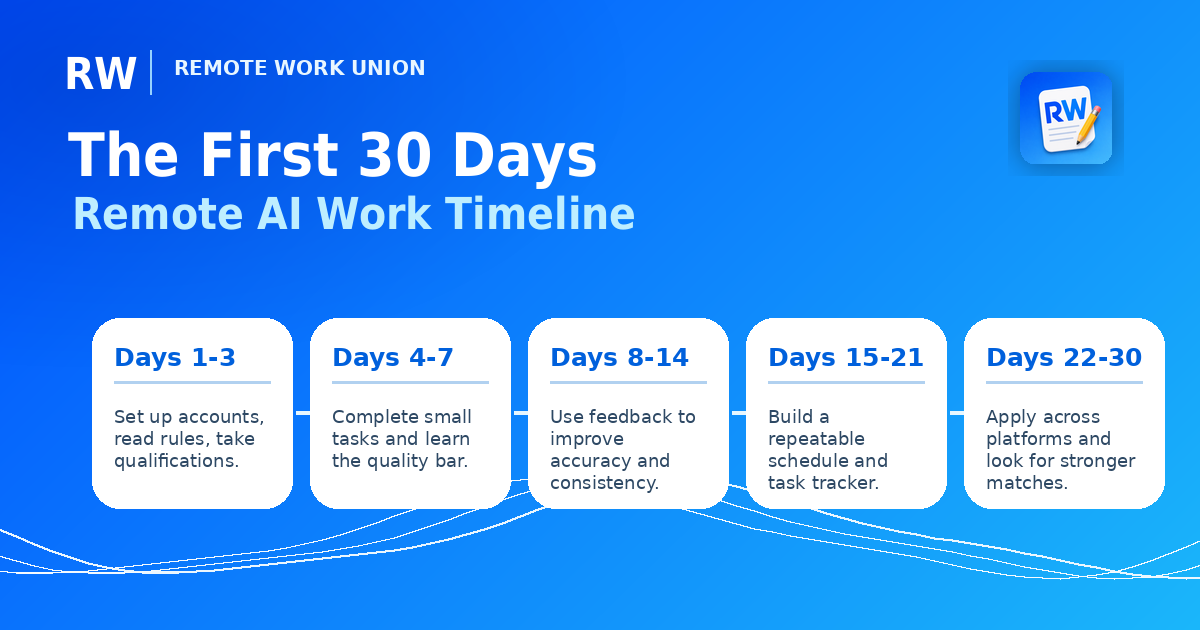
Days 1–3: Create or update your remote AI profile. Set up a task tracker. Gather examples of your writing, research, coding, language, or subject matter expertise. Read every guideline slowly.
Days 4–7: Complete qualifications carefully. Apply to more than one platform. Record which roles fit your skills. Avoid rushing through assessments.
Days 8–14: Review feedback. Identify the task types where you perform best. Build a short notes document with project rules and common decisions.
Days 15–21: Create a repeatable work schedule. Measure task time. Separate strong opportunities from low-value ones. Keep applying to better-matched projects.
Days 22–30: Update your profile based on what you learned. Look for higher-value expert, writing, research, coding, language, or analytical roles. Keep your platform pipeline active.
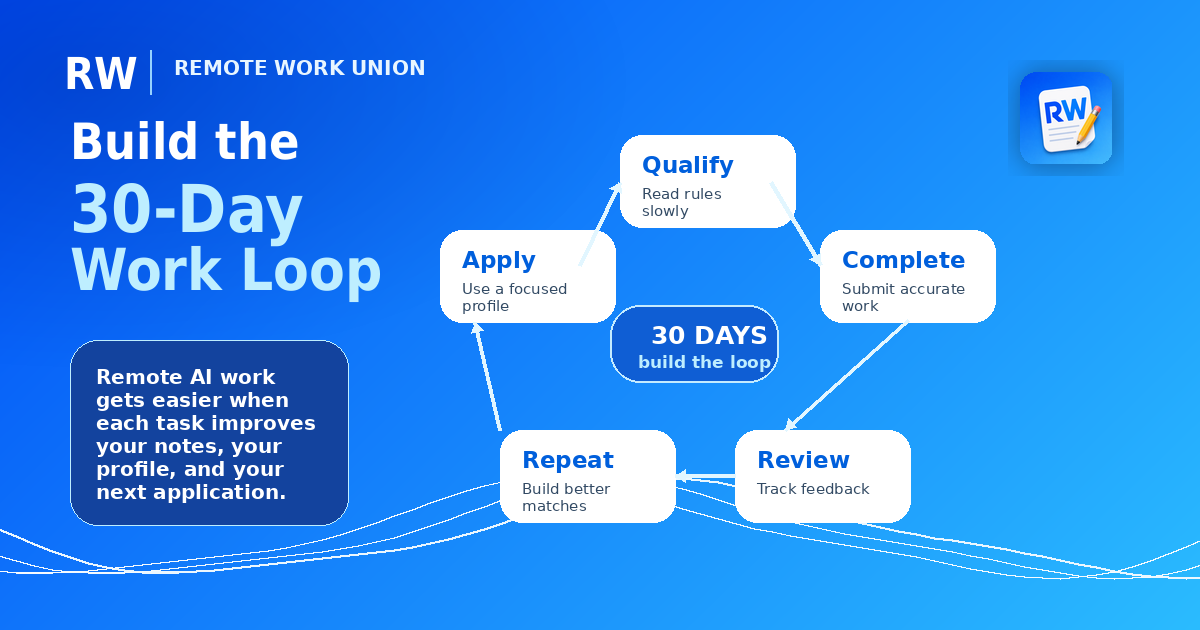
The Long-Term View
Your first 30 days of remote AI work are not just about earning your first payout. They are about learning how the AI work economy actually functions. The people who build long-term remote income usually do three things well: they apply consistently, they protect quality, and they keep improving their fit.
Remote AI work can be a side income, a bridge between jobs, or part of a larger work-from-home career. It can also teach valuable skills: evaluating AI systems, writing precise feedback, checking sources, analyzing outputs, and working independently. Those skills are becoming more useful across marketing, research, operations, education, customer support, legal services, finance, and software.
Treat the first month as a foundation. Learn the rules. Build the habit. Track the work. Apply broadly. Improve the profile. Then use what you learn to move toward better projects and steadier remote work.
Frequently Asked Questions
What should I do in my first week of remote AI work?
Spend days 1–3 setting up your profile clearly, creating a task tracker, and reading guidelines slowly. Days 4–7 should focus on completing qualifications carefully, applying to multiple platforms, and understanding which roles fit your real skills. Do not rush. Your first goal is understanding, not speed.
How long does it take to get tasks on remote AI platforms?
It varies. Some workers get tasks quickly after qualifying. Others wait days or weeks depending on project supply, location, skill match, and platform demand. Do not treat silence as rejection — project queues open and close based on client needs.
Can I use AI tools to help with remote AI work tasks?
It depends on the project rules. Some projects allow limited AI assistance. Many prohibit it because the task is specifically measuring human judgment. Always read the platform instructions carefully. Using AI tools when they are not permitted can get your account removed.
How much can I expect to earn in my first 30 days of remote AI work?
Earnings in the first month are often lower than they will be later because you are still qualifying, learning project rules, and building your platform presence. General AI training tasks typically pay $20+/hr, and expert-tier roles can pay $50–$200/hr, but you need to qualify and match first.
Should I apply to multiple remote AI platforms at once?
Yes. Do not build your remote income plan around a single platform. Apply to several legitimate AI training platforms, including micro1, Mercor, Handshake AI, and Outlier, using the same core profile tailored to each role. This gives you more options when one platform is slow or has no tasks available.