Remote AI work looks global from the outside. The job is online, the tasks are digital, and the companies building large language models serve users around the world. But applicants quickly learn that remote does not always mean worldwide. Some AI training jobs accept applicants from many countries. Others are limited to a short list of countries such as the United States, Canada, the United Kingdom, Australia, New Zealand, Ireland, or selected regions. Some are strictly US-only.
This matters because remote AI jobs can include very different types of work: AI data annotation, AI response rating, prompt writing, model evaluation, search quality review, fact-checking, translation, voice data collection, coding review, math review, legal review, medical review, finance review, and other subject matter expert tasks. A person in Nigeria, India, the Philippines, Kenya, Ghana, Indonesia, Canada, the UK, Australia, or the US may see different projects even when using the same platform.
The best way to think about the market is not "which platform hires everywhere?" It is "which type of AI job is most likely to accept my country, language, payment setup, and skill set?" That framing helps you apply smarter and avoid wasting time on roles that are remote but not eligible for your location.
What This Article Covers
- The Three Main Location Buckets
- Remote Does Not Mean Location-Free
- Remote AI Jobs More Likely to Hire Worldwide
- Remote AI Jobs That Are Often Country-Limited
- Remote AI Jobs That Are Often US-Only
- How to Read a Remote AI Job Posting
- Best Strategy for Applicants Outside the US
- Best Strategy for US Applicants
- Comparison: Which Role Type Goes Where
- Common Mistakes to Avoid
- Frequently Asked Questions
The three main location buckets
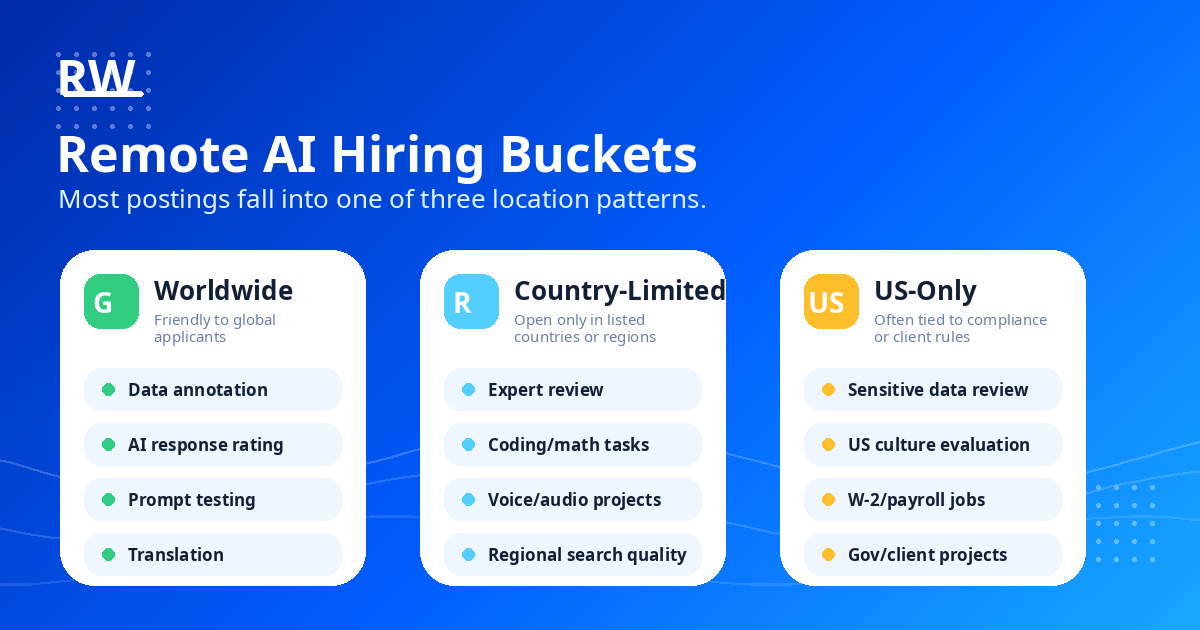
Most remote AI jobs fall into one of three buckets. The first bucket is worldwide-friendly work. These jobs are the closest to truly global. They often involve general AI data annotation, AI response comparison, prompt testing, translation, localization, audio review, image labeling, or language-specific evaluation. The company may still exclude some countries because of payment rails, sanctions, legal rules, or client restrictions, but the posting is not built around one national labor market.
The second bucket is country-limited work. These jobs are remote, but only for applicants in listed countries. A posting might say remote in the US, Canada, UK, Australia, New Zealand, Ireland, Mexico, Argentina, or another defined region. This is common for AI trainer jobs that require a specific language, tax setup, contractor agreement, or client relationship. Country-limited jobs can be good opportunities, but the country list matters more than the word remote.
The third bucket is US-only work. These jobs are remote, but the applicant must be based in the United States. US-only roles often appear when the project involves US legal knowledge, US medical language, US financial regulations, US culture, US English, government-adjacent work, sensitive data, W-2 employment, or client contracts that only allow US-based workers.
Remote does not mean location-free
A remote job can still have location rules for practical reasons. Payment is one of the biggest. A platform may only support certain bank transfers, contractor payment processors, or tax forms. A project may require a worker to complete a US W-9, a non-US tax form, or identity verification that only works in certain countries.
Labor law is another reason. Some companies avoid hiring contractors in countries or states where worker classification rules are complex. Others only operate in places where they already have legal infrastructure. This is why a job can be remote but still say "US only," "authorized to work in the United States," "remote within Canada," or "open to residents of listed countries only."
Data access can also restrict location. AI companies and their vendors may work with text, images, code, search results, safety examples, medical content, legal examples, or financial data. If the client wants only workers from a specific jurisdiction, the platform has to enforce that rule. A job connected to OpenAI, Anthropic, Google, Meta, Grok, or another major AI lab may still be delivered through a vendor or evaluation platform with its own location rules.
Pay range by role type: Worldwide-friendly roles such as general annotation and response rating often pay $20+/hr. Expert-tier roles in law, finance, medicine, coding, and other subject matter areas — which are frequently country-limited or US-only — can pay $50–$200/hr. Matching to the right bucket for your country helps you find work faster.
Remote AI jobs that are more likely to hire worldwide
Worldwide-friendly AI jobs usually share one trait: the work depends on judgment, language, or pattern recognition more than local compliance. AI data annotation is one of the most common examples. Workers label, categorize, compare, or evaluate data so that AI systems can improve. Some tasks are simple, such as deciding whether a response followed instructions. Others require more careful review, such as rating the helpfulness, accuracy, tone, safety, or completeness of an AI-generated answer.
AI response rating is also often global, especially when the project needs diverse perspectives. A worker may compare two model answers and decide which one is better. That can involve writing short explanations, flagging factual issues, checking whether the answer followed the prompt, or identifying harmful content. The core skill is clear reading, careful judgment, and the ability to follow detailed guidelines.
Prompt writing and prompt testing can also be worldwide-friendly, depending on the project. These roles involve writing prompts that test a model, creating examples of good and bad answers, or checking whether an AI assistant handles instructions properly. The work may not require coding, although technical prompt-writing roles can pay more and may be limited to countries where the platform has expert pools.
Translation, localization, and multilingual evaluation are some of the strongest categories for global applicants. AI models need better performance in Spanish, French, Hindi, Arabic, Portuguese, Swahili, Tagalog, Indonesian, German, Japanese, Korean, and many other languages. If you can write clearly in English and another language, your country can become an advantage instead of a limitation.
Voice, audio, and accent projects can also be international. These projects may ask workers to record speech, judge audio quality, transcribe clips, evaluate pronunciation, or help models understand regional accents. The more AI companies expand globally, the more they need human reviewers who understand how real people speak in different countries.
Remote AI jobs that are often country-limited
Country-limited roles are common in higher-paying AI training work. A platform may open a math reviewer role to the US, Canada, the UK, Australia, New Zealand, Mexico, or Argentina, while opening a different language role globally. A coding task may be available in several countries but not all. A finance, law, medical, or science role may be remote but restricted to countries where the client can verify credentials or where the legal agreement already works.
Expert reviewer work is frequently country-limited because the pay is higher and the projects are more specialized. A lawyer reviewing legal reasoning, a doctor reviewing clinical explanations, a CPA reviewing tax content, a software engineer reviewing code, or a researcher checking scientific answers may have to prove credentials. The platform may only support credential verification in certain countries.
Search quality evaluation is also often country-specific. A search result that is useful in the United States may not be useful in India, Nigeria, Kenya, Canada, or Australia. Local culture, local news, local shopping behavior, local slang, and local geography matter. This creates opportunities for international applicants, but the job posting may still say it is only open to residents of a particular country because the project needs local knowledge.
Find remote AI jobs matched to your country, skills, and experience on RemoteWorkUnion.com.
Find Roles Hiring Now →Remote AI jobs that are often US-only
US-only remote AI jobs tend to cluster around compliance, client requirements, and US-specific expertise. Some AI evaluation tasks involve US legal examples, US healthcare language, US tax rules, US insurance, US finance, American education, American politics, or American consumer behavior. For those projects, a US-based reviewer may be required even if the work itself is done from home.
Employee roles are also more likely to be US-only. A full-time AI operations role, AI content quality role, trust and safety role, data quality analyst role, AI support role, or AI project coordinator role may be remote inside the United States but not worldwide. That is because employee hiring usually requires payroll, benefits, tax withholding, employment law compliance, and sometimes state-specific rules.
Sensitive data review is another category that can become US-only. If a project includes proprietary client data, regulated data, legal data, health data, financial data, internal company documents, or government-adjacent material, the client may limit access to US-based contractors. This does not mean global applicants are unqualified. It means the project rules are narrower than the skill requirements.
How to read a remote AI job posting
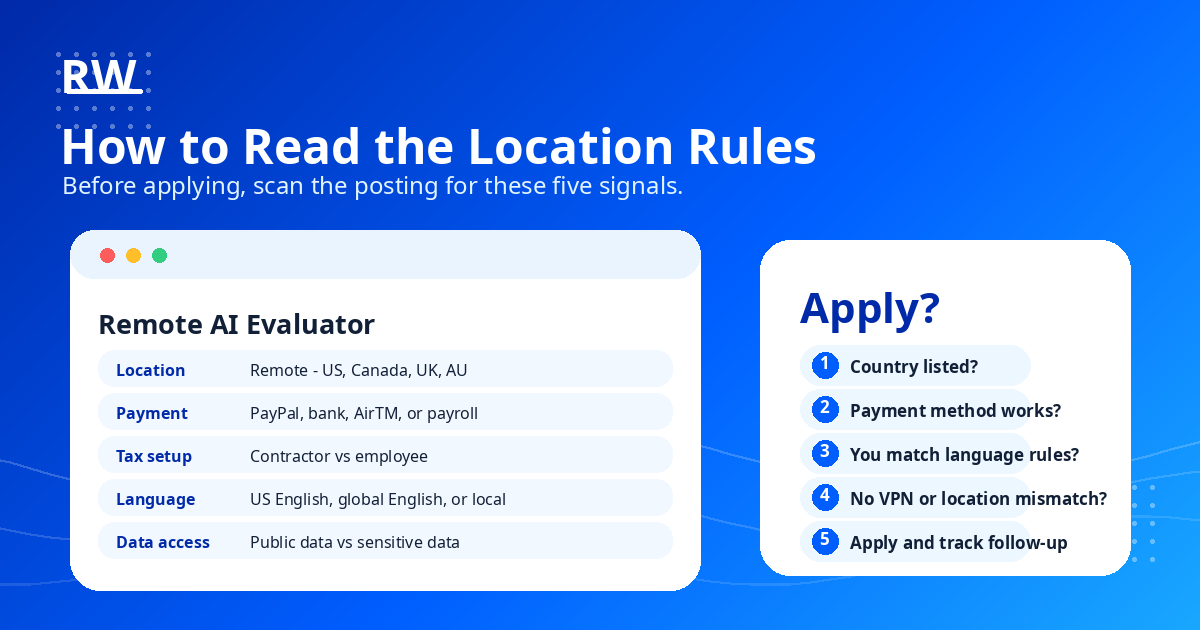
The most important line in any remote AI job posting is not the pay rate. It is the eligibility language. Before you apply, look for phrases like "remote worldwide," "remote - US," "remote within the United States," "open to residents of," "must be located in," "authorized to work in," "native English," "US English," "global English," "contractor," "freelance," "part-time," and "employee."
A posting that says "remote" but lists a country is not worldwide. A posting that says "US English" may prefer American language judgment even if it does not explicitly say US-only. A posting that says "work from anywhere" may still require residency in approved countries. A posting that says "paid via PayPal, AirTM, bank transfer, or payroll" tells you something about which applicants can actually get paid.
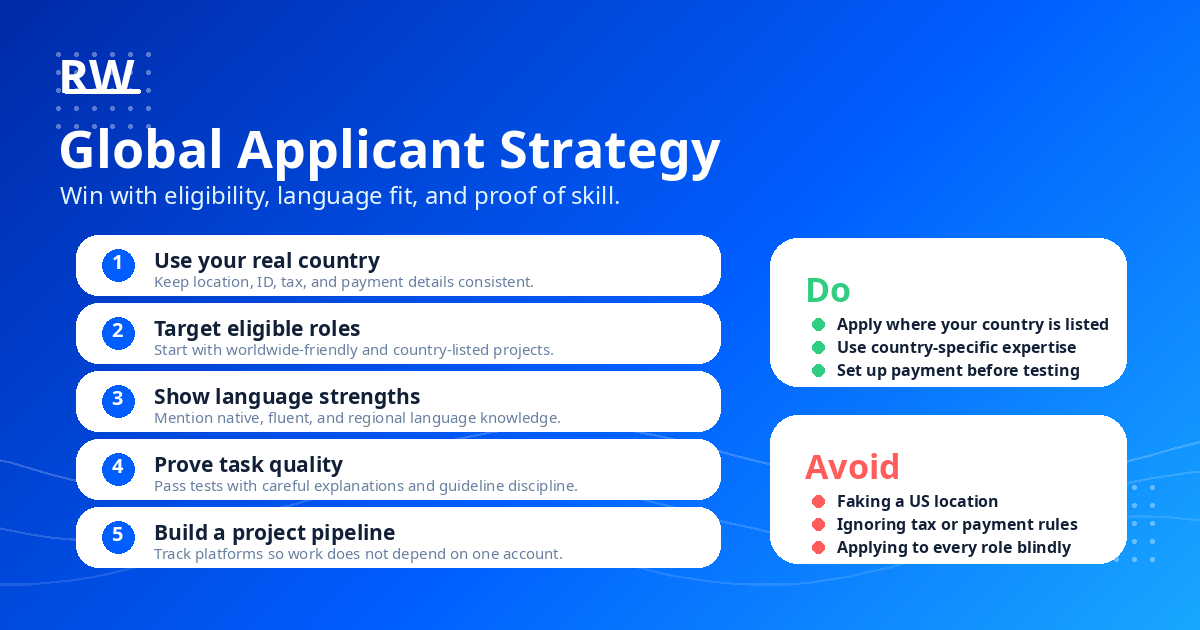
Do not use a VPN or fake your location. AI training platforms often verify identity, payment details, tax information, device signals, and task quality. Misrepresenting your country can get an account paused, blocked, or permanently removed. It is better to apply to fewer eligible roles than to risk losing access by pretending to be in a different country.
Best strategy for applicants outside the US
If you are outside the United States, start with roles that are naturally global: AI data annotation, AI response rating, translation, localization, prompt testing, multilingual evaluation, search quality in your country, and voice or accent data projects. These roles are more likely to value your actual location.
Build your profile around skills that travel well. Mention clear English writing, native or fluent languages, research ability, fact-checking, attention to detail, subject matter knowledge, coding, math, finance, legal experience, healthcare experience, education, customer support, editing, or operations. Avoid writing a profile that only says "I want remote work." Platforms match people to tasks based on skills, not just availability.
Use your country as a keyword when it helps. If you are in Nigeria, Kenya, Ghana, India, the Philippines, Indonesia, Brazil, Mexico, South Africa, Canada, the UK, Australia, or another market where AI companies need language and cultural data, say what you know. Local knowledge can matter for search evaluation, speech review, regional slang, ecommerce examples, political context, education content, and customer behavior.
Also prepare your payment setup before you apply. Make sure you understand whether you can receive payments through the method listed. Keep your tax information accurate. Use a consistent name, country, email, and payment identity. The fastest way to look unreliable is to have mismatched account details.
Best strategy for US applicants
If you are in the United States, you have access to more US-only postings, but that does not mean you should ignore worldwide roles. US applicants can be competitive for general AI evaluation, prompt writing, editing, factual review, coding review, expert review, and content quality roles. The advantage is that some high-context projects specifically need American English, US culture, US consumer behavior, US law, US finance, or US healthcare familiarity.
Use that advantage clearly. If you have experience in law, healthcare, accounting, sales, marketing, education, customer support, operations, software engineering, research, or writing, connect that experience to AI evaluation. For example, a former customer success manager may be strong at judging whether an AI answer is helpful to a customer. A marketer may be strong at reviewing brand tone and content quality. A paralegal may be strong at legal reasoning tasks. A teacher may be strong at curriculum and explanation quality.
US-only does not automatically mean higher-quality work, but it can reduce competition. When a role is limited to one country, fewer people can apply. That can help qualified applicants get matched faster, especially for niche projects.
Comparison: which role type goes where
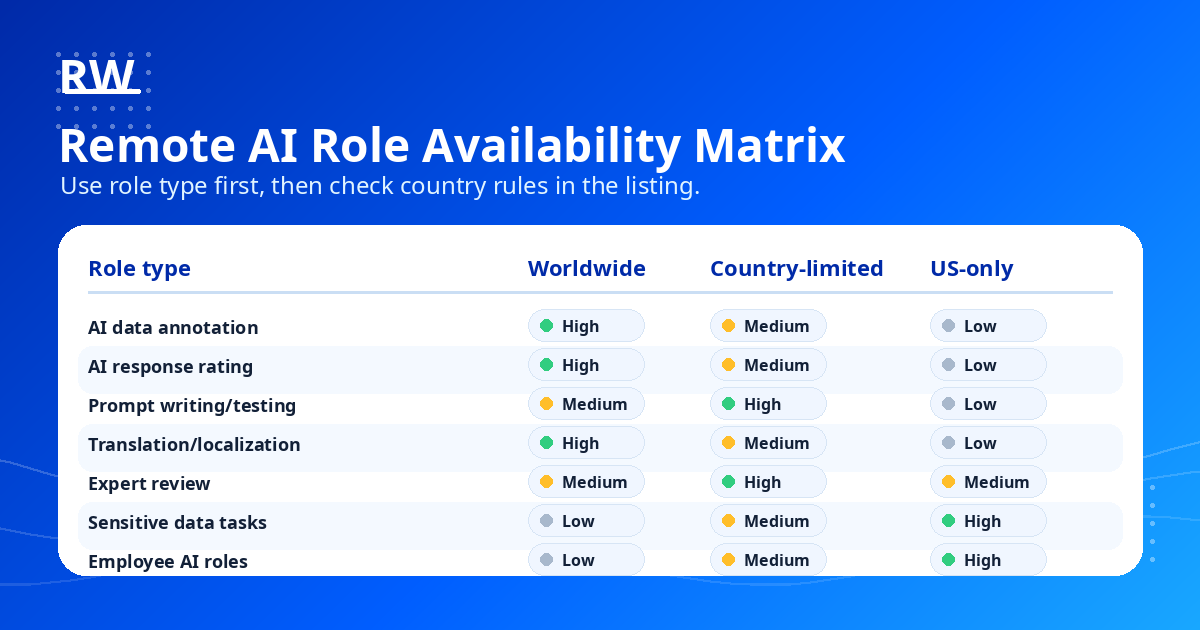
Worldwide-friendly roles are usually best for general AI training, language evaluation, response rating, data annotation, and multilingual tasks. Country-limited roles are common for expert projects, coding, math, science, search quality, and specific language markets. US-only roles are common for employee jobs, sensitive data projects, US English evaluation, US legal or medical review, and client-restricted work.
The same job title can appear in more than one bucket. "AI evaluator" could be worldwide on one platform, country-limited on another, and US-only for a specific client. "Prompt writer" could be global for creative prompts but US-only for a project about American tax software. "Data annotator" could be open worldwide for public text data but restricted for private business data. The title is only the first clue. The location language is the deciding factor.
Common mistakes to avoid
The first mistake is applying to every remote AI job without checking location rules. This wastes time and can make your application history messy. The second mistake is assuming a platform is either global or US-only forever. Platforms change country access by project, not just by company policy. One month they may need writers in Canada and India. Another month they may need US legal experts or UK English reviewers.
The third mistake is hiding your location. This is not worth it. If a project is US-only, it is better to move on to a worldwide-friendly role than to risk losing the account. The fourth mistake is ignoring language-specific roles. Many international applicants compete for generic English tasks while overlooking local language work that may have less competition.
The fifth mistake is treating remote AI work like a guaranteed full-time job. Many AI training projects are flexible, project-based, and inconsistent. The smarter strategy is to join multiple legitimate platforms, keep your profiles updated, track applications, and build a pipeline of possible projects.
Key takeaway: General AI data annotation, AI response rating, multilingual evaluation, translation, and prompt testing are more likely to hire worldwide. Expert review, coding, math, science, and search quality tasks are often country-limited. Employee roles, sensitive data review, US English evaluation, and US legal or healthcare tasks are often US-only. Apply where your country, skills, and payment setup actually match.
Frequently Asked Questions
Which remote AI jobs are most likely to hire worldwide?
General AI data annotation, AI response rating, translation, localization, multilingual evaluation, prompt testing, voice and accent data projects, and public-content review are the most likely to hire worldwide. These roles depend on judgment, language, and pattern recognition rather than local compliance rules.
What makes a remote AI job US-only?
US-only remote AI jobs tend to cluster around compliance, client requirements, and US-specific expertise. Common reasons include projects involving US legal examples, US healthcare language, US tax rules, employee-only roles requiring payroll and benefits, sensitive data with restricted access, and client contracts that only allow US-based workers.
Can applicants outside the US get hired for AI training jobs?
Yes. Many AI training platforms accept global applicants for annotation, response rating, translation, localization, multilingual evaluation, and search quality roles. International applicants are often competitive when they have clear writing skills, native or fluent languages, domain expertise, and accurate payment setup.
How do I know if a remote AI job is open to my country?
Read the eligibility language carefully before applying. Look for phrases like "remote worldwide," "remote - US," "open to residents of," "must be located in," "authorized to work in," or "native English." If a posting says "remote" but lists a country, it is not worldwide. Never use a VPN to fake your location — platforms verify identity and payment details.
What is the difference between worldwide-friendly, country-limited, and US-only AI jobs?
Worldwide-friendly jobs accept applicants from many countries for general annotation, response rating, translation, and multilingual work. Country-limited jobs are remote but restricted to a defined list of countries, common for expert review, coding, math, and search quality projects. US-only jobs require US residency and are common for employee roles, sensitive data review, US English evaluation, and client-restricted projects.