Writers searching for "AI detector jobs" or "AI humanizer jobs" are looking for something real — income tied to the exploding demand for AI-related writing work. But the search terms themselves often lead to dead ends: tools that detect AI content, services that rewrite it, or gig platforms offering low pay for repetitive tasks.
The real, consistent, well-paid writing work in the AI space is in AI model evaluation — reviewing AI writing for quality, accuracy, tone, and usefulness as part of model training and improvement pipelines. This work exists at significant scale. Understanding where it is and how to find it is more useful than chasing detector tools or humanizer services.
What These Searches Actually Mean
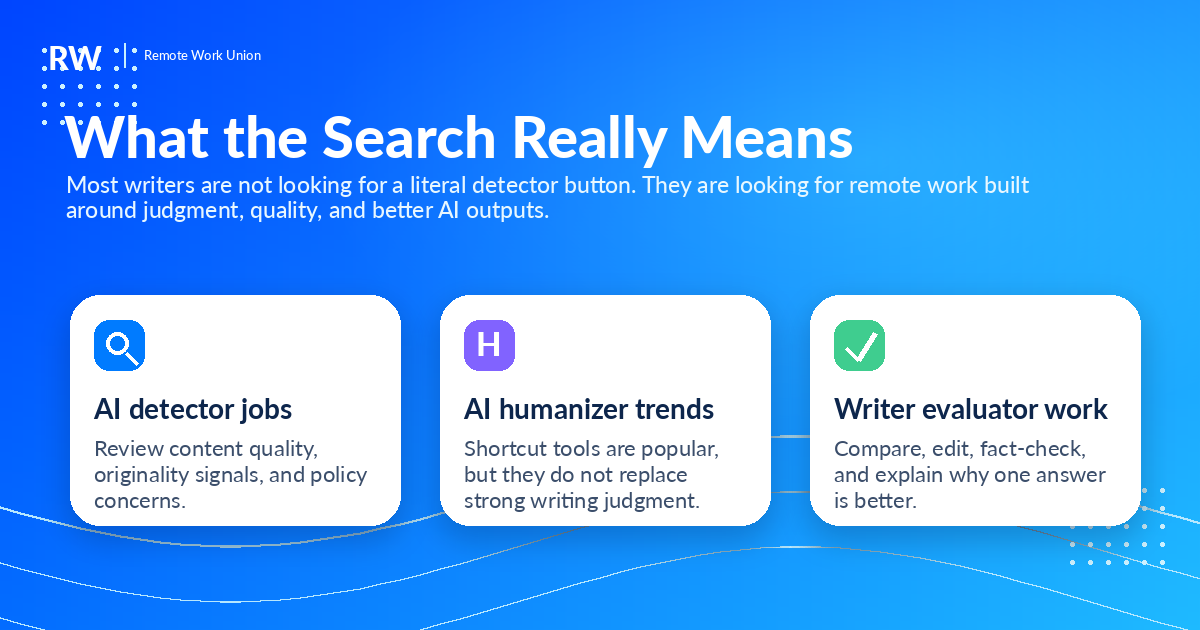
"AI detector jobs" is a phrase writers search when they want to work in quality control for AI-generated content. The underlying intent is usually: "someone needs a human to check whether AI-generated content is good, and I want to do that work." The actual job category that answers this intent is AI writing evaluator or AI model evaluation — not a role using detection software.
"AI humanizer jobs" reflects a related but different intent: making AI text sound more natural. Writers search this when they are hoping to be paid to rewrite or improve AI outputs. The legitimate version of this work exists as part of AI training — specifically, in tasks where evaluators provide style feedback on AI-generated writing or compare two responses and identify which is more natural and useful.
Where Real AI Writing Work for Writers Is
The best AI writing evaluation work for writers in 2026 comes through four main types of platforms:
- AI model evaluation platforms: Outlier AI, Mercor, Handshake AI, and micro1 all hire writing evaluators as contractors. Pay ranges from $20+ per hour for general writing evaluation to $50–$200/hr for specialist content areas.
- Search quality rating programs: Platforms that evaluate AI-powered search results for relevance and quality. Strong writers with good research skills do well in these programs.
- Specialized writing annotation: Some AI training projects specifically recruit editors, journalists, or content strategists to evaluate narrative structure, argument quality, or editorial consistency in AI-generated content.
- Vendor and contractor networks: Many AI companies use indirect sourcing through evaluation vendors. These often post on job boards under titles like "AI writing evaluator," "content quality reviewer," or "AI trainer."
Remote Work Union connects writers to AI training and model evaluation roles. Apply for free to find roles hiring now.
Find Roles Hiring Now →The AI Writing Evaluator Workflow
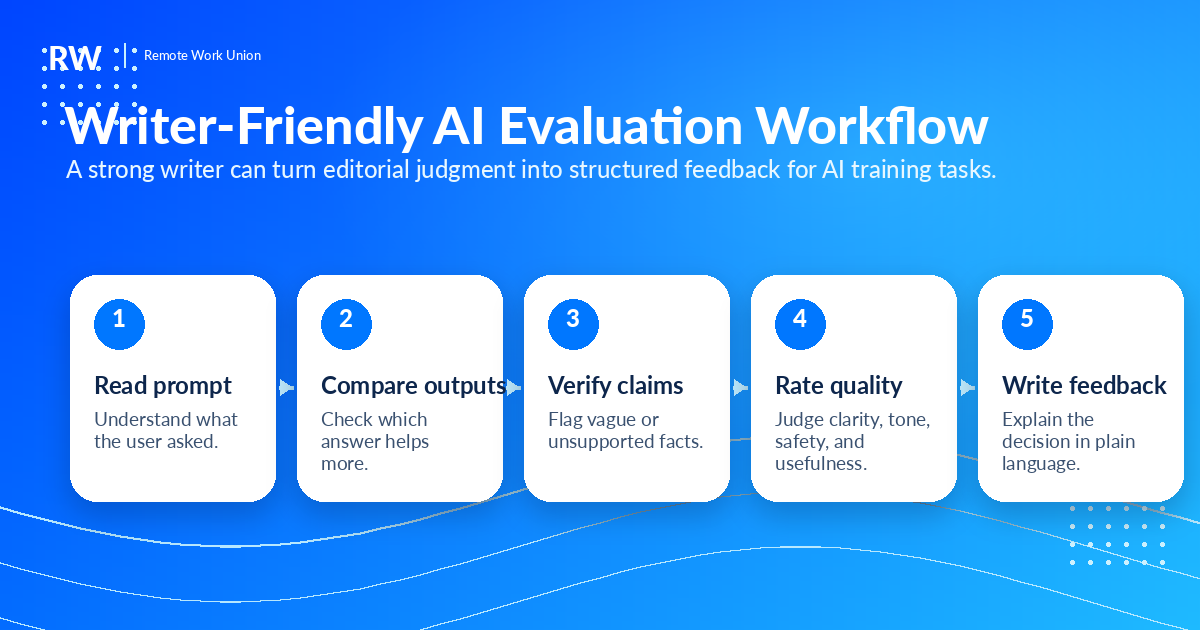
AI writing evaluation work for writers typically involves one or more of these task types: comparing two AI-generated responses and explaining which is better for the prompt, rating a single response on dimensions like helpfulness, accuracy, tone, and clarity, identifying specific problems in an AI-generated piece, suggesting or writing improvements to a draft, and categorizing writing style or format issues for model training datasets.
Each task is self-contained. You complete it, submit it, and move to the next one. There is no fixed schedule — you work when tasks are available and your schedule allows. This flexibility is one reason writers with other creative or professional commitments are well-suited to AI evaluation work.
Skills That Matter for Writers in AI Evaluation
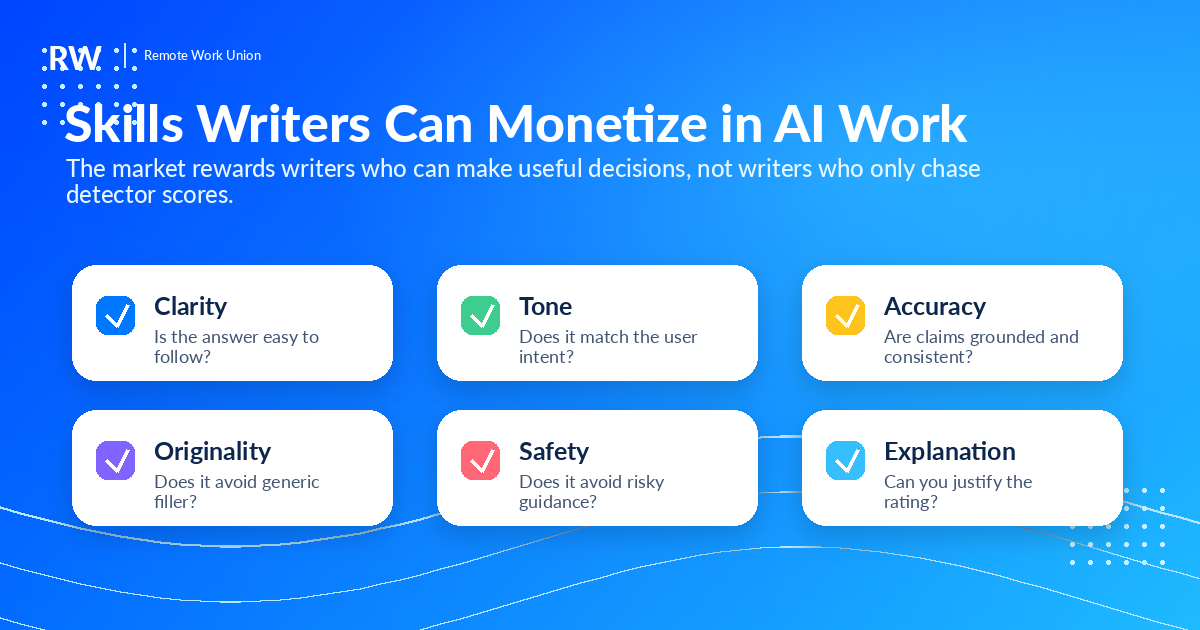
The most valuable skills for writers pursuing AI model evaluation roles are: precise reading (noticing tone shifts, unclear antecedents, overreaching claims), consistent judgment (applying the same quality standard across many pieces), concise feedback writing (explaining what is wrong and how to fix it in two sentences, not two paragraphs), awareness of accuracy (AI writing evaluation often requires checking whether facts are correct, not just whether the prose sounds good), and understanding of audience (what makes a good response depends on who asked and what they needed).
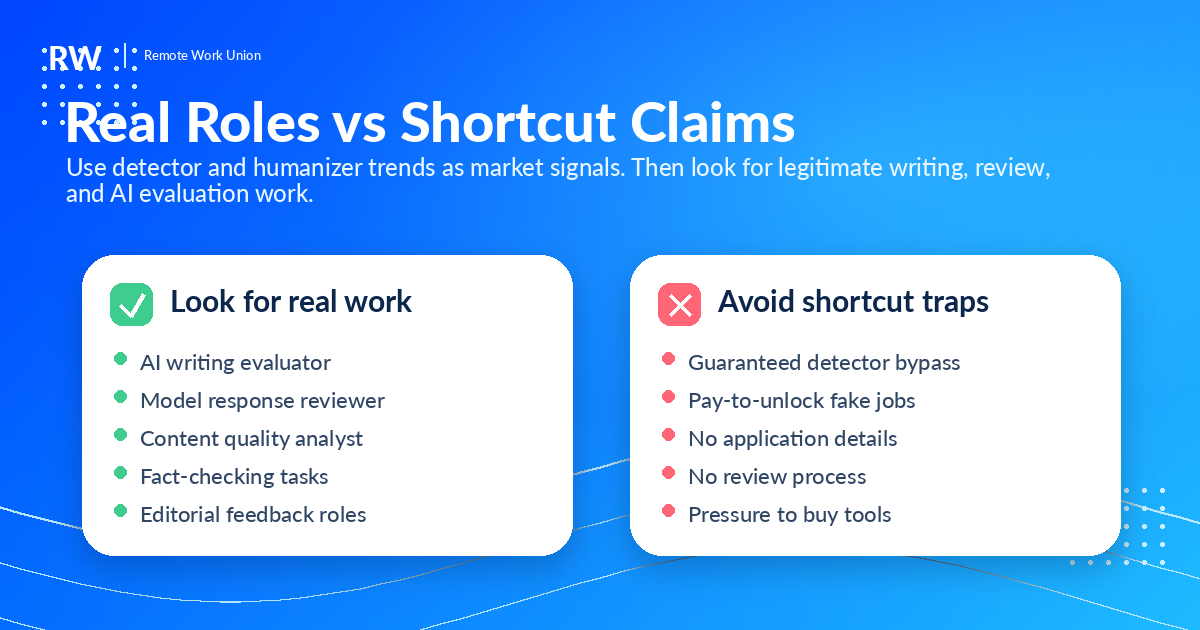
Real Roles vs Quick-Money Shortcuts
The AI writing space has attracted many low-quality job listings aimed at writers looking for fast income. Warning signs: pay per word rather than per hour (usually very low), promises of guaranteed income for minimal effort, requests to use a specific AI tool to produce the work then submit it (this is ghostwriting AI content, not evaluation), and vague descriptions that mention AI but describe simple transcription or data entry tasks.
Real AI writing evaluation roles describe the evaluation process clearly, pay per task or per hour at rates above minimum wage, require a skills assessment before starting, and are offered through platforms with verifiable company information.
How to Prepare a Portfolio for AI Writing Evaluation
You do not need a formal portfolio to apply for AI writing evaluation roles — but you can prepare examples to use during assessments. Take a piece of AI-generated writing from a public source, identify three specific writing quality issues (not just "this sounds robotic"), write one sentence explaining each issue and what would fix it, then write or sketch an improved version. This practice does two things: it sharpens the evaluation skill, and it gives you a concrete example to describe in application essays or assessments.
Tip: Do not frame your experience around AI detection tools or humanizer tools when applying. Frame it around editorial judgment, content quality, research skill, and clear feedback. That is what AI evaluation platforms are actually hiring for.
Frequently Asked Questions
What are AI detector jobs?
AI detector jobs is a search phrase used by people looking for work related to identifying AI-generated content. In practice, the real paid work in this category is AI writing evaluation — reviewing AI responses for accuracy, tone, clarity, and quality, not running outputs through a detection tool. AI writing evaluators are paid $20+ per hour by AI training platforms and major AI companies through vendors.
What is the AI humanizer trend and does it lead to real work?
The AI humanizer trend reflects demand for making AI-generated text sound more natural and less obviously machine-generated. This search often leads to tools or services, not jobs. The actual paid work behind this trend is in AI writing evaluation, style feedback, and training AI models to produce better, more natural writing. That work is found on platforms like Outlier AI, Mercor, Handshake AI, and micro1.
What skills do AI writing evaluators need?
AI writing evaluators need strong reading comprehension, the ability to judge tone and style consistently, awareness of factual accuracy (not all writing evaluation is just stylistic), clear feedback writing, and consistency across tasks. Prior editing, journalism, content strategy, or professional writing experience is highly relevant.
How should writers position themselves for AI training jobs?
Emphasize the skills that matter for AI evaluation: clear judgment, consistent quality standards, fast reading, and concise feedback. Avoid focusing on AI humanizer tools or detection software — that is not the same as the evaluation work that pays well. Apply to Outlier AI, Mercor, Handshake AI, and micro1 directly and complete their writing assessments with the same care you would give a professional editing assignment.