HR professionals and recruiters are often assumed to need an office. That assumption is increasingly wrong. Most of what HR does has always run through systems, documents, emails, calls, and spreadsheets — all of which work as well at home as in a conference room. What changed is that employers now expect it, and remote-first companies have created demand for HR professionals who can operate fully online.
The best remote jobs for HR professionals are not generic admin roles. They are jobs that use real HR judgment: knowing how to screen candidates, manage compliance, structure onboarding, handle sensitive communications, build people processes, and understand what makes a hiring workflow actually work. If you have that background, you have more options than you may realize.
Why HR and Recruiting Skills Transfer Online
Recruiting, HR operations, and people management were already moving toward digital systems before remote work became standard. ATS platforms, LinkedIn Recruiter, video interviews, digital onboarding, e-signature tools, HRIS systems, payroll software, and communication platforms handle most of the logistics. The judgment layer — deciding who to hire, how to structure a process, how to communicate sensitive topics, how to ensure compliance — is the part that still requires human expertise.
That judgment is exactly what remote employers need. A remote company hiring at scale cannot afford a broken interview process, unclear job descriptions, inconsistent candidate communication, or onboarding that leaves new hires confused. HR professionals who can build these systems remotely are genuinely valuable.
Key reframe: Do not apply as a generic HR person looking for remote work. Apply as someone who can build, run, or improve a specific part of the people operations workflow — hiring, compliance, onboarding, coordination, sourcing, or training.
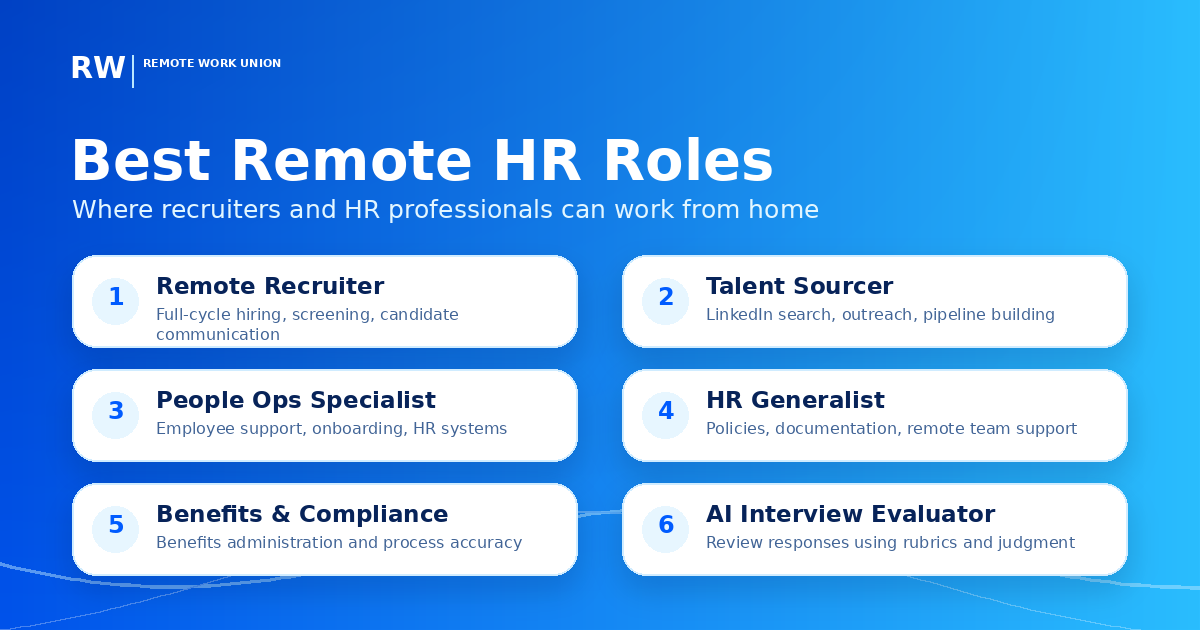
The Best Remote Roles for HR Professionals
1. Remote Recruiter
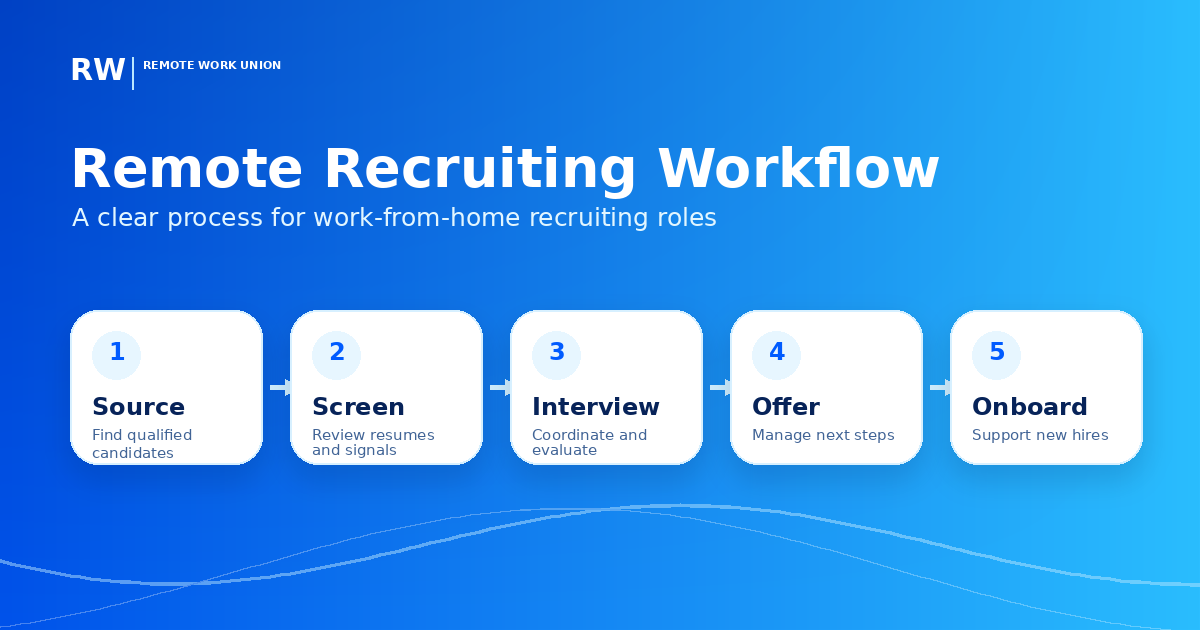
Remote recruiting is one of the most natural work-from-home paths for HR professionals. A remote recruiter manages the full hiring cycle: sourcing candidates, screening resumes, conducting phone and video interviews, managing ATS pipelines, coordinating with hiring managers, extending offers, and supporting the close. All of this can happen fully online. Keywords: remote recruiter, talent acquisition specialist, full cycle recruiter, technical recruiter, remote sourcing recruiter, hiring specialist.
2. Talent Sourcer
Sourcing is the research side of recruiting — identifying and reaching out to potential candidates before they apply. Remote sourcers use LinkedIn Recruiter, Boolean search, GitHub, professional communities, databases, and outreach sequences to find people who fit specific roles. This is one of the most naturally remote-compatible recruiting functions because it is primarily research and writing. Keywords: remote talent sourcer, Boolean search, LinkedIn Recruiter, candidate pipeline, sourcing specialist.
3. Recruiting or Interview Coordinator
Recruiting coordinators handle the scheduling, logistics, and communication that keep the hiring process running. Remote coordinators schedule video interviews, send confirmations, coordinate with candidates and interviewers, manage ATS updates, send offer letters, and handle documentation. The work is deadline-driven and detail-heavy. Keywords: remote recruiting coordinator, interview scheduling, candidate experience, ATS coordination, Greenhouse, Lever, Workday.
4. People Operations Specialist
People operations is broader than traditional HR — it covers the systems and processes that help employees work well, from onboarding to performance tracking to benefits administration to engagement programs. Remote people ops specialists build workflows, manage HRIS data, answer employee questions, and support managers. This is a strong path for HR generalists who want to work in a more systems-focused environment. Keywords: people operations, HRIS, HR systems, employee experience, remote workforce management.
5. Remote HR Generalist
Remote HR generalists handle a broad range of HR responsibilities for one company or across multiple clients. This can include employment law compliance, employee relations, policy updates, benefits support, recruitment support, onboarding, disciplinary documentation, and HR analytics. The role requires comfort with multiple areas of HR. Keywords: remote HR generalist, HR business partner, employee relations, employment law, HR compliance, benefits administration.
6. Onboarding Specialist
Onboarding specialists design and run the process that helps new employees start successfully. Remote onboarding work includes building checklists, coordinating with IT and managers, sending welcome communications, tracking completion rates, improving the new hire experience, and supporting the first 30-90 days. This is a strong fit for people-focused HR professionals who enjoy structure and coordination. Keywords: remote onboarding specialist, new hire experience, digital onboarding, employee integration, people coordination.
7. Benefits Coordinator or HR Compliance Specialist
Benefits administration and HR compliance are highly remote-compatible because the work is primarily documentation, tracking, and communication. Benefits coordinators manage enrollment, answer employee questions, coordinate with vendors, and ensure accurate records. Compliance specialists review policies, track regulatory changes, prepare documentation, and support audits. Both roles reward attention to detail and written communication.
8. Learning and Development Coordinator
L&D coordinators design, organize, and manage employee training programs. Remote L&D work may include building eLearning content, coordinating training sessions, managing LMS platforms, tracking completion, and evaluating program effectiveness. This is a strong path for HR professionals with training, curriculum, or facilitation experience. Keywords: learning and development, LMS, eLearning, training coordinator, instructional design assistant, remote training programs.
9. Resume Reviewer or Career Coach
HR and recruiting professionals who understand what makes a strong job application can build a client-facing practice or work with job placement firms, career coaching platforms, or workforce development organizations. Remote resume reviewers and career coaches help job seekers improve their materials, practice interviews, and navigate job searches. This is a practical freelance or part-time path for experienced HR professionals.
10. HR Content Writer or Employer Brand Specialist
Employer brand and HR content work involves writing job descriptions, career page copy, employee stories, recruiting content, culture documentation, LinkedIn posts, interview guides, and internal HR communications. This is a strong fit for HR professionals who write well and understand what candidates actually want to know before applying. Keywords: HR content writer, employer branding, recruitment marketing, job description writing, candidate experience content, talent marketing.
11. Contractor Operations or Marketplace Operations Specialist
As remote work grows, more companies hire independent contractors and gig workers through online platforms. Contractor operations roles involve onboarding contractors, managing agreements, tracking compliance, supporting marketplace quality, and coordinating between contractors and clients. This path suits HR professionals with experience managing non-employee workforces, vendor relationships, or platform-based talent.
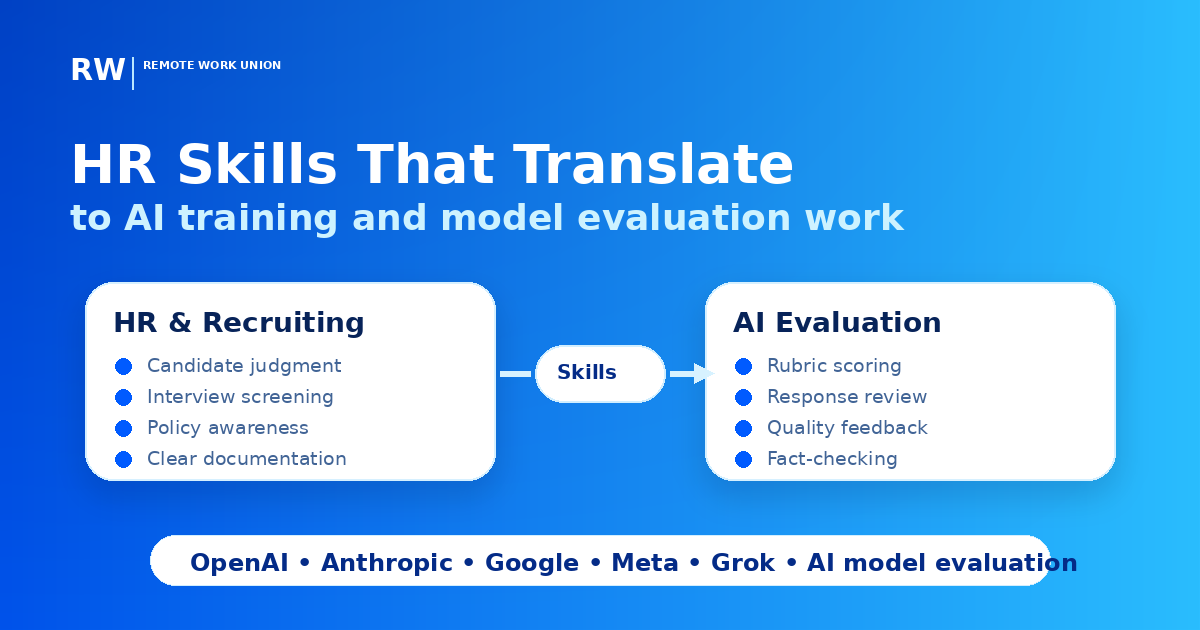
12. HR Subject Matter Expert for AI Training and Interview Review
AI companies need human reviewers who can evaluate whether AI outputs about hiring, workplace communication, employment law, compensation, DEI policies, and HR best practices are accurate, appropriate, and useful. HR and recruiting professionals can apply their expertise to AI model evaluation work — reviewing responses, flagging errors, writing better examples, and judging the practical quality of hiring-related content.
This is one of the newer but growing paths for HR professionals. Platforms like micro1, Mercor, Handshake AI, and Outlier all match professionals to review and evaluation roles based on domain expertise. Expert-tier AI evaluation work can pay $50–$200/hr for reviewers with strong professional backgrounds.
Remote Work Union connects HR professionals and recruiters to legitimate remote roles and AI evaluation work. Apply for free.
Find Roles Hiring Now →AI Training and Interview Review Work for HR Professionals
AI companies and AI platforms need human reviewers who understand hiring, people management, workplace communication, and employment law. That is because AI models are increasingly used in HR contexts: drafting job descriptions, answering employment policy questions, writing performance review language, suggesting candidate screening criteria, and generating onboarding materials.
For those outputs to be accurate and appropriate, the people reviewing them need real HR knowledge. A generic writer cannot easily spot a job description clause that creates unintentional bias, an onboarding policy that violates a state law, or interview guidance that runs afoul of fair hiring standards. An experienced HR professional or recruiter can.
Best Remote HR Path by Background
- Recruiter background: Remote recruiter, talent sourcer, recruiting coordinator, employer brand content
- HR generalist background: People operations, HR generalist, onboarding specialist, compliance support
- Benefits or compliance background: Benefits coordinator, HR compliance specialist, policy documentation
- L&D or training background: Learning and development coordinator, instructional design assistant, training program support
- Any HR background: AI training and HR model evaluation roles — use your domain judgment for expert review
How to Rewrite Your Resume for Remote HR Jobs
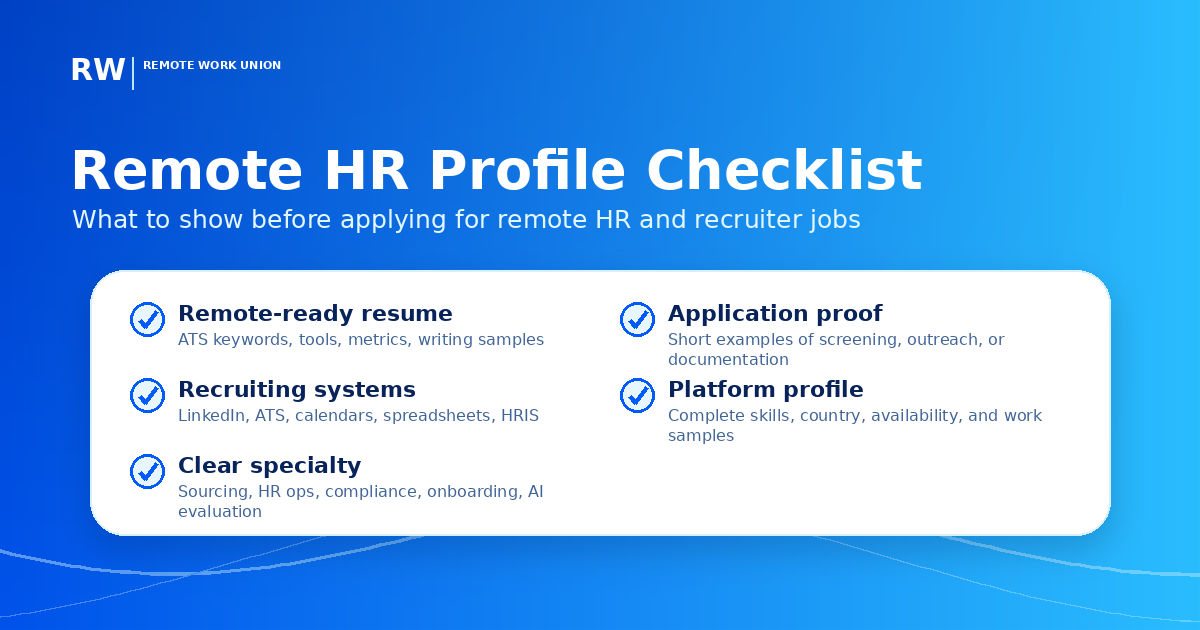
Your resume should emphasize remote-work-relevant language. Instead of listing job titles and general HR duties, show the specific systems you operated, the processes you owned, and the outcomes you supported.
Replace vague phrases with concrete skills: ATS management, video interview coordination, Boolean sourcing, HRIS data entry, digital onboarding, employment law compliance, benefits open enrollment, written employee communications, job description writing, and remote team coordination. If you used specific platforms like Greenhouse, Lever, Workday, BambooHR, Gusto, ADP, LinkedIn Recruiter, or Rippling, name them.
For AI evaluation or expert review roles, add language like: "Reviewed HR-related content for accuracy, appropriate compliance framing, and practical usefulness; experienced with job descriptions, candidate evaluation criteria, onboarding documentation, and workplace communication standards."
Where to Apply
Search across multiple angles. Direct job search terms: remote recruiter, remote HR generalist, remote people operations, remote onboarding specialist, talent sourcer remote, recruiting coordinator remote, remote HR coordinator, virtual HR specialist, remote HR consultant, and employer brand remote. For AI training paths: AI model evaluation HR, AI training human resources, subject matter expert recruiting, AI interview content reviewer.
Apply to HR consulting firms, HR tech companies (ATS vendors, benefits platforms, people analytics companies), staffing agencies with remote divisions, and AI training platforms that accept domain experts. Also look at direct applications to remote-first companies where people operations is critical and the HR team operates distributed.
Red Flags to Avoid
Watch for listings that ask HR professionals to do sales disguised as HR work — such as "talent advisor" roles that turn out to be commission-only recruiter-salespeople. Be cautious with vague "HR consultant" listings that are actually cold-call staffing roles. For AI evaluation opportunities, avoid any platform asking you to pay to unlock tasks, access work, or join a training program before you can earn.
The Strongest Combined Strategy
The most effective approach for HR professionals is to apply to both traditional remote HR roles and AI training platforms simultaneously. Traditional remote HR provides stable recurring income. AI evaluation platforms provide flexible income tied to domain expertise. Together, they create a broader and more resilient remote income mix.
Frequently Asked Questions
What are the best remote jobs for HR professionals?
The strongest remote paths for HR professionals include remote recruiter and talent sourcer, recruiting coordinator, people operations specialist, remote HR generalist, onboarding specialist, learning and development coordinator, HR content writer, employer brand specialist, AI interview reviewer and model evaluator, and contractor operations specialist. The right lane depends on which part of the HR function you know best.
Can recruiters transition to fully remote work?
Yes. Most recruiting work is already digital: job postings, resume screening, ATS management, scheduling, video interviews, offer letters, and candidate communication all happen online. The main shift is replacing in-person relationship-building with strong written communication, structured processes, and consistent follow-up through tools like LinkedIn, Greenhouse, Lever, and Zoom.
Do HR professionals qualify for AI training jobs?
Yes. AI companies need human reviewers who can evaluate whether AI-generated content about hiring, interviewing, compensation, workplace communication, employment law, DEI, and HR compliance is accurate, appropriate, and useful. HR and recruiting professionals make strong candidates for AI model evaluation work at platforms like micro1, Mercor, Handshake AI, and Outlier.
How do I rewrite my HR resume for remote roles?
Translate internal HR tasks into remote-work-relevant language. Instead of listing "managed onboarding," say that you built and coordinated digital onboarding workflows across time zones, managed checklists, sent communications, and tracked completion rates. Instead of "sourced candidates," say you used LinkedIn Recruiter, Boolean search, job boards, and applicant tracking systems to identify and pipeline qualified candidates.
What HR tools should I know for remote work?
The most useful tools include ATS platforms like Greenhouse, Lever, Workday, Taleo, BambooHR, and Rippling; sourcing tools like LinkedIn Recruiter; HRIS systems; payroll platforms like ADP and Gusto; communication tools like Slack, Zoom, and Google Workspace; and general documentation tools like Notion and Confluence. For AI training roles, comfort with structured annotation, rubrics, and written evaluation is more important than any specific HR software.