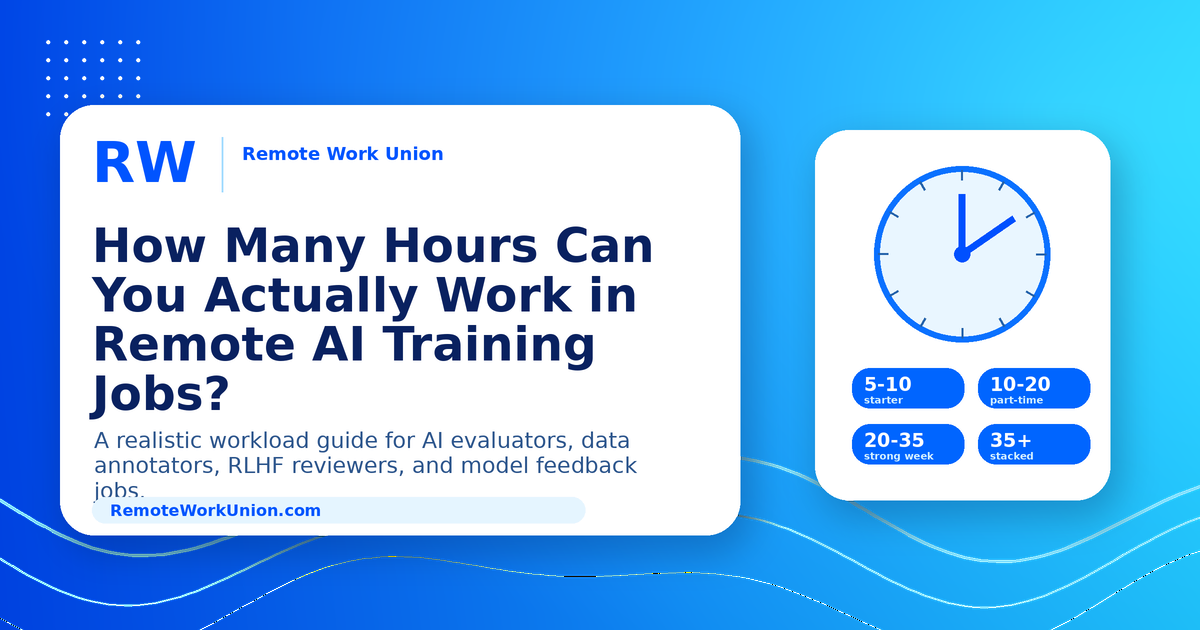
One of the most common questions about remote AI training work is also one of the hardest to answer directly: how many hours can you actually work? The answer depends on your platform access, your quality scores, your expertise, and which projects are active at any given moment. There is no universal answer, but there are realistic ranges that experienced contractors have learned through trial and error.
Understanding hours in AI training work is important because it determines income potential, helps you decide whether to treat the work as a side income or a serious supplement, and shapes how you build your platform stack. Here is what the data and experience from real remote AI contractors actually show.
Realistic Hours by Experience Level
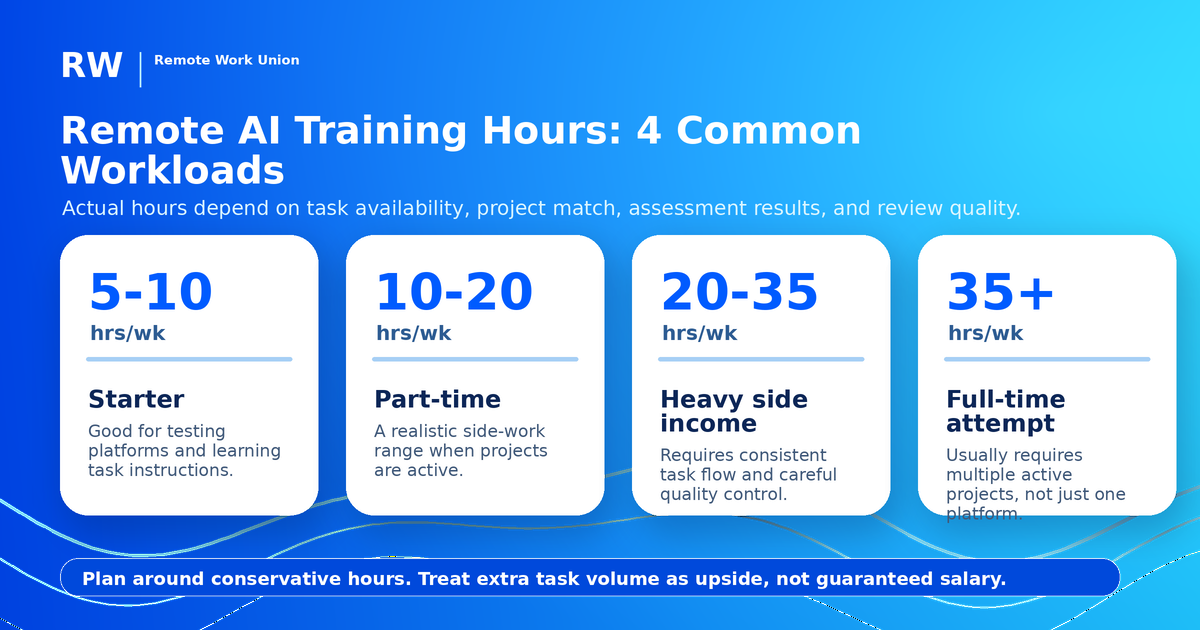
Remote AI training hours follow a tiered pattern. Most contractors start in the lower tiers and work up over weeks or months as they qualify for more projects and demonstrate consistent quality.
Beginner (0–5 hours per week): You have applied to one or two platforms, passed initial assessments, but have limited project access. Tasks may appear sporadically and require time to complete at high quality. This phase is normal. It does not mean the work is unavailable — it means you are still building your track record.
Casual (5–10 hours per week): You have at least one active project and have proven your quality score is stable. Work arrives more regularly. This range is comfortable for someone treating AI training as a supplement to a primary income or a flexible side source of earnings.
Part-time (10–20 hours per week): You are qualified on two or more platforms, have good standing on your main project, and have likely picked up expertise in a specific area that earns consistent tasks. This range can generate meaningful monthly income especially at rates of $20–$50/hr.
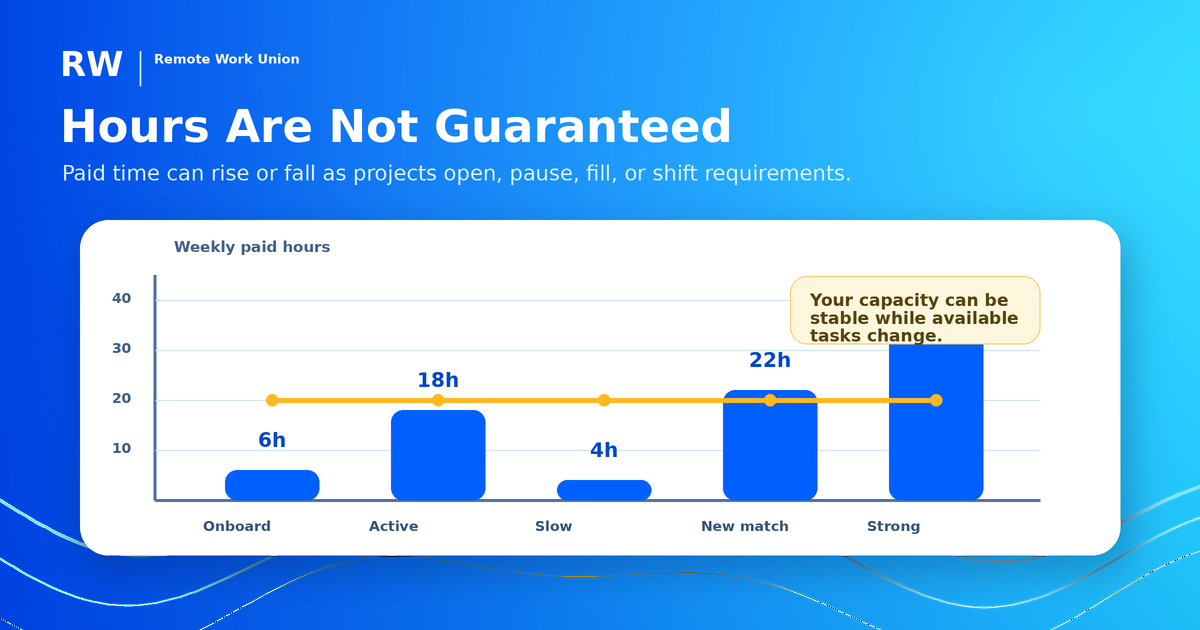
Strong (20–35 hours per week): You have multiple active platforms, maintain high quality, and have a strong enough skills match that tasks are regularly available. This level requires real commitment to staying competitive.
Full-time equivalent (35+ hours per week): Rare, and usually only sustained by contractors with deep specialized expertise, multiple active projects across multiple platforms, and high demand for their specific background. If one project slows, another fills the gap.
What Limits Your Hours
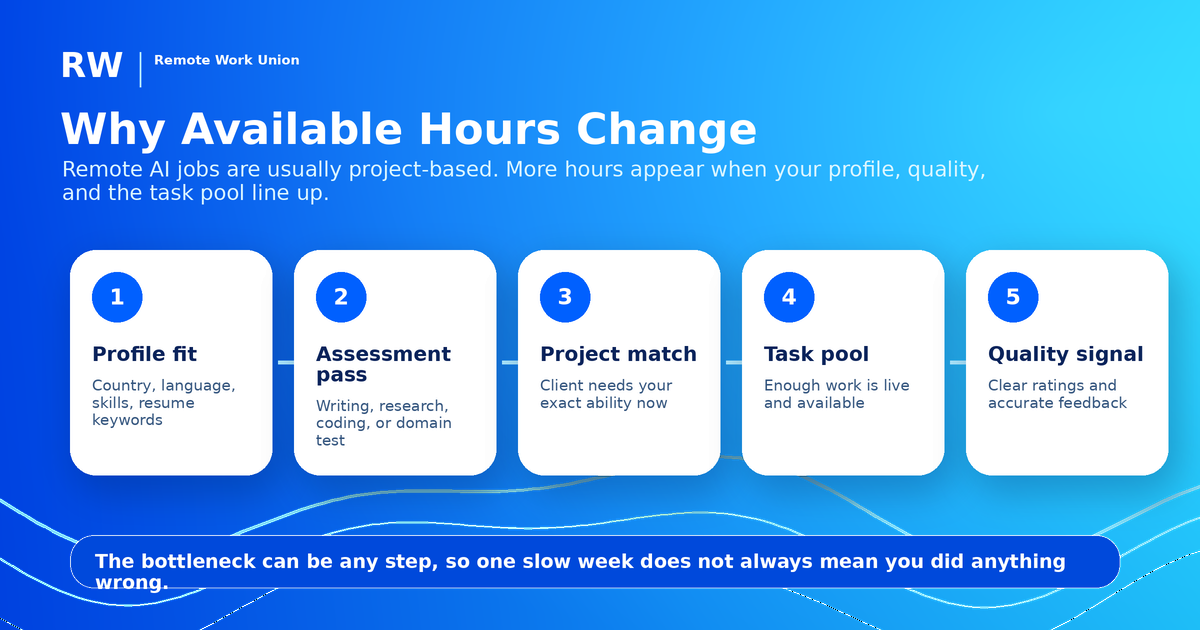
Most contractors who work fewer hours than they want hit one or more of four bottlenecks.
Project availability: The single biggest factor. AI training projects are funded by external AI companies that assign work in batches. When a batch is complete, that project may slow or pause. Not every platform has active tasks at every moment for every skill profile.
Quality requirements: Platforms routinely filter out lower-quality contributions. If your accuracy score or evaluator rating falls below a threshold, you may receive fewer tasks or be temporarily removed from a project. Consistent quality is not optional — it directly determines how many hours you can work.
Skill match: Many AI training projects have specific requirements. A writing evaluation project may prioritize strong editors and writers. A code evaluation project needs engineers or developers. A medical review project may need clinical background. If your skills do not match what is currently funded, you will see fewer tasks even on platforms where you are technically approved.
Platform stage: Some platforms have active task pipelines; others may be between projects. This is why multi-platform contractors tend to have more consistent hours than single-platform contractors.
How Platform Availability Affects Hours
On Outlier AI, task availability is project-driven and can fluctuate significantly from week to week. Some contractors report active weeks followed by quiet periods, then a new project opening. Keeping your profile active and checking in regularly helps catch new project launches early.
On Mercor, matching is skill-based and interview-driven. Once matched to a project, hours can be more predictable, but the initial matching process is selective. The best-fit candidates often get more consistent work.
On Handshake AI and micro1, hours depend on the projects you are connected to and your expertise match. Expert-tier projects on these platforms can offer higher pay per hour, which means you can reach meaningful income at fewer hours.
Remote Work Union connects you to legitimate remote AI training platforms. Apply for free to find roles hiring now.
Find Roles Hiring Now →How to Increase Your Hours
The most effective strategies for increasing your weekly AI training hours:
- Qualify on more platforms. Each additional platform increases your total task pool. A slow week on one platform can be filled by another. Two or three active platforms often double or triple available hours.
- Protect your quality score. Every platform tracks accuracy, helpfulness, or consistency. If your score is strong, you stay eligible for more tasks and better projects. If it drops, your access shrinks.
- Develop in-demand expertise. Writing, legal, medical, finance, and code evaluation all have steady demand. Building a demonstrable specialization makes you more attractive to high-value projects.
- Complete assessments fast. When new projects open, platforms often offer limited spots. Contractors who complete assessments quickly get priority. Check your platform dashboards regularly.
- Respond quickly during high-availability periods. Some platforms assign tasks in real-time windows. If you are slow to accept, the task goes to someone else.
Building a Sustainable Weekly Schedule
Many contractors who burn out do so because they try to maximize hours in high-availability periods without building in recovery time. AI evaluation work requires focus. A tired reviewer makes errors. A reviewer with errors loses project access. The sustainable approach treats AI training like a skilled cognitive job — not a factory floor where you can just add more hours.
A practical sustainable week for a 10–20 hour contractor might look like: two to three dedicated working sessions of two to three hours each, spread across different days. Longer tasks are better attempted when you are fresh. Shorter rating tasks can be batched in smaller windows.
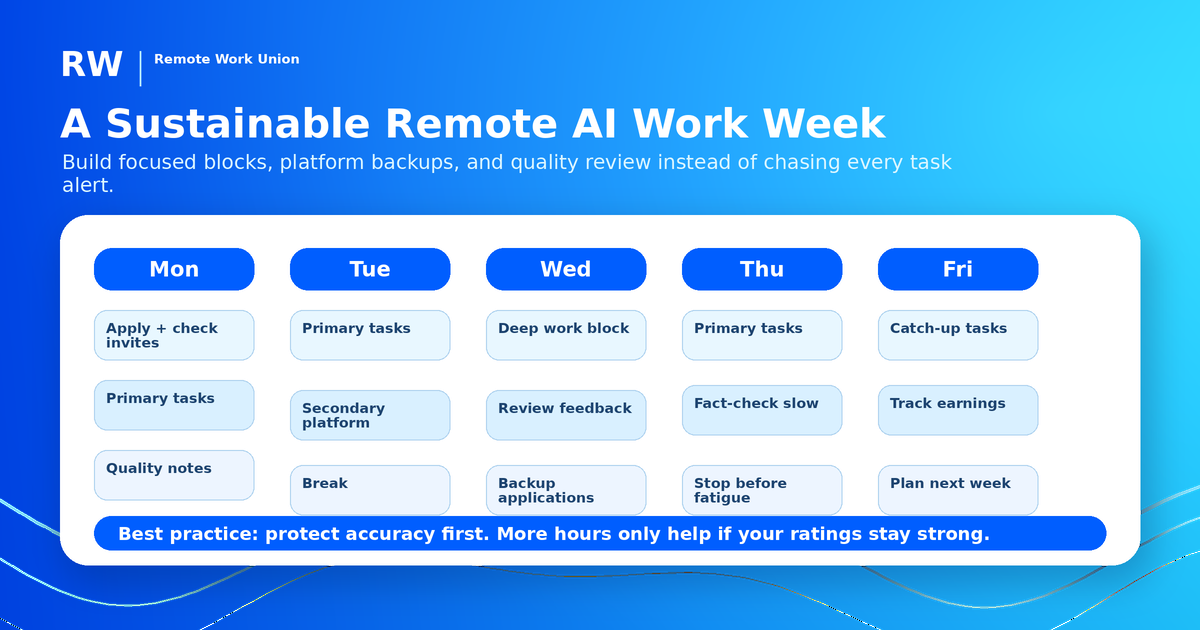
Tip: When task availability is high, resist the urge to rush. Quality scores are easier to lose than to rebuild. A strong, paced week protects your future earnings better than a rushed high-volume day.
Why Hours and Income Are Not Always Linear
More hours do not automatically mean more income in AI training work. The relationship depends on which tasks you are completing and at what rate. A general writing evaluation project at $20/hr for 20 hours and a specialized expert review project at $75/hr for 8 hours can generate similar income. This is why building toward expert-tier projects matters more than chasing raw hours.
The ideal AI training income strategy is not maximum hours — it is maximum quality combined with good skill alignment. High-quality work on the right projects earns more per hour and keeps you eligible for the best projects over time.
Frequently Asked Questions
How many hours per week can you realistically work in remote AI training jobs?
It varies significantly based on platform access, qualification status, task availability, and quality scores. Beginners typically see 0 to 5 hours per week. Established contractors with one active platform often reach 5 to 20 hours per week. Experienced contractors on multiple platforms with strong quality scores can work 20 to 35 hours per week or more in high-availability periods.
Why is more time not always available in AI training work?
Task availability depends on which projects are active, how many contractors are competing for the same tasks, your quality score and eligibility status on each platform, and your area of expertise. Some weeks have plenty of tasks; others have very few. This is normal in project-based contract work.
How can I increase the hours I work on AI training platforms?
The most effective strategies are qualifying on additional platforms to increase your task pool, maintaining a strong quality score to stay eligible for better projects, developing expertise in high-demand areas like coding, law, medicine, or finance, completing assessments promptly when new projects open, and responding quickly when task availability spikes.
Is there a maximum hours limit on AI training platforms?
Some platforms enforce weekly hour caps on certain projects. Others limit work based on available task inventory rather than a formal cap. In practice, most contractors are limited by task availability and quality requirements rather than a hard cap. Very high weekly hours (35+ hours consistently) are rare and usually require multiple active platforms and high-demand expertise.