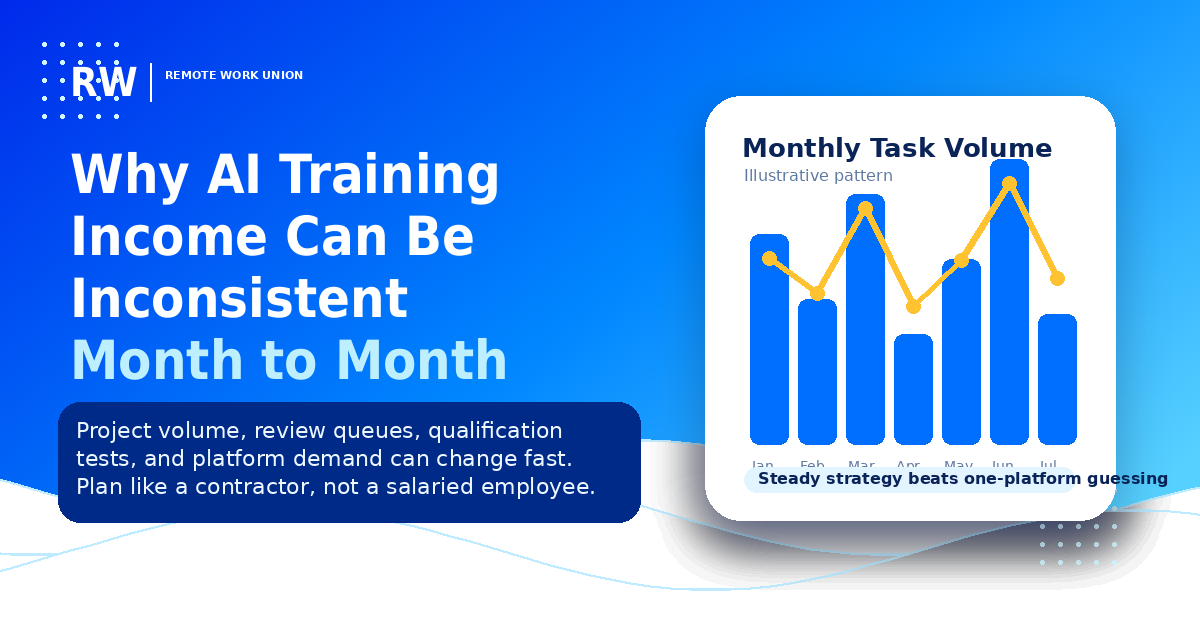
One of the most common frustrations remote AI training workers report is that income varies unpredictably from month to month. A strong month can be followed by a much quieter one. Projects that were busy in January slow to a trickle in February. This is not a sign that AI training work is a scam, and it is not necessarily a sign you did something wrong. It reflects how project-based AI work actually functions.
Understanding why AI training income fluctuates — and how to manage that variability — is one of the most useful things you can do as a remote AI contractor. This article explains the main causes of income inconsistency and what the most stable contractors do differently.
Why AI Training Is Project-Based, Not Salary-Based
AI training platforms contract with AI companies to collect specific types of data, evaluate specific model behaviors, or support specific training phases. When that project is complete, or when that phase ends, the platform reduces task volume. You may have done everything correctly — quality was good, you were consistent, you stayed engaged — and still see a significant drop in available work.
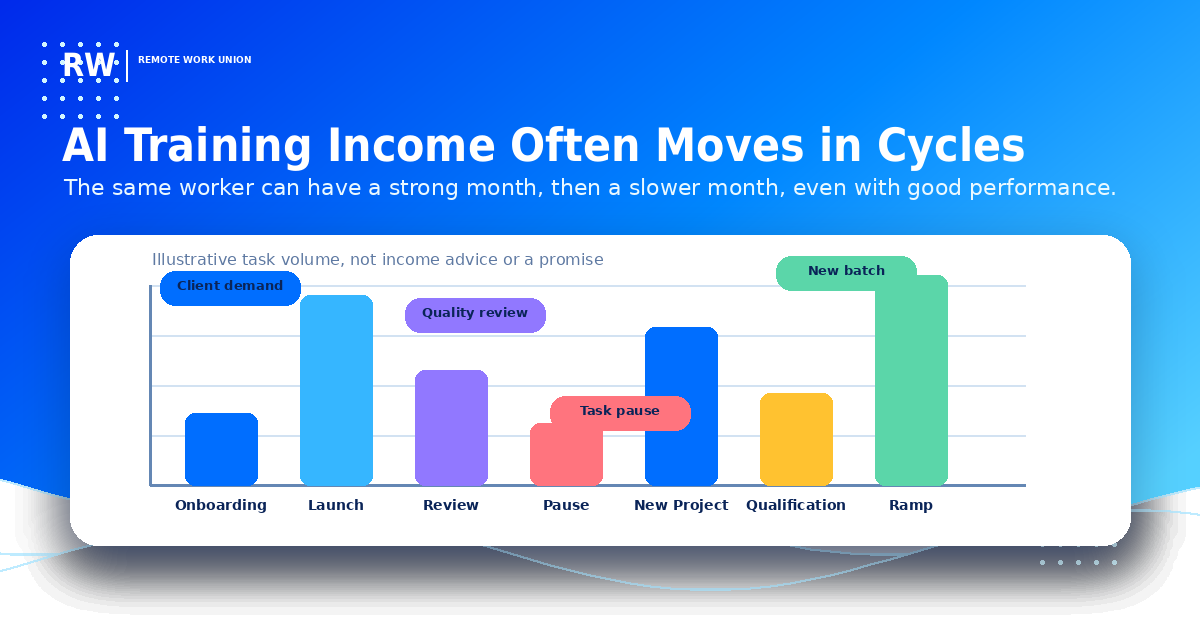
This is the core of income inconsistency in AI training. Unlike a salaried job where income is fixed regardless of project status, AI training income is tied to task availability, which is tied to what AI companies need to build and evaluate at any given moment. The demand rises and falls with model development cycles.
The Main Causes of Monthly Income Swings
Project completion: When a data collection or evaluation project finishes, tasks disappear. The platform may open a new project weeks or months later, but the gap can be significant.
Contractor pool changes: Platforms regularly adjust how many contractors they have active on a given project. If your skill set is well-represented, you may receive fewer tasks even if the project itself is still running.
Quality score changes: A dip in accuracy or feedback quality can reduce how many tasks you receive. Platforms use quality signals to match their best contractors to their best projects. If your score dropped, your task volume may follow.
Model training phases: AI model development is not linear. Some phases require large volumes of human-generated data. Others require minimal human input. Income from evaluation work often peaks during data collection phases and slows during other phases of the training pipeline.
Budget cycles: AI companies operate on quarterly or annual funding cycles. Project spending can slow at the end of a quarter and spike when new funding arrives. Contractors often notice seasonal patterns without understanding they are tracking spending cycles.
How Platform Pipeline Slowdowns Work
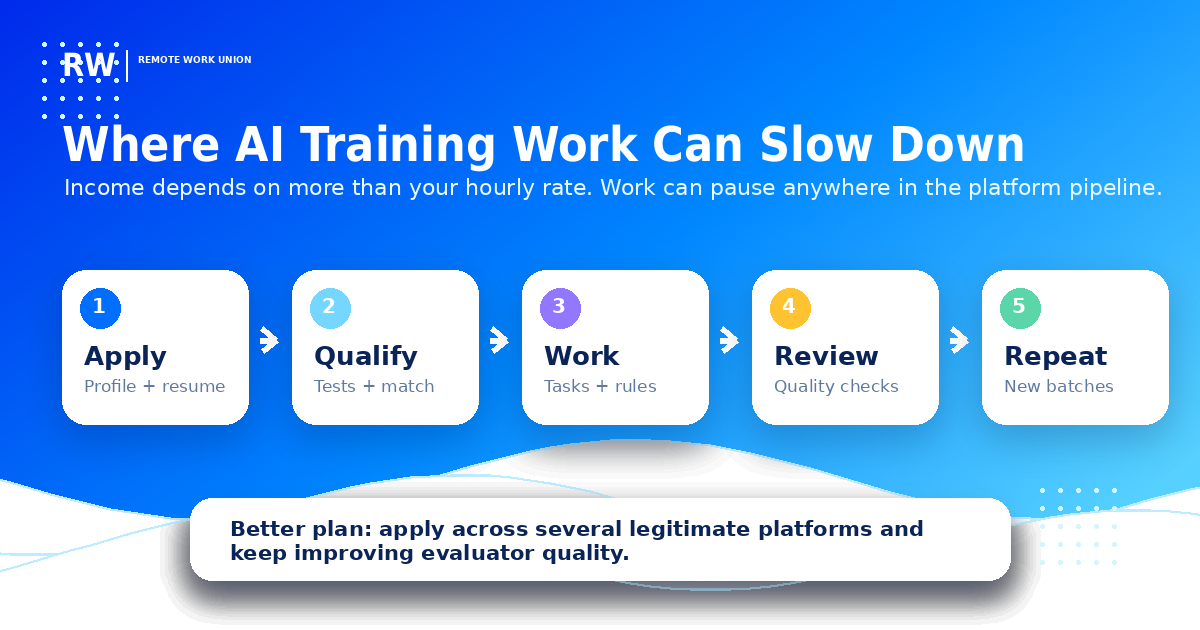
Each major AI training platform has its own project pipeline. On Outlier AI, task availability often follows a project-launch pattern: new projects open with high volumes, then taper as they fill. Contractors who joined early on a project often get better task access. On Mercor, slowdowns can happen when the company or project you are matched with pauses or shifts priorities. On Handshake AI and micro1, project access can be narrower by design — fewer contractors, higher value, less volume-based.
The key insight is that slowdowns are structural, not personal. A month with limited tasks on one platform does not mean you have been removed or penalized.
Remote Work Union connects you to legitimate remote AI training platforms. Apply for free to find roles hiring now.
Find Roles Hiring Now →How to Tell a Slowdown From a Real Problem
A slowdown and a real problem can feel similar from the outside — both result in fewer tasks. The difference is in the signals.
A slowdown usually looks like: tasks are sparse but not zero, you have received no direct feedback about quality issues, other contractors on the same platform are reporting similar patterns, and the platform is still accepting new applications.
A real problem usually looks like: you received explicit quality feedback or a warning, your account status shows something unusual, you are no longer receiving any tasks even when the platform shows activity, or you failed an assessment or review that changed your standing.
In a slowdown, the best action is to check other platforms, stay engaged without overreacting, and look for new projects or assessments to qualify for. In a real problem, you need to review the platform feedback, improve what is flagged, and attempt requalification where available.
What Actually Stabilizes AI Training Income
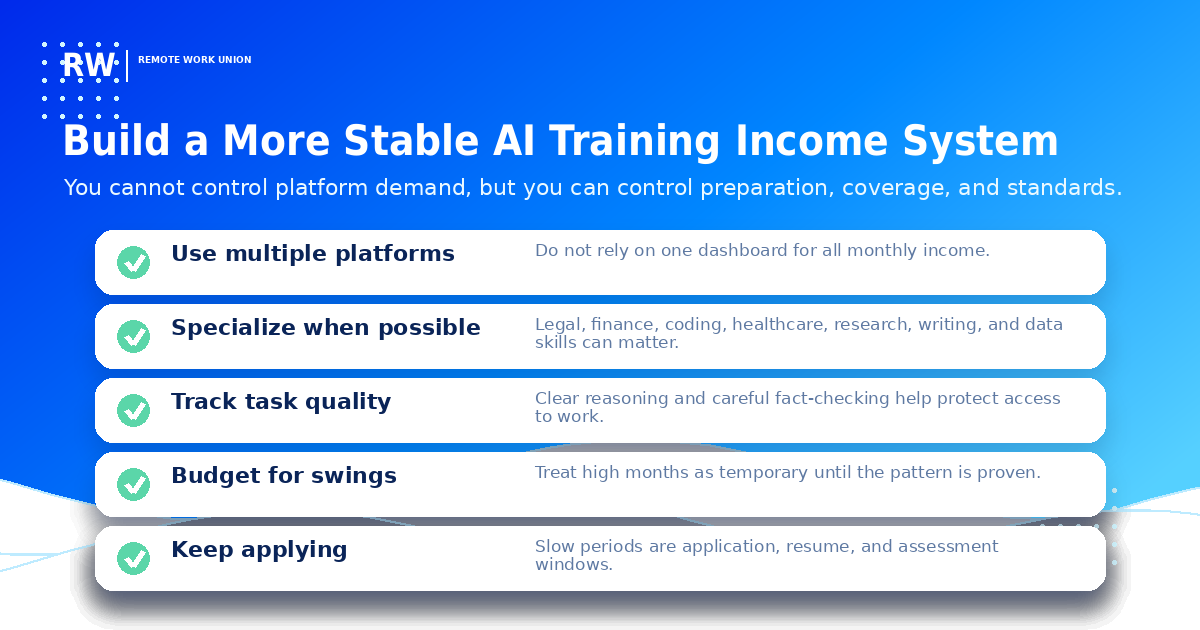
The contractors with the most stable AI training income share a few consistent habits. They qualify on multiple platforms — usually two to four active sources — so that a slowdown on one does not eliminate their earnings entirely. They maintain strong quality scores consistently, not just when starting a new project. They build expertise in areas with durable demand — legal, medical, financial, and code evaluation projects tend to have more consistent funding than general writing tasks. They keep a cash reserve that covers two to three months of essential expenses so that slow periods do not create emergencies. And they treat AI training as one income stream within a broader financial plan rather than their only source of income until they have proven stability over many months.
Tip: If your income dropped this month, check whether other contractors on the same platform report similar patterns. If they do, you are experiencing a structural slowdown, not a personal issue. The most productive response is to use the slower period to qualify on another platform or complete a new assessment.
The Income Consistency Checklist
To build more consistent AI training income over time, work through these steps:
- Active on two or more platforms. If only one platform is active, start applications on a second.
- Quality score is stable. Check each platform for feedback and make sure your accuracy or rating has not slipped.
- Expertise is documented in your profile. Platforms match you to projects based on your stated skills. An incomplete or generic profile gets fewer specialized projects.
- Cash reserve of one to two months of expenses. This is your buffer for slow periods.
- Assessment pipeline is active. Always be in the process of qualifying for at least one new project or platform.
Frequently Asked Questions
Why does AI training income change so much from month to month?
AI training work is project-based. When a data collection project ends, when a model enters a new training phase, or when a platform rebalances its contractor pool, task volume can drop significantly. These slowdowns are not always a sign that you did something wrong. They often reflect changes in what AI companies need at that moment.
What is the best way to protect against AI training income swings?
The two strongest protections are platform stacking and cash reserves. Platform stacking means qualifying on multiple platforms so a slowdown on one is covered by activity on another. A cash reserve of two to three months of expenses means a quiet period does not become a financial emergency.
Is income inconsistency a sign of a scam?
No. Legitimate AI training platforms have inconsistent task availability by design. Work is tied to funding cycles and project timelines, not a fixed schedule. A real AI training platform will have slow periods. A scam typically demands upfront payments or overpromises guaranteed weekly income — not the usual pattern of real AI evaluation work.
Can I stabilize AI training income over time?
Yes, but it takes deliberate effort. The most stable contractors have strong quality scores on multiple platforms, expertise that matches high-demand projects, and a consistent work routine that makes them reliable contributors. Income still varies, but the floor gets higher as your track record and platform access improve.