Remote AI work can feel unpredictable when you treat it like a single job board. One week you may have a full queue of model responses to review, writing tasks to complete, or research prompts to fact-check. The next week you may log in and see nothing available. That does not always mean you did something wrong. It often means the work is project-based, demand shifts quickly, and platforms match workers based on skills, quality, availability, location, language, and client needs.
The goal is not to eliminate every slow week. No realistic system can do that. The goal is to reduce surprise, create more chances to match, and build a repeatable routine that keeps applications, profiles, tests, and paid projects moving at the same time. If you want remote AI work to become a steady part of your income, you need a system, not just a login.
What This Article Covers
- Why Remote AI Work Is Project-Based, Not Job-Based
- Build a Platform Stack Instead of Depending on One Dashboard
- Keep Your Profile Easy to Match
- Track Every Application, Test, Approval, and Pause
- Use a Weekly Work Loop
- Improve the Skills That Transfer Across Platforms
- Keep a Bench of Backup Work
- Avoid Behaviors That Interrupt Remote AI Work
- Turn Short Projects Into Long-Term Momentum
- A Simple System for Steady Remote AI Work
- Frequently Asked Questions
Remote AI work is usually project-based, not job-based
A traditional remote job is usually built around a title, manager, schedule, and predictable set of responsibilities. Remote AI work is different. Many AI training, AI evaluation, data annotation, prompt writing, research, and model response review roles are organized by project. A platform may need thousands of people for a short evaluation sprint, a small group of subject matter experts for a specialized dataset, or bilingual reviewers for a language-specific task.
That structure is why remote AI jobs can be attractive and frustrating at the same time. They can be flexible, skill-based, and accessible from home, but they can also pause suddenly. A project can finish. A queue can close. A client can change guidelines. A platform can stop routing work to a profile that has not been updated. A test can sit under review.
A steady-flow strategy starts by accepting this reality. You are not trying to force one platform to behave like a full-time employer. You are building a pipeline of opportunities across AI training platforms, remote work job boards, direct applications, and referral networks.
Build a platform stack instead of depending on one dashboard
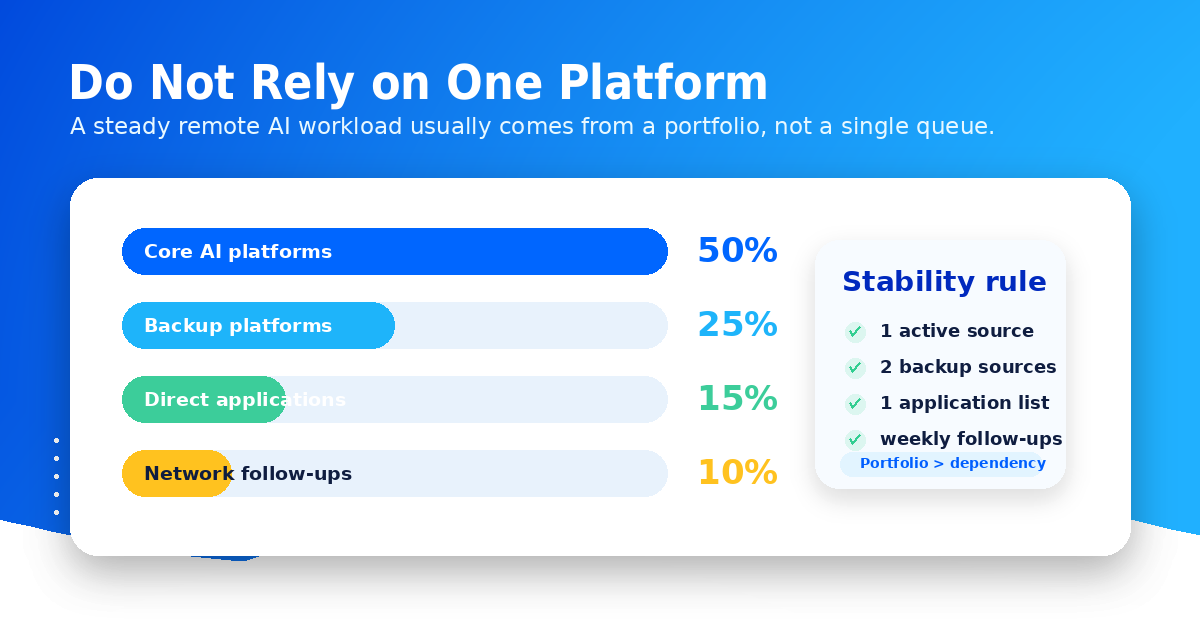
The biggest mistake beginners make is joining one platform, waiting for one approval, and treating silence as the end of the process. A better approach is to build a platform stack. That means you have multiple places where work can come from, and each one has a role in your system.
Your primary platform is where you currently get the most paid work. Your backup platforms are places where you have passed screening or are still applying. Your application pipeline includes roles you have not been accepted to yet. Your long-term network includes recruiters, referrals, remote work communities, and direct company applications.
This matters because remote AI work is uneven by design. If your entire plan depends on one dashboard staying active every week, one pause can shut down your income. If you have several platforms moving, one slow queue becomes a problem to manage instead of a full stop.
Your stack may include AI training platforms, remote AI evaluator roles, data annotation projects, LLM response rating, research evaluation, coding review, writing review, translation work, and subject matter expert projects. The exact mix depends on your background. A lawyer, teacher, accountant, writer, software engineer, marketing specialist, analyst, or bilingual professional may qualify for different projects. The principle is the same: create more legitimate ways to match.
Practical tip: Platforms worth considering for your stack include Handshake AI, Mercor, micro1, and Outlier AI. Each has different screening requirements and project types, so having applications across all four increases your chances of matching at any given time.
Keep your profile easy to match
Platforms cannot match you to work they cannot understand. A vague profile is one of the easiest ways to miss projects. Your profile should make it obvious what you can review, write, research, evaluate, or explain.
Use clear skill categories. If you are a writer, include content writing, editing, proofreading, tone evaluation, search quality, prompt writing, and fact-checking. If you are analytical, include research, spreadsheet work, data review, business analysis, finance, operations, or technical documentation. If you have professional experience, name the field directly. AI companies need generalists, but they also need people who can evaluate specialized outputs.
Do not exaggerate. A profile that claims everything can look less credible than a profile that clearly explains your strongest areas. The best remote AI profiles are specific without being narrow. They show what the worker can do, what topics they understand, what languages they can work in, and what kind of remote work schedule they can maintain.
Update profiles when your situation changes. If you gain experience in AI data annotation, model evaluation, prompt writing, AI response review, or research tasks, add that language. If you pass a platform test, complete a project, or build a relevant sample, add it where appropriate. A profile is not a resume you submit once. It is part of your matching system.
Track every application, test, approval, and pause
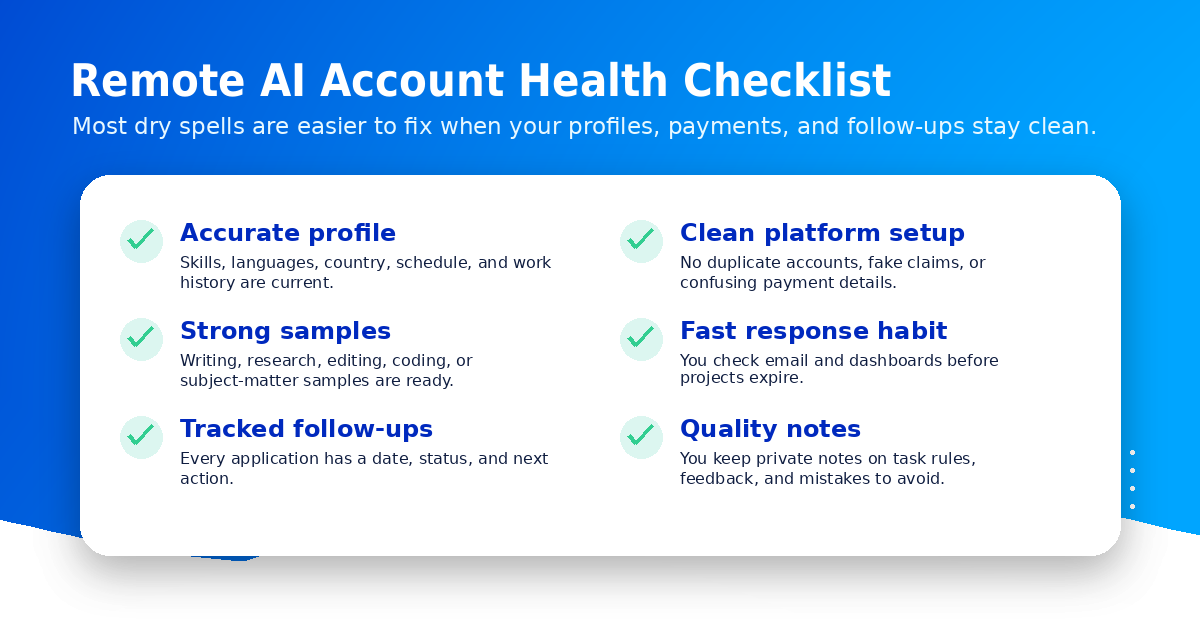
Steady work becomes much easier when you know what is actually happening. Many workers lose momentum because everything lives in memory: which platform they applied to, which test they passed, which account went quiet, which email needed a reply, which role required a portfolio, and which dashboard should be checked again.
Use a simple tracker. It does not need to be complicated. At minimum, track the platform or company, the role, the date applied, the current status, the next action, and the last time you checked it. Add notes for tests, payment setup, profile improvements, and project pauses.
This turns remote AI work into a pipeline. Some opportunities will be active. Some will be under review. Some will need follow-up. Some will be paused but worth checking again later. Some will be dead ends. When you can see the pipeline, you can make better decisions. You stop refreshing the same dashboard all day and start moving the next useful thing forward.
Want to build a steady remote AI income? Find platforms and roles matched to your background on RemoteWorkUnion.com.
Find Roles Hiring Now →Use a weekly work loop
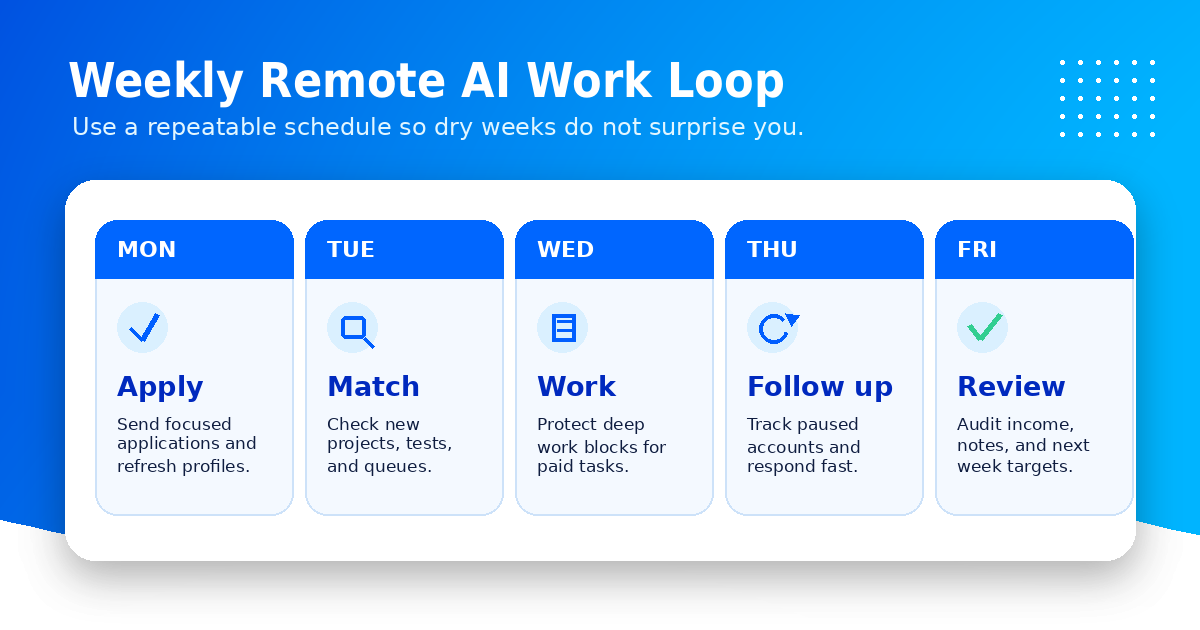
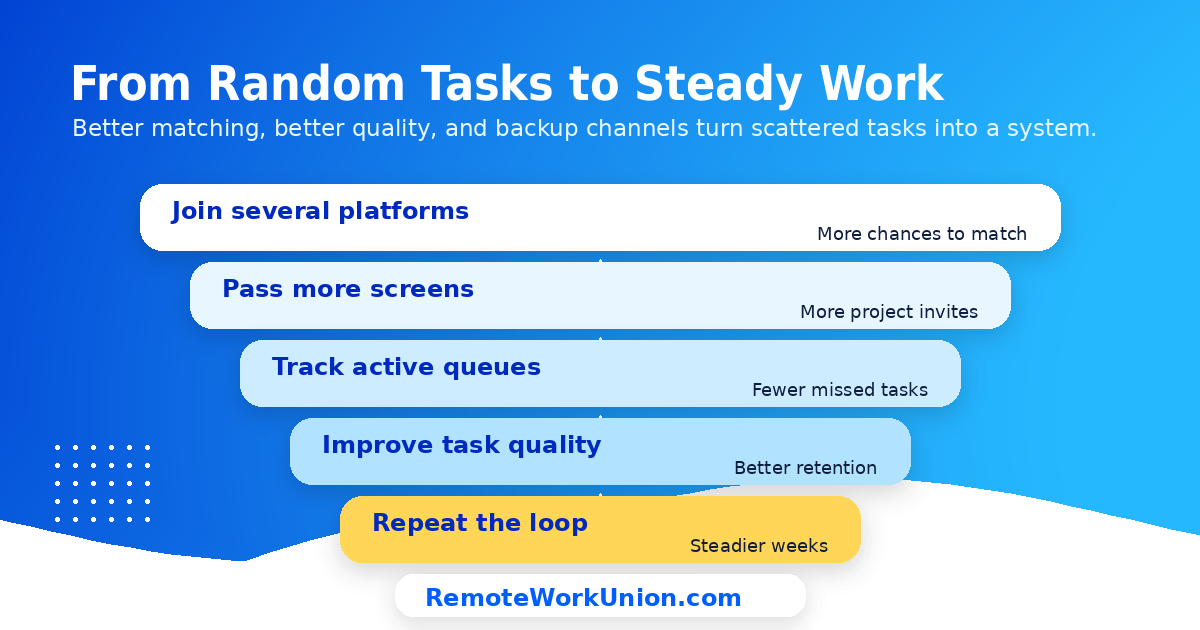
A steady flow is created weekly, not randomly. The simplest system is a recurring loop: apply, check, work, follow up, review.
Early in the week, look for new remote AI jobs, AI evaluator roles, data annotation projects, AI training roles, and work from home opportunities that fit your skills. Update profiles while you are already in application mode. Midweek, focus on active paid tasks and platform tests. Protect deep work blocks because quality matters. Later in the week, follow up on stalled applications, check paused dashboards, review earnings, and decide which platforms deserve more attention next week.
This loop prevents the common beginner pattern: only applying when work disappears. If you wait until a project ends before looking for the next one, you are always behind. The pipeline should be moving while you are still busy.
Improve the skills that transfer across platforms
Different platforms use different instructions, but many remote AI tasks reward the same core skills. The more transferable skills you build, the easier it is to move between projects.
The most useful skills include careful reading, instruction following, fact-checking, concise writing, source evaluation, prompt understanding, grammar, tone judgment, topic research, and the ability to explain why one AI answer is better than another. For technical roles, coding review, debugging, math reasoning, data analysis, and domain expertise can matter. For language roles, fluency, translation judgment, localization, and cultural context can matter.
Quality is a work-flow tool. Strong work can help you remain eligible for better projects, avoid avoidable removals, and qualify for more specialized tasks. Speed matters, but speed without accuracy is not a stability strategy. Read the instructions. Save private notes on rules that are easy to forget. Review feedback when you get it. Notice the patterns that repeat across model evaluation, AI response rating, and data annotation work.
Keep a bench of backup work
Backup work does not mean low-quality work. It means work that can keep your remote income moving when your main AI project slows down. Good backup options can include freelance writing, editing, virtual assistance, research support, transcription review, search evaluation, content quality review, customer research, online tutoring, or direct remote contract roles.
The best backup work is adjacent to your main AI work. If you are good at AI writing evaluation, editing and content review may fit. If you are good at research tasks, remote research assistant roles may fit. If you are good at analytical AI projects, operations, QA, spreadsheet, or data review roles may fit.
This also protects your mindset. A slow platform feels less dramatic when you already have other options. You can keep applying calmly instead of making rushed decisions, accepting scammy offers, or paying for fake opportunities. Legitimate remote work platforms should not charge you to start.
Avoid behaviors that interrupt remote AI work
Some dry spells are normal. Others are self-inflicted. If you want steady remote AI work, protect your accounts and reputation.
Do not create duplicate accounts to bypass a pause or rejection. Do not use fake locations, fake credentials, or copied work samples. Do not ignore platform rules about AI assistance, confidentiality, screenshots, or sharing task content. Do not rush qualification tests. Do not submit low-effort work just because a task looks simple.
Remote AI work often involves trust. Platforms and clients need workers who can follow detailed instructions and handle sensitive evaluation work responsibly. A clean setup, accurate profile, consistent quality, and professional communication reduce unnecessary risk.
Turn short projects into long-term momentum
A short project can still help your long-term remote career if you use it correctly. After each project, write down what kind of work you did, what skills it used, what tools or topics appeared, and what you learned. You do not need to reveal confidential details. You can describe the category: AI response evaluation, research fact-checking, writing quality review, model safety evaluation, data labeling, coding assessment, legal review, finance review, translation evaluation, or prompt testing.
Those notes help you update your resume, platform profiles, and applications. They also help you identify your strongest lane. Some workers are better at creative writing review. Some are better at factual research. Some are better at technical analysis. Some are better at spotting policy issues or unclear instructions. Steady work often comes from finding the type of remote AI work where you are both fast and accurate.
A simple system for steady remote AI work
Here is a practical setup that works for beginners and experienced remote workers:
Keep one tracker for every platform, application, test, project, and follow-up. Keep one folder of work samples that can be reused for applications. Keep one weekly block for new applications. Keep one weekly block for profile updates. Keep one weekly block for reviewing earnings, paused projects, and next actions. Keep a short list of backup work that uses similar skills.
The system does not need to be complex. It needs to be consistent. The workers who stay active are often not the ones who found a secret platform. They are the ones who keep applying before they need work, keep profiles clear, respond quickly, protect quality, and avoid depending on one source of income.
Remote AI work is still remote work. It rewards skill, reliability, communication, and follow-through. Treat it like a pipeline, and you give yourself a better chance of building steady income from AI training, AI evaluation, data annotation, prompt writing, research review, and other work from home roles.
Bottom line: Keeping a steady flow of remote AI work is less about luck and more about structure. Join more than one legitimate platform. Make your profile easy to match. Track every application and project. Build a weekly loop. Improve the skills that transfer across AI training jobs, AI evaluator roles, model response review, and data annotation work. Keep backup options ready before your main queue slows down.
Frequently Asked Questions
Why does remote AI work feel inconsistent?
Remote AI work is project-based, not job-based. Platforms match workers to tasks based on skills, quality, availability, location, and client needs. Projects can pause, queues can close, and demand can shift without warning. The best strategy is to build a pipeline across multiple platforms rather than depending on one dashboard.
How many AI training platforms should I be on at once?
Most experienced remote AI workers maintain a stack of two to four platforms at different stages: one primary platform with active paid work, one or two backup platforms where they have passed screening, and one or two applications still in progress. This prevents any single pause from shutting down your income.
What skills help you get more steady remote AI work?
The most transferable skills include careful reading, instruction following, fact-checking, concise writing, source evaluation, grammar, tone judgment, topic research, and the ability to explain why one AI answer is better than another. Technical workers can also apply coding review, math reasoning, and domain expertise. Building these skills improves your eligibility across multiple platforms and project types.
How do I avoid dry spells in remote AI work?
The most effective approach is to keep applying before you need work. Use a weekly loop: apply to new opportunities early in the week, focus on active tasks midweek, and follow up on stalled applications later in the week. Keep backup work options ready, track every application and project, and update your platform profiles regularly so you are easy to match.
What behaviors can interrupt or end remote AI work?
Common avoidable interruptions include creating duplicate accounts to bypass a pause, submitting low-quality work on tasks that seem simple, rushing qualification tests, ignoring platform guidelines about AI assistance or confidentiality, and using fake credentials or copied work samples. Platforms need workers who can follow detailed instructions and handle evaluation work responsibly.